Search This Blog

Saturday, 11 August 2012

Conwy Valley Museum

In a nutshell

Gauge:        15" tramway and 7¼" miniature railway

Length:  ½mile (15"), over a mile (7¼")

Opened: Early 1970s

Location:

Conwy Valley Railway Museum
The Old Goods Yard
Betws-Y-Coed
Conwy
LL24 0AL 

Tel: 01690 710568


View Larger Map 

Web:   www.conwyrailwaymuseum.co.uk
Email
.
info@conwyrailwaymuseum.co.uk


Date of visit: 8 August 2012


Key Facts

  •  The museum occupies the former railway yard adjacent to Betws-y-Coed mainline railway station
  • The museum was originally established by Alan Pratt in the early 1970s with a small exhibition in a standard gauge bogie coach. The museum now has its own dedicated building housing exhibits and model railway layouts.
  • The museum has a well stocked model railway and railway book shop
  • There is also a café and rides for children

Route

  • The 15" tramway runs for half a mile, the length of the site, parallel to the mainline railway.
  • The 7¼" railway includes two overlaid and intertwined dogbone loops giving a ten minute ride overall.

My Impressions

 We arrived at the museum early in the day before it had opened and were able to enjoy a coffee in the cafe on the mainline railway platform opposite. This gave us a good view of the museum building and shop.......

.... and the standard gauge exhibits which house the café and a coin-operated model railway.

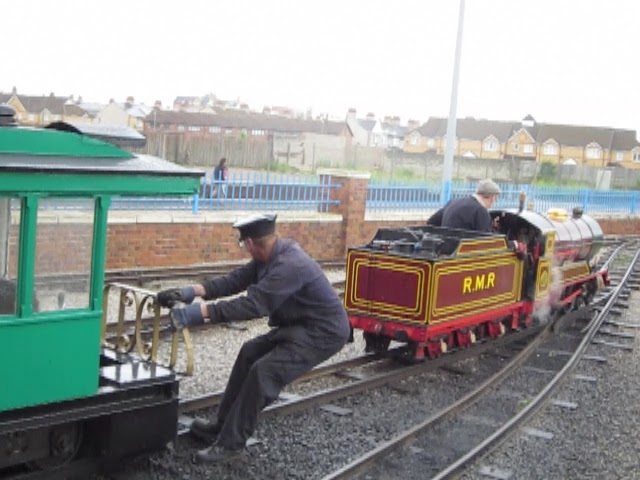
Unfortunately, the 15" tramway wasn't running while we were there but we were able to see first few of the day's trains on the 7¼" railway hauled by one of the line's diesels, Gwydir Castle.


In the meantime, one of the line's steam locos, Douglas was being steamed in the yard.

On various visits previously, there always seems to be something happening with plenty to keep all members of the family happy. Just a flying-visit on this occasion, with a return visit is on the cards when more time is available.

Penrhyn Quarry Railway

In a nutshell

Gauge:    1' 10¾"

Length:  Less than a mile (at present), potentially 6 miles

Opened: 1801 (horsedrawn) - 1876 (steam introduced)

Location: 

Penrhyn Quarry Railway
Felin Fawr Cyf,
Felin Fawr Works,
Bethesda, Bangor,
Gwynedd.
LL57 4YY

View Penrhyn Quarry Railway in a larger map


Date of visit: 8 August 2012 (preliminary visit)


Key Facts

  • The railway was constructed to carry slate from the quarries at Bethesda to Port Penrhyn on the shore of the Menai Straits six miles away
  • Initially, the railway was horsedrawn, with three gravity inclines, but the route was amended and steam locomotives introduced in 1876
  • The railway closed in 1962.
  • Two former Penrhyn locomotives - Blanche and Linda - are presently owned by the Ffestiniog Railway. Other Penrhyn locos are preserved at other sites around the UK including Bressingham Steam & Gardens in Norfolk
  • There are more exhibits and information about the railway at Penrhyn Castle in Bangor, the former residence of Lord Penrhyn who was responsible for the quarry and the railway


Route

The line extends from the yard at Felin Fawr Works (the former workshops for the railway) to St Anne's, approximately half a mile down the original route of the railway.


My Impressions

 There was no one in evidence when we visited the railway - but we did arrive unannounced. The workshops for the railway are situated in the Felin Fawr Works, in the shadow of the quarry tips. These were the workshops for the quarry railway when the line was in its heyday.

It is clear that the workshops are preparing for more extensive operation in the not too distant future.....

 ...... while at the rear of the workshop track has been laid on the former trackbed of the railway.

Image: Penryhn Quarry Railway - http://amutek.co.uk/penrhynrailway/
 The Official Opening of the railway was held on 24th July 2012, exactly 50 years since the line closed. The former Penrhyn Quarry locomotive, George Sholto, made a special return visit from its present home in Bressingham Steam & Gardens to mark the occasion.


This first visit was a preliminary reconnoitre to find the exact location of the railway and check developments. A further visit will be made when the railway has its next Open Day.

Thursday, 2 August 2012

Rhyl Miniature Railway


In a nutshell

Gauge:      15"   

Length:  Just under a mile

Opened: 1911

Location: 

Central Station,
Marine Lake,
Wellington Road,
Rhyl
LL18 1LN


View Larger Map


Date of visit:  2 August 2012


Key Facts

  • Built in 1911 by Henry Greenly and W.J. Bassett Lowke
  • The oldest miniature railway in Britain
  • In its first season the railway carried over 5000 paasengers
  • In 1920 four locomotives were built locally for the railway by Henry Greenly, named after his children; Joan, John, Michael and Billy
  • Two of these original locomotives (Joan and Michael) currently run on the railway while the other two are presently being reconstructed.
  • The railway also possesses three diesel locomotives and an American 4-4-0 locomotive (Cagney)
  • It also possesses a battery powered tramcar which is pressed into service during wet weather where it provides covered passenger accommodation and the occasional additional boost when the rails are slippery


Route

My Impressions

There was a steady flow of passengers and visitors on the day we visited, despite the unpredictable weather conditions.

Our loco for the day was Michael, on of the original Atlantic locos built for the railway in 1920.


We bought our tickets and took our seats in the open toastrack coaches and with a blast from the guard's and the loco's whistle ..........

 ....... we began our journey around the lake.


 The train crossed the road into the car park very tentatively. This is a blind corner for both motorists and the train driver and so extreme caution was exercised.

  Half way round, the weather took a turn for the worst and the heavens opened. However, undaunted, we (and the train) pressed on.

At the furthermost corner of the lake, the line curves round through the trees


 At the fourth corner of the boating lake, the line rises up a small gradient. The sudden shower had clearly dampened the rails and the four-coupled loco struggled to get a grip. With great skill, the driver coaxed the loco up the grade, ..........
.........  and we coasted the down gradient back into the main station.

 With the rain worsening, the crew decided to abandon the train of four open coaches in favour of the covered coach (which also doubles as a self-propelled tram) plus one open coach (which includes a compartment for wheelchairs).


 I decided to explore the small museum which includes one of the original locos (Billy), .......

................... some operating exhibits (signals and a Thomas the Tank Engine model) and some smaller Bassett-Lowke models.

 Under the station canopy, most of the rest of the railway's stock was on show including Clara, the railway's Perkins-powered diesel (formerly from Dudley Zoo), .........

..... Railway Queen (originally called Michael) awaiting restoration after returning to the line from Belle Vue Zoo, and ...........

...... Cagney, a refugee from the USA.

I found the railway staff to be very warm and approachable - taking great pride in the railway's heritage and in running it. The setting for the railway is great - a haven of tranquillity amid the commercialisation of Rhyl's traditional seaside resort.  If you fancy travelling behind some of the earliest miniature locomotives in Britain and a pleasant half day-out, then this railway is well worth a visit.

Video


Friday, 27 July 2012

Progress Report 2

You will see that so far I have managed to visit two closed railways (the Leek & Manifold and the Glyn Valley Tramway) and travelled on four railways (the Great Orme Tramway, the Bala Lake Railway, the Fairbourne Railway and the Talyllyn Railway). For now, I am concentrating on those in Wales as many of them are within a day's travelling of home and I have a discount card from the Little Trains of Wales website which gives me 20% discount on some of the railways.

Over the winter I prepared a spreadsheet detailing the locations, contact details and opening times of all the railways which fit my criteria - this has been uploaded as a Word document to Google Docs from where it can be downloaded if you feel the need.

In addition I have created a Google Map showing the actual location of each railway.


View Narrow Gauge Railways in a larger map

This took some considerable time to collate, as several locations shown on Google are inaccurate and others are not shown at all. I am presently preparing a map showing the routes of all the closed narrow gauge railways. This is taking a lot longer to complete as I am trying to use satellite images, old Ordnance Survey maps and web-based information to show as accurately as possible where the railways ran. As you can see, the map is not yet complete:


I have also plotted all the railways on a large scale wall map which acts like a plan of campaign in my study. It certainly helps ensure I make the most of any trips I make. Over the summer I intend to visit more of the Welsh narrow gauge railways and may opportunistically visit a few others when they happen to be en route or near to other places I am visiting for other purposes.

Talyllyn Railway

In a nutshell

Gauge: 2' 3"

Length: 7¼ miles (11.8km)

Opened:  1865

Location: 

Talyllyn Railway Company
Wharf Station
Tywyn
Gwynedd
LL36 9EY
Wales


View Larger Map  


Department Within UK From abroad
Wharf Station (Main Office) 01654 710472 +44 1654 710472
Fax 01654 711755 +44 1654 711755
Shop 01654 711012 +44 1654 711012
Café 01654 712704 +44 1654 712704
Engineering Department (Pendre Workshops) 01654 710643 +44 1654 710643


Web: http://www.talyllyn.co.uk/home
Email:


Date of visit:  24 July 2012


Key Facts

  • The world's first preserved railway. The Preservation Society was established in 1951 by LTC (Tom) Rolt.
  • The first two locomotives bought by the Preservation Society from British Railways cost £25 each (they formerly ran on the Corris Railway).
  • In 1957 the BBC visited the railway for live outside broadcasts on two consecutive days.
  • The railway was engineered by James Swinton Spooner, whose father, James Spooner built the Ffestiniog Railway.
  • The railway was built primarily to convey slate from the quarries at Bryn Eglwys to the Cambrian mainline railway at Tywyn
  • The village of Abergynolwyn was originally served by an incline allowing wagons to descend from the railway on the hillside above
  • The terminus for the railway is 3¼ miles from Talyllyn Lake - it is unclear why the railway was so-named.
Abergynolwyn Village Incline - (Wikimedia Commons)

Route


View Talyllyn Railway in a larger map

My Impressions

I found the Railway Shop at Wharf Station had a good selection of railway books and souvenirs and the café served a selection of food including hot meals. If we hadn't already eaten earlier in the day I most definitely would have been tempted. The narrow gauge railway museum (free entry) was fascinating with exhibits from across the UK and the Continent.

The replica of the Rev. W. Awdry's study was interesting, particularly as it includes some of his railway models and a relief map of the Isle of Sodor hanging from the wall. The Rev W. Awdry's connection with the railway stemmed from its early days when he acted as a volunteer. He also based some of his Thomas the Tank Engine stories on the the railway - inventing the Skarloey narrow gauge railway on the Isle of Sodor, which was based on the Talyllyn Railway.

We boarded the last train of the day and were fortunate to get a seat in the first carriage immediately behind the loco, which on this occasion was Talyllyn. The carriage was a replica of a Corris Railway coach (which were originally two four-wheel coaches mounted on a bogie chassis).

A plaque above our seats informed us that the Princess of Wales had travelled in the coach in 1982.

The journey up the line was fairly uneventful, the view being restricted by the rear of the locomotive and there being no opening windows on the sides of the coach..


However, as the train meandered slowly along the line, it paused at each station and on one occasion at a halt to deposit a local inhabitant and so there was plenty to see - as here at Rhydyronen, where plenty of passengers alighted for the adjacent camp site ..........

 ....... and at Brynglas where we passed the Down train hauled by Dolgoch (an original Talyllyn loco).

We paused briefly at Dolgoch Falls - made famous by the iconic Cuneo painting ........


 ........ before rolling into Abergynolwyn which was the terminus for the railway until the line was extended to Nant Gwernol at the foot of the incline to Bryn Eglwys quarry.

The train sat quietly at Abergynolwyn for fifteen minutes to allow sufficient time for a cup of tea and a bun ........

........ before setting out once more for Nant Gwernol, ............

 ....... passing the site of the incline down to the village of Abergynolwyn (see above).

The return journey was considerably more interesting for a railway enthusiast. Although the Corris coach had no opening side windows it had windows across both ends in the middle of which was an opening window. We thereby had a view of the track all the way back down the line.


We paused for a few minutes at Pendre, awaiting permission to steam into Wharf Station. This provided an opportunity to see some of the stock and hardware stored outside the railway's workshops.


Before steaming once more into the terminus at Wharf Station.


Because of its location outside the main tourist routes, the Talyllyn does not get the number of visitors that it needs or deserves. I found all the staff to be very helpful and accommodating - taking time to answer any questions I had and to find the most appropriate way of travelling given the time of day. Although this final train did not return until 6.20pm, I found that it was not as crowded as earlier trains and as a consequence there was more time and opportunity to look around the museum, take a leisurely coffee and pester the staff with questions while waiting for the train.

Video


Thursday, 26 July 2012

Fairbourne Railway


In a nutshell

Gauge: 12¼"

Length:  2 miles

Opened: 1895 (as 2' gauge tramway) converted to 15" gauge in 1916. Closed in 1940. Reopened in 1947. Re-gauged to 12¼" in 1986.

Location:   

Fairbourne Railway,
Beach Road,
Fairbourne,
Gwynedd,
LL38 2EX.
Tel: +44 (0) 1341 250 362
Fax: +44 (0) 1341 250 240

View Larger Map


Date of visit:   24 July 2012


Key Facts

  • Originally built as a 2' gauge horsedrawn tramway to convey building materials and then passengers
  • It was converted to a 15" miniature railway in 1916 by Wenman (Wynne) Joseph  Bassett-Lowke, a pioneer of early miniature railways. This railway became a test-bed for some of his ideas along with the Ravenglass and Eskdale Railway (See also - 15" gauge railway chronology).
  • Some locomotives are half-size replicas of narrow gauge originals (eg Lynton & Barnstaple - Yeo; Darjeeling & Himalaya Class B - Sherpa; NWNGR - Beddglelert; WHR - Russell)
  •  There is a passenger ferry linking the end of the railway with Barmouth on the other side of the estuary.
  • The railway has had a troubled history and is presently facing problems owing to the death of one of its owners.


Route


My Impressions

The station buildings in Fairbourne are well organised and the café provides a very satisfying cup of coffee. There is a relaxed and friendly atmosphere with staff pleasant and welcoming. There is even a G Scale model railway with free entry.

 There were two trains running the services on the day we visited, one hauled by L&B replica Yeo

and the other hauled by the D&HR Class B replica, Sherpa.
The journey along by the sea wall and into the sand-dunes is a delight - including a tunnel through the dunes - with spectacular views up the Mawddach estuary to Cader Idris and the Cambrian Coast main line railway bridge across the river.
Apologies for quality - still shot from video
At the end of the line is another café and the possibility of taking the passenger ferry across the estuary to Barmouth where there are plenty of places to eat and all the usual amenities of a small seaside resort.

Although there is a return-loop at the esturary end of the railway, this was not being used on the day we visited. The locos were running round their trains and running bunker-first back up the line.

The locos and stock are well turned-out and there is an air of professionalism and pride among the staff whom we encountered on our visit.

If you have not yet visited the railway, I would strongly urge you to do so and lend your support. There is some uncertainty as to the future the railway and it would be a great shame to lose this fascinating and historically significant miniature railway.


Video