Search This Blog

Tuesday, 21 May 2013

Corris Railway

In a nutshell

Gauge:         2' 3"


Length:       Originally = 6½ miles
                     Preserved railway = ¾ mile


History:      1858 - horsedrawn tramway from Aberllefenni to Derwenlas Quay opened
                    1864 - line from Machynlleth to the quay at Derwenlas closed
                    1878 - steam locomotives and passenger services introduced                   
                    1929 - line acquired by GWR
                    1931 - passenger services removed
                    1948 - railway closed and stock scrapped or sold off
                    1966 - Preservation Society established
                    1970 - Museum opened
                    1985 - First preserved train ran

Location:


View Narrow Gauge Railways in a larger map


Date of visit:  6 May 2013


Key Facts

  • The railway ran for most of its length beside the road up the valley from Machynlleth to Corris with a steady gradient of around 1:40
  • The railway was originally constructed to transport slate from the quarries around Corris and Aberllefenni to a wharf on the River Dovey to the west of Machynlleth
  • When the Cambrian mainline reached Machynlleth, the line from Machynlleth to the wharf was closed and the slate traffic was instead transferred to standard gauge wagons
  • In 1878 the railway acquired three steam locomotives and ten four wheeled passenger carriages, though passenger services were suspended until 1883 owing to a dispute with local quarry owners
  • The Great Western Railway acquired the line in 1927 and shortly afterwards suspended passenger services
  • When the railway bridge over the River Dovey near to Machynlleth was weakened by floods in 1947, it was decided that it was uneconomic to continue running the line
  • The railway was one of the first to be closed by the newly nationalised British Railways
  • In 1966 a small group of Talyllyn Railway members formed the Corris Railway Preservation Society and acquired the station buildings and yard in Corris
  • The museum and a short length of track was opened in 1970-71
  • In 1981, the railway acquired the engine shed at Maespoeth and shortly afterwards the line was relaid from Maespoeth to Corris although for various bureaucratic reasons it was not possible to re-establish passenger services until 2002
  • There are plans to extend the railway from Maespoeth for 2½ miles down the valley to Tan-y-Coed and eventually to Machynlleth

Route

Original route - source: wikimedia
The railway today - source: http://www.corris.co.uk


My Impressions

When I arrived at the station yard in Corris, a train was in the station and about to depart for Maesporth. On this occasion only one coach was in use as the line's other carriage was in the sheds awaiting repair.

The coaches are replicas of the railway's original coaches which were in fact made from the bodies of two four wheel coaches mounted on a chassis with bogies.

I boarded the train with the twelve other passengers and the line's steam locomotive, a faithful replica of one of the railway's original Tattoo class locomotives, began its sedate journey down the ¾ mile to the line's workshops and sheds at Maespoeth.

 This was the site of the junction where the line divided to serve the quarries at Corris Uschaf and Aberllefenni.

We were given a guided tour of the workshops. In the carriage shed, the lines other coach was under repair, another was under construction and some goods stock was in the process of being renovated.

 After an enlightening talk about the history of the railway and its subsequent preservation, we made our way up to the station yard, where a new platform is under construction and one of the line's diesel locos was pottering around shunting wagons loaded with building materials and sleepers.

The signal cabin which controls the station area is not a replica of the original but has been constructed on-site by the Society.

 Once the line has been extended further down the valley, the signal box will perform an essential function monitoring and controlling the movement of trains through the station.
Maespoeth Junction signal diagram - Source: http://www.256.eclipse.co.uk/tube/MaespoethDiag.jpg
We then had an opportunity to view the engine shed which is one of the railway's original structures. It has recently been re-roofed and still retains many of its original features, including a large slate water tank.

After wandering around and viewing more of the station area, we wandered back to the platform, taking in a glimpse of the track winding back up the valley to Corris.

There was a quick opportunity to take a few more pictures of the our train.......

....before re-boarding for the return journey. As there are presently no operational run-round facilities at either station, the train operates as a shuttle. We were sedately propelled up the line to Corris where there was an opportunity to view the line's museum and shop.

In addition to railway artefacts, there are some fine models of various parts of the original railway on display.
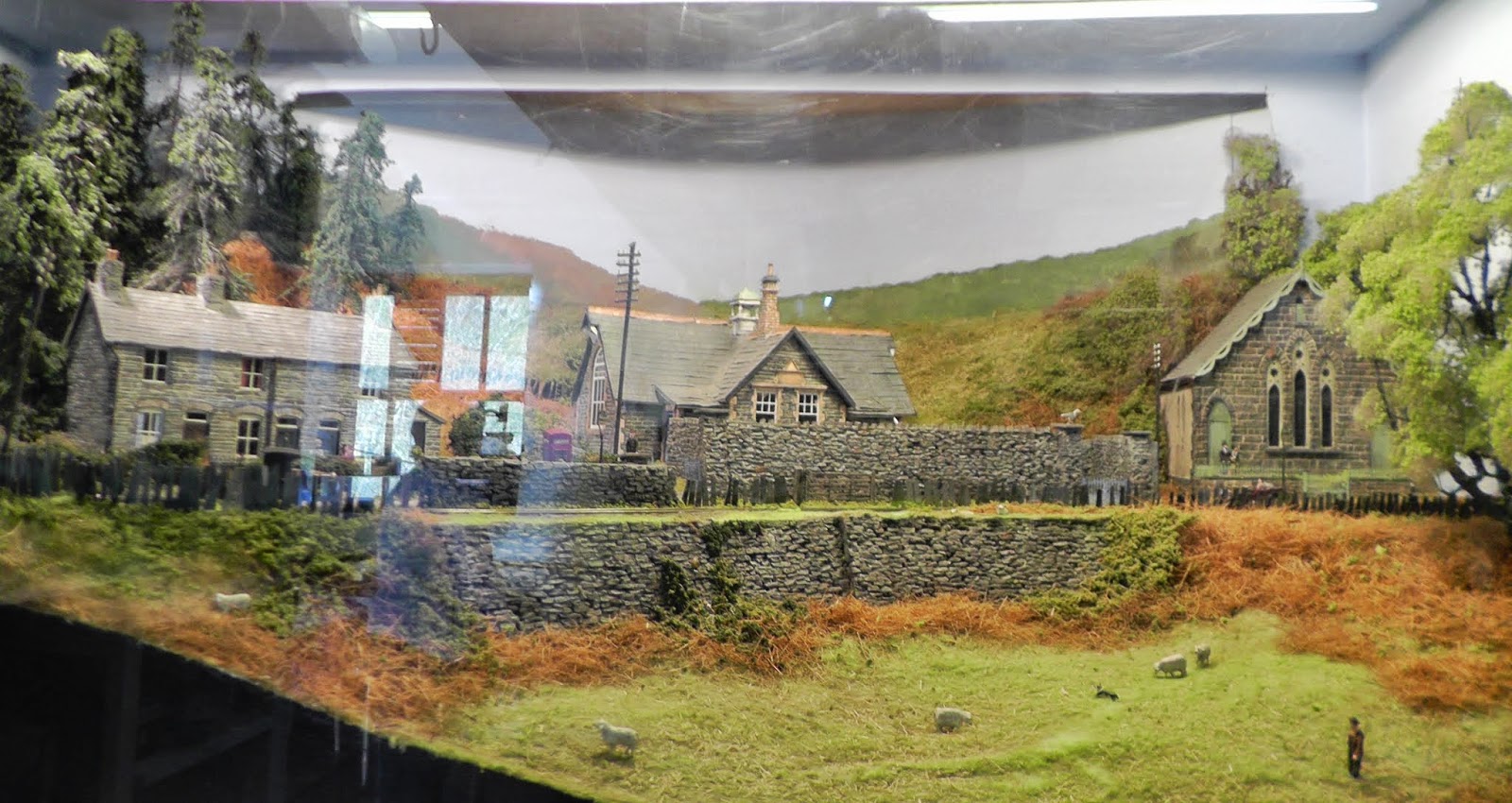
 After partaking of a freshly made cup of tea, I explored the immediate locality, finding the street modelled in the above photo.......

.... and discovering that as the railway continued its way through the village and onwards towards Aberllefenni, it passed very close behind the houses, which have now adopted the route of the railway to provide some much needed backyard psace and/or extensions.


One day I will return to walk the route of the line, documenting what remains of the trackbed, but on this occasion, I took a lingering look up route of the railway towards Aberllefenni ......

....... before walking back through the village towards the station, passing on the way the bridge over the stream which has now become a patio area for the neighbouring house.

I then followed the route of the existing railway ..........

.... taking the opportunity to get some lineside shots as the train made its way down to Maespoeth .......
 

..... and then back up the line to Corris. 

As this was the last train of the day, I returned to my car in the station's car park and then made my way back home.

I found the Corris Railway to be a very friendly place. The staff were clearly (and rightly) proud of their achievements and more than willing to answer even the most naive of my questions and also to provide plenty of additional information. It seems they have plans to remodel Corris Station, including a rebuild of the train-shed which was a feature of the stations at both Corris and Machynlleth. The planned extension will be the next phase in their ambition to restore the line to Machynlleth, which is readily achievable as much of the trackbed is still in existence, though road widening has, in some places, encroached on the route of the railway.

Although the museum and shop are quite small, the welcome is large and there are plenty of secondhand books and DVDs to satisfy the enthusiast whose sales will help to swell the society's funds. There are light refreshments and hot drinks available and an opportunity to discuss the railway's past, present and future with the staff as you sit and sup.

One advantage of a compact railway such as this is that can be visited in around an hour (or longer if you want to explore further aspects). And so, it caters well for those who want to drop in on their way through the valley. I would strongly urge you to do so whenever you are in the area. Such an interesting and unique narrow gauge railway is well worth the visit.

Virtual Visit Video


Monday, 13 May 2013

Welsh Highland Heritage Railway

In a nutshell

Gauge:         1' 11½"

Length:       ½ mile

Opened:     WHR - 1863 - extended 1923 - closed 1937 - re-opened in phases from 1997 to 2011
                    WHHR - 1980

Location:


View Narrow Gauge Railways in a larger map  

Email. info@whr.co.uk 


Date of visit: 6 May 2013


Key Facts

  • The original Welsh Highland Railway opened in 1923 following a unification of three pre-existing railways - The North Wales Narrow Gauge Railway (NWNGR), The Croesor Tramway, The Portmadoc, Beddgelert, & South Snowdon Railway (PBSSR)
  • The North Wales Narrow Gauge Railway (NWNGR) was opened in 1881 and ran from its station beside the LNWR mainline at Dinas (Just south of Caernarfon) to Rhyd Ddu on the lower slopes of Snowdon. It also had a branch to the Bryngwyn the slate quarries on Moel Tryfan.
  • The horse-drawn Croesor Tramway was built in 1864 to transport slate from the Croesor Valley to Portmadoc. 
  • The Portmadoc, Beddgelert, & South Snowdon Railway (PBSSR) was formed by Act of Parliament in 1901 with the intention of linking the Croesor Tramway with the NWNGR. Work commenced in 1906 and by 1908 it had completed the tunnels and trackbed through the Aberglaslyn Pass and built the bridge over the road to the South of Beddgelert and abutments for another two bridges before running out of money. The bridge and abutments are still visible when approaching Beddgelert from the Aberglaslyn Pass. The line was to be electric powered with hydro-electric power from the power station which is still in existence at Nant Gwynant.
  • The WHR changed the route to the South of Beddgelert to ease the gradient from 1:27 to 1:40.
  • The WHR was never financially successful and went into receivership in 1927. It was then leased to the Ffestiniog Railway which soldiered on with the railway until 1936, when the WHR was closed, the track lifted and the stock sold off.
  • One of the railway's original locomotives, Russell, is owned by the Welsh Highland Heritage Railway and is currently being rebuilt by Alan Keef Ltd.
  • In the 1980s there was some controversy between the WHHR and the Ffestiniog Railway over the restoration of the WHR - the FR eventually gained approval to reconstruct the railway though the WHHR does have running rights over the railway - albeit with several caveats.
  • In 1961 a group of railway enthusiasts created Welsh Highland Railway Society in 1961 with the aim of preserving and rebuilding the original WHR.
  • The society acquired the site of the original WHR station (Beddgelert Sidings) alongside the Cambrian Coast line from British Railways in the 1970s
  • The railway has accumulated a range of industrial rolling stock and has reconstructed or replicated some of the original WHR and NWNGR stock
  • A trip on the railway takes about an hour and includes a tour of the railway's stock sheds and workshops at Fferm Gelert.
  • There is a very well stocked railway bookshop with a range narrow gauge model railway equipment and souvenirs at the station in Porthmadog. There is also a cafĂ© which serves snacks and light meals.

Route


View Welsh Highland Heritage Railway in a larger map


My Impressions

I have visited the Welsh Highland Heritage Railway on several occasions previously; it has one of my favourite railway bookshops; but until this visit I had not properly documented my visits.

This particular trip coincided with the Ffestiniog Railway's 150th anniversary celebrations and so I decided to take some time out on this long weekend to properly document the WHHR.

On my arrival, I bought my ticket, which gives a full day's unlimited travel on the railway, and made my way to the platform where I just caught the departure of a goods train hauled by two of the line's  Simplex Motor Rail locomotives.

The railway was also holding a gala event and had laid on some additional trains for enthusiasts such as myself.

After my obligatory browse around their well stocked bookshop .......

....... I once more headed for the platform where I witnessed the arrival of the line's stalwart 0-4-2T Bagnall steam loco, Gelert, and watched as she ran around her train.

The line possesses six steam locomotives including the original WHR locomotive Russell which is currently undergoing major restoration at Alan Keef Ltd.

I boarded the train and, before we departed, one of the line's former Romanian diesel locomotives (Lyd2) arrived with a train. This massive powerful beast looks more than capable of hauling a loaded train up the 1:40 gradients of the WHR line to Caernarfon (though it is not yet clear when this right will be granted by the FR to the WHHR - apparently, negotiations are ongoing).

We set off up the line and before long reached Fferm Gelert (Gelert's Farm) station where we were invited to detrain to tour the sidings and stock sheds.

 As this was a gala weekend, there was a lot to see. Many of the line's collection of industrial diesel locos were on display and several were quietly chugging on tick-over or trundling up and down the yard taking people on footplate rides.

I must admit to having a fascination for these machines which even up until the 1960s and 70s were often to be found hauling skips of excavated soil on road building projects and busily pottering around factory yards and mine workings. The Simplex rail motor locomotives such as this one first went into production before the First World War and gave sterling service on the supply lines behind the trenches before finding their niche on industrial railways across the world.

For more information about Simplex Motor Rail locomotives see the Moseley Railway Trust website whose collection is housed on the Apedale Valley Light Railway in Stoke on Trent.

On this occasion, the stock shed was hosting a model railway exhibition with exhibits across of range of scales and gauges.


After spending some time studying the models and full size exhibits, I made my way back to the station platform just as the Romanian diesel, Lyd2 was arriving with its train from Porthmadog station.

 I boarded the train and was transported to the line's other terminus beside the restored WHR. Here, Gelert was waiting on the loop with her train, ready for the return to Porthmadog Station

 As we departed, I was able to look back from my seat in the open carriage at the rear of the train towards the station to see Lyd2 running round her train for the return journey.

On arrival at the line's main terminus ....

..... which for some time in the WHR's history was principal terminus in Porthmadog when the Cambrian Railway refused to give permission for the WHR trains to cross their tracks to make their way across town to the Harbour Station, the terminus for the Ffestioniog Railway. Fortunately, that is no longer the case and WHR trains now regularly cross the mainline. I watched again as Gelert ran round her train before enjoying a rather tasty lamb pasty in the railway's café.

At this time of year, the Cambrian Coast Railway was not running its steam-hauled tourist trains but on a previous occasion in 2010, I was fortunate to be at the WHHR station when a Black 5 class locomotive steamed past. My apologies about the quality of the photo - particularly the white post in the middle of it. See video below.

Video


Thursday, 9 May 2013

Welsh Highland Railway

In a nutshell

Gauge:         1' 11½"

Length:       25 miles

Opened:      1863 - extended 1923 - closed 1937 - re-opened in phases from 1997 to 2011

Location:

    
View Narrow Gauge Railways in a larger map


Date of visit: 6 May 2013


Key Facts

  • The first part of what is now the Welsh Highland Railway was opened in 1863. This was the horse-drawn Croesor Tramway which ran from Porthmadog to the Croesor Valley. This has now been incorporated into southern part of the railway.
  • In 1877, the North Wales Narrow Gauge Railway opened a line from Dinas Junction on the LNWR mainline to the south of Caernarfon, initially to Snowdon Ranger and then in 1881 to Rhyd Ddu.
  • In 1923, the Welsh Highland Railway was completed with the link from Rhyd Ddu, through Beddgelert and the Aberglaslyn Pass to link up with the Croesor Tramway.
  • The Depression years of the 1920s was not the most lucrative time to open a new railway and from its inception the WHR struggled financially.
  • The railway limped on until it was put into receivership in 1927 and closing in 1933 when it was leased to the Festiniog Railway Company. The FR tried to make the railway successful through development of the tourist trade but was eventually forced to abandon the railway in 1937 when the it was closed and the stock and track sold off.
  • The restoration of the railway was mired in controversy with both the Welsh Highland Heritage Railway and the Festiniog Railway initially seeking to purchase the trackbed and gain funding to reopen the line. Eventually, the Ffestiniog Railway was successful and through National Lottery funding was able to rebuild and reopen the railway in stages from 1997 to 2011.
  • Restoration began with the completion of the railway from Caernarfon to Dinas along the trackbed of the former standard gauge railway.
  • The final phase of construction was the completion of the link from the WHR, through the town of Portmadog to the Ffestiniog Railway station which entailed the re-installation of the crossing over the standard gauge railway near to the Welsh Highland Heritage Railway station.
  • The original WHR inherited two locomotives from its constituent companies; a single Fairlie locomotive, Moel Tryfan, which survived until 1954 when it was scrapped by the FR; and a 2-6-2T Hunslet locomotive, Russell, which is owned by the Welsh Highland Heritage Railway and is currently undergoing restoration by Alan Keef Ltd. The line also bought an ex War Dept Baldwin locomotive which did not prove to be successful or popular with crews on the railway.
  • The railway now uses a fleet of Beyer-Peacock Garratt articulated locomotives to tackle the tortuous, steeply inclined route. Most of the locos are from South Africa, but the line also possesses a former Tasmanian Railways K class locomotive which was the world's first Garratt articulated loco and
  • The line also has a fleet of diesel locomotives
  • From time to time Ffestiniog Railway locomotives haul trains along the line as they did when the line was first opened
  • The Welsh Highland Heritage Railway also has opportunities to run special trains on the railway, as part of an agreement between the two railways when restoration began. 

Route

Source: http://www.railway-technology.com/projects/welshhighlandrailway/

My Impressions

This was not the first time I had travelled along or visited the Welsh Highland Railway. I was fortunate enough to travel on the first public train through the Aberglaslyn Pass in May 2009, though for some reason I took only one photo to commemorate this auspicious event!


My visit on this occasion was as part of a visit to the Ffestiniog Railway's 150th anniversay celebrations when I took the opportunity to take a ride on the WHR as a respite from the events on the FR.

Prior to my trip on the railway, I took some lineside shots in the Aberglaslyn Pass. Mainly, I wanted to see the two ex-Penrhyn Hunslet locomotives, Blanche and Linda, hauling a special FR/WHR train non-stop from Blaenau to Caernarfon.

The following day, I travelled the line from Porthmadog to Rhyd Ddu, which I consider to be the most spectacular part of the railway. Mind you, the section from Rhyd Ddu to Waunfawr also has its attractions but it was more convenient for me to change trains at Rhyd Ddu.

Before boarding the train, I was able to watch our loco running round and taking on water at Harbour Station.

 Because the tracks at Harbour Station are not yet aligned for the WHR, trains have to be hauled out from the platform by a pilot loco before the WHR loco is then attached to take the train across the bridge and through the town.
WHR Beyer Peacock loco 138 negotiates the road bridge at Porthmadog
The station platforms at Harbour Station are presently being remodelled and so from Spring 2014, this interesting reverse manoeuvre will no longer be necessary.

The first part of the railway is unspectacular as the line crosses the farmland which was reclaimed from the salt flats when the Cob across the estuary was built in 1811 by William Maddocks who gave his name to the town of Porthmadog (Maddock's Port).

Before long, however, the train starts its ascent towards Beddgelert. Shortly after leaving Nantmor, the train plunges into a 280m long tunnel ......

 ...... before emerging into the Aberglaslyn Pass, where the railway clings to the hillside on a ledge above the river and passes through a further two short tunnels.

After crossing the river on a girder bridge the railway begins a steep climb through woodland towards Beddgelert Station which is located above a short way above the town.

 After taking on water, the train started the next and most tortuous stage of the railway's climb up gradients of up to 1:40 and taking in a series of S-bends to enable it to gain height.

Adapted from: http://web.bethere.co.uk/steven.harris/twa/std/images/map07.gif

Towards the end of the climb, the railway emerges from the woodland to cross some heathland and begin its descent towards Rhyd Ddu on the lower slopes of Snowdon. On this particular occasion, this marked the end of my journey and I waited on the platform for the arrival of the train from Caernarfon.

On the journey back, there was an opportunity to wait at Beddgelert for the arrival of a special train from Porthmadog, hauled by one of the Ffestiniog Railway's stalwart 0-4-0 England locomotive, Palmerston.

We passed once more through the woodland below Beddgelert .........

........ and through the Aberglaslyn Pass.

Before entering the town of Porthmadog once more, we passed the link with the Welsh Highland Heritage Railway. ........

 ...... before crossing the standard gauge Cambrian Coast Railway ......

...... and then winding our way across the back of the town. We then negotiated the road crossing over Britannia Bridge and was pulled back into Harbour Station by one of the FR's ex Penrhyn Railway locomotives, Linda.


The Welsh Highland Railway is certainly one of the most spectacular of the preserved narrow gauge railways in the UK. As it is now connected to the Ffestiniog Railway the two now boast around 40 miles of continuous railway from Caernarfon to Blaenau Ffestiniog. It is possible on gala days such as this to travel the entire length of the railway non-stop (apart from when the locomotives have to take on water). Personally, I prefer to do the trip in stages as it provides opportunities for me to take lineside pictures. However, if you have not yet had the opportunity to travel on and/or view the railway as it passes through the Aberglaslyn Pass, then it must surely rank as one of the must-see stretches of narrow gauge railway in the country.

I will return! It's about time I traversed the northern end of the railway and gathered a few more lineside shots. Hopefully I'll do that sometime in the summer and can then complete the video of the journeys.

Video

[In preparation]