Search This Blog

Friday, 30 August 2013

Ravenglass and Eskdale Railway

In a nutshell

Gauge:         15"

Length:      7 miles

Opened:     1875 - 3' gauge (closed 1913)
                    1915 - 15" gauge

Location:    


View Narrow Gauge Railways in a larger map  


Dates of visits:     9 May 2010, 26 July 2013


Key Facts

  • When the railway opened in 1875 it was 3' gauge.
  • Its original purpose was primarily to transport iron ore from quarries and mines to the mainline railway at Ravenglass
  • When it was given permission to carry passengers in 1876, it became the first public narrow-gauge railway in England
  • The first incarnation of the railway closed in 1913 as the income from iron ore and passengers declined making the railway unviable
  • The line re-opened as a 15" 'minimum gauge railway' in 1915 under the ownership of W. J. (Wynne) Bassett-Lowke and Robert Proctor-Mitchell who were interested in demonstrating the potential of 15" gauge as a commercial venture, based on the earlier work of Sir Arthur Heywood (see A Brief History of Minimum Gauge Railways)
  • Initially, trains were hauled by one of Bassett-Lowke's  4-4-2 locomotives (Sans Pareil) which was a miniaturised version of a full scale standard gauge loco.
  • More rolling stock was provided from Sir Arthur Heywood's Duffield Bank Railway, following his death in 1916.
  • Whilst summer passenger tourist traffic was the mainstay of the line, it also transported granite from Beckfoot Quarry to a crushing plant at Murthwaite. 
  • The railway ran one of the first diesel locomotives in 1929 
  • The railway closed to traffic during the years of the Second World War
  • In 1959 the railway was threatened with closure but was bought by a preservation society in 1960 which has remained in ownership ever since
  • Around 120,000 passengers are carried on the railway each year
  • The railway is open throughout the year though there is usually a brief closure for maintenance during the month of January

Route

Source: http://www.rerps.co.uk/images/main_map_672x199.gif

My Impressions

I have visited and travelled on the Ravenglass & Eskdale (L'al Ratty) on several occasions but my first visit in 2010 ,laid the foundations for my desire to create this blog. It was my first attempt to properly document a visit.

As we were staying with relatives not far from Ravenglass, we arrived at the station fairly early and so there was time to watch the trains being prepared for the day and have an opportunity to partake of one of the station cafe's fine breakfasts - which is somewhat of a feast.

River Mite was built by the Preservation Society in 1966
Originally built as a 2' gauge 0-4-0WT by Kerr Stuart in 1900 for Dundee gasworks, Bonnie Dundee is now an 0-4-2 tender engine
Our locomotive for the trip down the line was River Irt which had been renamed Greendale Rocket as part of the line's Postman Pat event for that weekend. River Irt is one of the line's original 15" gauge locomotives, it's chassis coming from Sir Arthur Heywood's 0-8-0 locomotive Muriel which was built in 1894.

We boarded the train and made our way down the line taking in the views as the train took the 1:55 gradients to the furthermost terminus at Dalegarth.

We spent a while at Dalegarth, watching the train movements and had a light lunch in the cafe which is situated in the station building.

Meanwhile, 2-8-2 River Esk arrived with a full train from Ravenglass. Built by Davy Paxman in 1923 to a design by the renowned Henry Greenly, she is a very impressive and powerful locomotive.

As there are turntables at each end of the line, the locos always run chimney-first up and down the line and the turning of the locos usually seems to attract a great deal of interest.


We then boarded the train and were fortunate enough to have a seat directly behind the locomotive.

After watching the arrival of River Irt, we made our way back up the line to Ravenglass.

 As this was a special Postman Pat themed day, there were events organised at the stations for children and a busy schedule of trains running in each direction. There was plenty to see and do, for children and adults alike. It's unsurprising this this is one of the Lake District's leading visitor attractions.

Return visit - 26 July 2013

 On arrival at Ravenglass Station, we exchanged the pre-booked ticket voucher which we had bought online for our tickets and then retired to the station café for their slap-up breakfast - which has become a bit of a tradition when we visit the line.


While my wife ordered breakfast, I had a few minutes to wander around the station forecourt, where I discovered the outcome of the devastating fire which had led to difficulties for the railway in providing a full complement of locomotives.
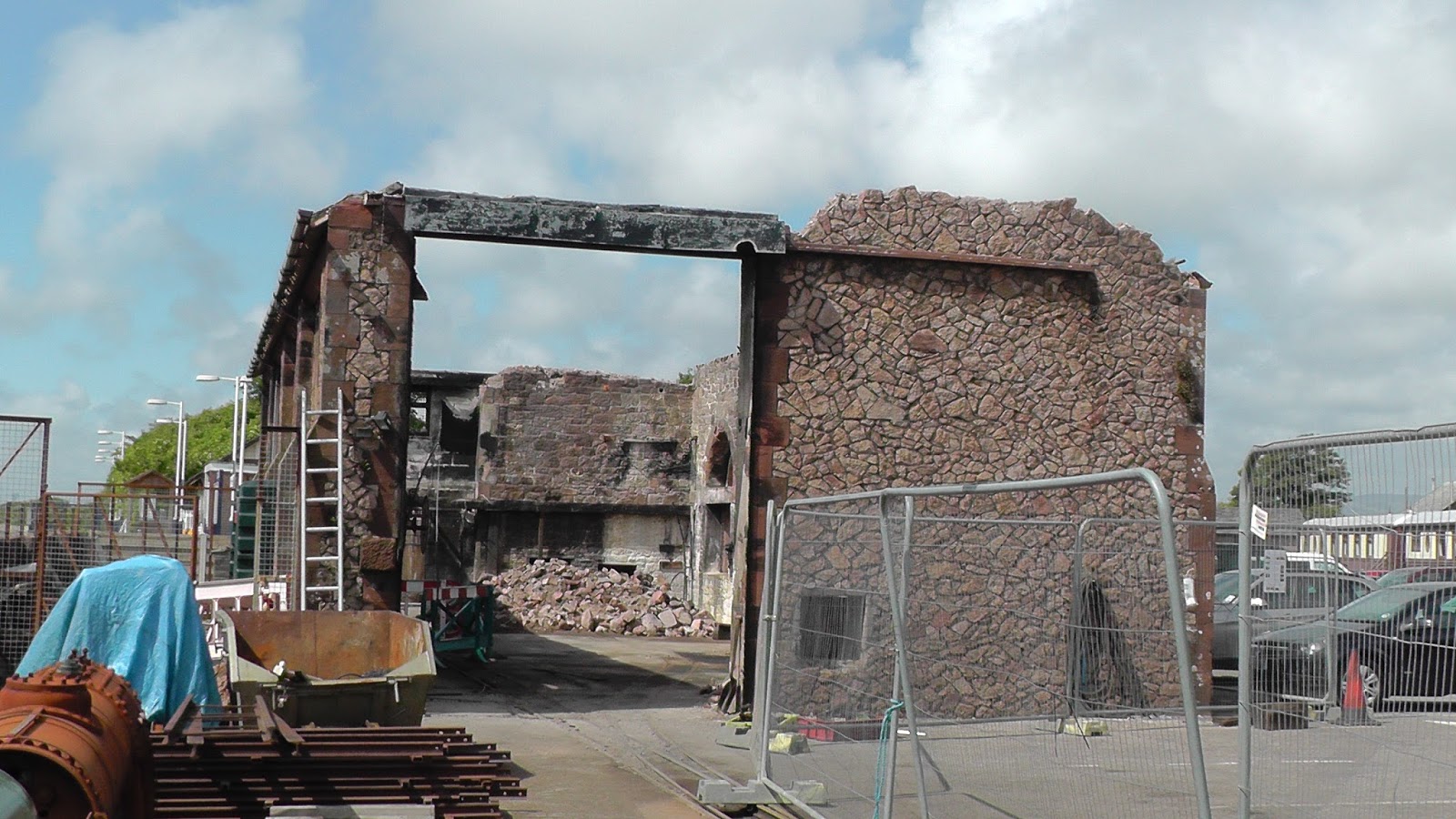
However, the 15" narrow gauge railway community is close-knit and, thanks to loans of locos from the Bure Valley and the Romney, Hythe & Dymchurch, the railway has been able to continue running its services through the summer. Waiting in the station for the right of way was the Bure Valley loco, Wroxham Broad

Our loco was the RH&DR 4-8-2, Hercules but there was no time for a picture and so, with a slice of toast still in my hand, we boarded the train to set off up the valley.


The first part of the journey takes the train beside the estuary of the River Mite before turning inland to pass under the main A595 road beside which is Muncaster Mill - a request stop.

The line then begins a gentle ascent up the valley, winding its way through woodland and passing the site of the granite crushing plant at Murthwaite.

Sometimes trains pass each other at Irton Road, but not on this occasion - we passed the Up train at Miteside Loop.

 After passing under the road bridge at Irton Road which was built to clear the height and width of the line's original 3' gauge trains, we continued our journey.

We chugged through The Green station which serves the community of Eskdale Green and climbed up Eskdale Valley, passing the site of Beckfoot Quarry .......
Model of Beckfoot Quarry in the museum at Ravenglass

....... the source of the granite which was transported down the valley to the crushing plant.

After a stiff climb of 1:38, the train crossed the River Esk and pulled into Dalegarth Station where Wroxham Broad was awaiting the off.

As Hercules was too long to fit on to the turntable with her tender, they each had to be turned separately.

There was an opportunity to take a few shots of this impressive Greenly designed and Paxman built locomotive.

.... and watch the arrival of the next train behind the railway's 2-6-2 locomotive, Northern Rock, built in the line's workshops in 1976.

We decided to walk along the road down the valley to Eskdale Green, passing on the way the one of the line's B-B diesels, Douglas Ferreira, on its way up the valley.

By the time we reached The Green, Douglas Ferreira, was returning Up the line and so we flagged it down and boarded the train.


At Miteside Loop, we passed Northern Rock on the Down Train.

 On arrival at Ravenglass, we visited the museum where there are some photos of the railway in its early days - such as this picture of Eskdale Green station when the railway was 3' gauge........

 .... and this photo of Sir Arthur Heywood's 0-8-0T loco, Muriel running on the railway before she was converted into 0-8-2 tender loco River Irt.

After a quick snap of Douglas Ferreira, we hopped in the car and reluctantly left the railway behind.


As can be seen from both the visits. There is always plenty to see on the R&ER and there are plenty of walking routes which start and finish at stations along the line. The quality and range of food available at the cafés at each end of the railway is very good and the staff are happy to explain to visitors what they are doing and how the railway operates.

Hopefully, the locos which were affected by the fire will soon be back in service but it was interesting to see visiting locos hauling service trains.

Video

[In preparation] 


Tuesday, 4 June 2013

Statfold Barn Railway

In a nutshell

Gauges:        7¼", 10¼", 2', 2'6", 4'8½"

Length:         Garden Railway (7¼", 10¼", 2') - ¼ mile
                       Field Railway (2', 2'6") - 1½ miles

Opened:     2002


Location:    


View Narrow Gauge Railways in a larger map


Date of visit:     1 June 2013


Key Facts

  • The Garden Railway was the original line built around 2002 by Graham Lee and his wife and the subsequent developments arose out of the need to find a 2' gauge steam locomotive to run on it.
  • With Graham's acquisition of Andrew Barclay's and the Hunslet Engine Company in 2004, the facilities developed at Statfold Barn to now include a fully equipped engineering workshop and an extensive collection of locomotives - including the Hunslet Museum of locomotives and artefacts.
  • In addition to the operational narrow gauge locomotives from various parts of world there are several locos awaiting restoration.
  • The original Garden Railway is still in operation, with triple gauge tracks  (7¼", 10¼", 2').
  • The 1½ mile long dual gauge (2' and 2'6") Field Railway runs from the main terminus beside the engine sheds past further storage sheds located at Oak Tree Halt about half way along the line to a balloon loop at the end of the railway.
  • There is also another more recent 2' gauge railway which runs parallel with the Field Railway as far as Oak Tree Halt. This railway is embedded in a concrete road for most of its length. 
  • The Statfold Barn Railway is privately owned but has three open days during the year for which members of the public can apply in advance for tickets by post.
  • On Open Days all the workshops and sheds are open to the public with unlimited rides on the three railways which run a continuous shuttle service throughout the day.
  • Refreshments are provided in the form of large burger and hot potato vans located under cover in one of the farm buildings
  • There are usually book stalls and other railway traders' stands on Open Days.

Route


My Impressions

On arrival, several noticeboards on the driveway reminded us that the Open Days are by invitation only, which can be obtained in advance via a form on the Railway's website. We were directed to a large field used as a car park which filled to well over half its capacity through the day.

The buildings immediately adjacent to the car park house the collection of operational locos, plus traction engines and the railway workshops which boast an impressive array of engineering machinery sufficient to not only maintain and restore but also to build replica steam locos (three have been built to date).

In addition there was a shed and a shelter for traders selling books and railwayana.

After admiring the static exhibits, and inevitably buying more books to add to the collection, we got our bearings and passed through the main loco shed .......

...... and set up base camp on the green between the main station and the loco shed. This provided an opportunity to take a closer look at the locos as they waited on the shed roads for their turn to haul trains on the mainline.
Hudswell Clarke 0-6-0 Lautoka Mill No 19
0-6-0PT Corpet 439 Minas De Aller
 There is quite a stiff climb from the mainline up to the loco shed which provides an opportunity to see and hear the locos in full steam.  I noticed several keen loco-spotters with notepads in hand jotting down the details of each loco as it came and went.
Hunslet 0-4-0 Statfold and Krauss 0-4-2T Sragi No. 1
 The main station for the Field Railway has two platforms and, by crossing a footbridge, the platform for the recently added two foot gauge line can be accessed.

Eventually, after watching a few trains come and go, I hopped aboard one of the trains and made my way down the line. First, the train crossed the branch to the loco sheds, crossed the standard gauge line and then passed the junction for the original Garden Railway.

About half way along the Field Railway, we passed through Oak Tree Halt, where the Up train was waiting on the loop and another train simmered on the parallel 2' gauge railway.

 After exchanging tokens, we made out way out into the fields towards the balloon loop which marks the end of the line.

....where another train was waiting to take the line back to the main site. I decided to leave the train here and get a few lineside shots as I strolled back up the line. After taking a photo of my train and its loco .......


.... I watched the loco which would haul the train back up the line couple up.

I also took a moment to admire the quality of the trackwork which on the main Field Railway is dual gauge (2' and 2'6") for its entire length.

As I meandered back along the line I got a shot of the next train, steaming its way down the line towards the balloon loop.

and then watched my own train on its return journey up the line.

I then found a comfortable position beside the line on a slight incline which gave an opportunity to film some trains steaming up the bank with their regulators open. Here I caught my train loco on her return journey with another train.

...... followed after a short while by the line's Hudswell Clarke 0-6-0WT, Bronllwyd in her Surrey County Council livery, piloting the line's O&K 0-6-0TT former Sragi Sugar Mills loco No. 14 on a goods train.

There was considerable activity going on at Oak Tree Halt ......

.... where I paused for a while to see the goods train returning ......

.... before taking a slight diversion to view the carriage shed, where more of the line's fleet are stored ........
...... including some Hunslets in various stages of restoration.


 .... and various other locos, such as this Porter, which look badly in need of considerable TLC.

 Strolling alongside the line between Oak Tree Halt and the main terminus there were many vantage points for photos, one of which afforded an opportunity to see the Land Rover railmotor

and the last Hunslet loco to be built at the Jack Lane works, Trangkil No. 4 on a mixed train.......

 ..... and 2'6" gauge 0-4-0 Pakis Baru No.1 on a double header with articulated 0-4-4-0T Pakis Baru No. 5.

 Hardly a moment goes by without another train steaming into view. This time it was 0-4-2T Hunslet Josephine.

Before making my way back to the terminus and 'base camp', I spent a while in the garden, watching the train chug its way round the Garden Railway, which is indeed in a very fine setting.

Considering the engine shed is only about ten years old, it has been lovingly constructed in the style of the period when narrow gauge railways were becoming established.

 We then decided to partake of some refreshment in the barn where the queues for food had died down but the range of grub was in no way diminished.

 The level of activity on the railway during the Open Day is very impressive. It looked as if every working loco was in steam and rostered on a rolling basis to strut its stuff on the railway. As a consequence, there was always something happening and something to see. For narrow gauge locomotive enthusiasts it would be difficult to find a more captivating and interesting venue. If I was giving railway events rankings, this would have to come somewhere near the top of the list.

Video Virtual Visit