Search This Blog

Saturday, 23 February 2013

Windmill Farm Railway

In a nutshell

Gauge:       15"

Length:      ½ mile (one mile round trip)

Opened:    1997

Location:  

THE WINDMILL ANIMAL FARM
Red Cat Lane,
Burscough,
Lancashire.
L40 1UQ


View Narrow Gauge Railways in a larger map

 
Tel.:      01704 892282
 

Date of visit:   23 February 2013


Key Facts

  • The railway was set up in 1997 by Austin Moss to store and run his collection of 15" historic locomotives and rolling stock
  • The collection includes stock from the 15" Fairbourne Railway, the Lakeside Railway at Southport, the Romney Hythe and Dymchurch Railway, Bressingham Gardens, Liverpool Garden Festival and Dudley Zoo.
  • The farm site includes children's play areas, a cafe and livestock exhibits
  • Trains run during weekends during the winter and daily during the summer


Route


View Windmill Farm Railway in a larger map


My Impressions

Having paid my entry fee to the farm, I made my way to the railway, passing through the animal sheds, the cafe and the children's playground.

The loco and carriage sheds are adjacent to the animal barn and a window gives a glimpse of some of the railway's collection of stock - principally the Lakeside Railway locomotives from Southport - though in the background can be seen the railway's Pullman coach which was scratchbuilt on the premises.

The sheds connect directly to the line's main station which boasts its own trainshed.

Our loco for this journey was a Bo-Bo diesel which had formerly run on the railway at Dudley Zoo. As this was the midday train service the coaches were rapidly filled with enthusiastic children and their parents

Once all the passengers had found their seats, the train departed, initially winding its way through the fields past the windmill which gives the farm its name, and then through the fields.

After negotiating a couple of reverse curves the line approached its destination, passing the now disused junction for the balloon loop.

Taking the left hand branch, we skirted the lake, getting a view of the Lakeside Station building across the water.

When we arrived at the station, the loco ran round the train and there was a fifteen minute stop while the children took the opportunity to play in the playgound. In the summer, this would make a pleasant spot for a picnic, but with the occasional flurry of snow in the air, no one seemed interested using the picnic benches.

I took the opportunity to discuss the railway with the driver and guard, and view the photos and information in the station building about various other 15" gauge railways with which the railway has some relationship. I was interested to see some photos of Haigh Hall Railway when it was operational.

I understand there have been some discussions about the Windmill Farm Railway taking over some of the operation and maintenance of the Haigh Hall Railway, but at present there is no firm news on this.

I was also interested in seeing some pictures of Blacolvesley which was the only internal combustion powered locomotive to be constructed by Bassett Lowke and ran on the Blakesley Hall Railway. I believe it is now preserved at the Ravenglass & Eskdale Railway.

What I find really fascinating is tracing the history of 15" 'minimum gauge' gauge railways in this country, from their original promotion by Sir Arthur Heywood in the late 1800s to the present day (see A Minimum Gauge Railway Chronology). Sir Arthur was almost obsessed with investigating, demonstrating and promoting what he considered to be the minimum viable gauge for a commercially successful railway. Whilst he had the opportunity to construct only one other railway (the Eaton Hall Railway) in addition to his own, the gauge was adopted by many of the more successful community and leisure railways (eg the Romney Hythe and Dymchurch, the Ravenglass & Eskdale and the Fairbourne Railway).

 There was also an interesting panel explaining the origin of the station building which had formerly been a signal cabin on the Great Western Railway near Bristol.


When we re-boarded the train, I was fortunate to be offered a seat in the guards van, which gave me a great view of the locomotive as we made our return journey.

Before long we once more returned to the main station, where we de-trained and the passengers made their way back to the delights of the farm.

Meanwhile, I took the opportunity to look over some of the line's collection of stock, including what looked like a replica of one of the original Heywood minimum gauge carriages.

I was then invited to view the railway's other stock in the sheds, which includes the 2-8-2 diesel hydraulic loco, Konigswinter, which up until this time has handled much of the railway's summer traffic.

In addition I was able to admire the recently restored former Fairbourne Railway 2-4-2 Guest loco Katie, which is intended to come back into operation this summer (an excuse for a return visit, maybe?). It seems Katie will be returning to Fairbourne in May 2013 for guest appearance (sorry about the pun!) at its steam gala.

The former Fairbourne Lister diesel, Whippet Quick, was also in evidence ......

.... as were the former Southport Lakeside diesel electric locos, Princess Anne, Duke of Edinburgh, Prince Charles and City of London.

Another loco which greatly intrigued me was what must be the most minimal of all, an 0-4-0 (or maybe a 2-2-0) vehicle powered by what looks like a recycled lawnmower engine.

The sheds also house a fascinating collection of rolling stock from various sources in various stages of restoration.

Having visited several 15" gauge railways over the past year I am rapidly coming to see their historical significance and the fascination which this gauge holds for those who are determined to preserve and to promote its continued existence. I am determined to re-visit this railway during the summer, particularly during their gala weekend when I assume much of the stock will be on show and operational. (eg see http://homepage.ntlworld.com/chrismansfield/windmill/ ). In the meantime, if you are ever in the vicinity, I would strongly urge you to visit the railway - maybe coinciding it with a visit to Martin Mere, which is less than a mile down the road, or a visit to the West Lancs Light Railway which is about fifteen minutes' drive away. I really feel that Narrow Gauge Railway collections such as this need to be supported and nurtured to ensure that this important part of our industrial and leisure heritage is preserved and further developed.

Video


Friday, 22 February 2013

Llechwedd Slate Caverns

In a nutshell

Gauge:         1' 11½"

Length:       800m (Tramway) 500' descent plus half mile walk (Deep Mine)

Opened:      1846 (Original quarry) 1972 (Miners' Tramway) 1979 (Deep Mine)

Location: 

Llechwedd Slate Caverns
Blaenau Ffestiniog
Gwynedd LL41 3NB

View Larger Map

 Tel.:   01766 830306
Web:   http://www.llechwedd-slate-caverns.co.uk/index.php


Date of visit: 20 February 2013


Key Facts

  • The Llechwedd slate quarry was opened in 1846 by John Greaves. He later became the treasurer and eventually chairman of the Festiniog Railway.
  • At its peak, the quarry had 513 employees and produced 23,788 tons of finished slate per year (1884)
  • In 1890 the quarry machinery was converted to electrical power with the quarry's own hydro-electric generating station.
  • In its heyday, slate was mined by hollowing out large galleries. A team of four men was responsible for extracting and finishing the slate from each gallery. Some galleries were up to 250' from floor to ceiling.
  • Blocks of slate were transported from the galleries to the finishing sheds along horse-drawn tramways.
  • Slate is still being extracted on the site by open-cast quarrying from the surface.
  • The caverns now include two separate visitor attractions - the Miners' Tramway which uses a battery powered locomotive to haul visitors through a tunnel with two stops in galleries for illustrated talks - and the Deep Mine which involves descent via an incline with a guided walk through a series of galleries, some of which are now flooded.
 

My Impressions

I coincided this visit with a trip on the Ffestiniog Railway and only had time on this occasion to travel on the Miners' Tramway. I will return at some time in the future to complete the visit by touring the Deep Mine.

As this was only a flying visit, I did not have time to sample the delights of the cafe though I did spend a while exploring the shop, which provides a selection of slate-related memorabilia and some literature relating to slate quarrying and the local community. At this time of the year, tours depart at half hourly intervals and so, after a short wait, our train reversed into the station and we boarded the coach for our trip into the mine.

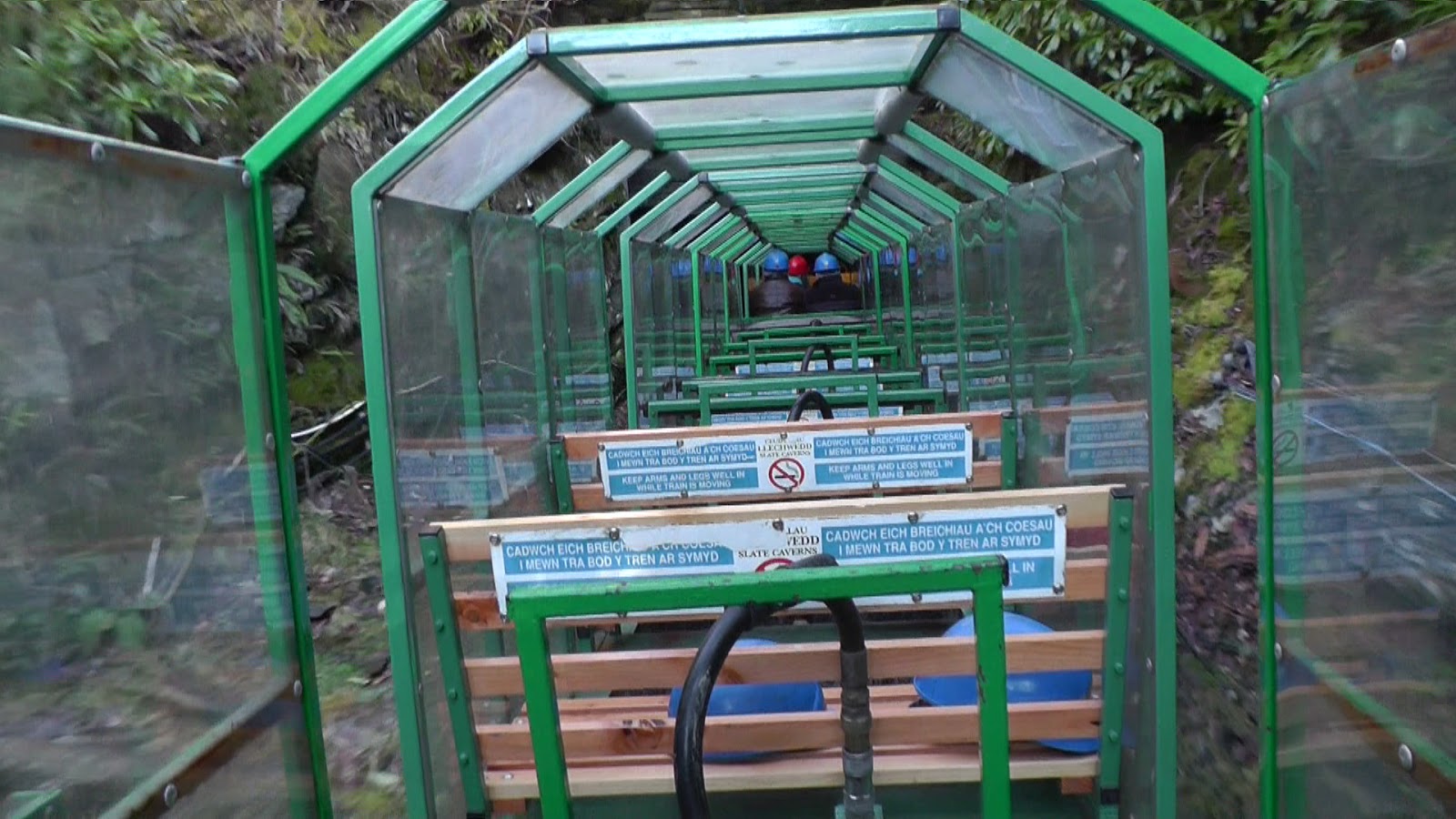
I took my seat in the last carriage which gave me a view through the other coaches as the train wound its way through the twisting tunnels.

After passing a few floodlit galleries and side tunnels we stopped at the entrance to a gallery where we alighted and our guide explained the Victorian working practices for extracting slate.

We hopped aboard the train once more and wound our way through to another two galleries where we were entertained with an audio visual presentation of working practices and a further live talk, explaining some of the health and safety issues associated with life in the mines.

Meanwhile, our train had turned round via a reversing triangle and we resumed our seats for the return ride. We were then given a demonstration of slate-splitting in the finishing shed.................

............ before my fellow-passengers made their way to the Deep Mine. I will have to save this part of the tour for my next visit as we needed to travel back to Cheshire for an appointment.

The slate caverns are certainly impressive and if you have not already seen them, they are well worth a visit. The opportunity to see first-hand this reconstruction of an important part of North Wales' industrial heritage is both enlightening and salutary. The last time I visited the Caverns was 26 years ago when I accompanied a school party on a visit. It was reassuring to see that this tour was very much as it was then. It would seem that the winning formula from the early days of this visitor attraction has been retained. I am looking forward to my next visit when I will be able to relive my experiences in the Deep Mine.

Video

[In preparation]


Thursday, 21 February 2013

Ffestiniog Railway

 In a nutshell

Gauge:        1' 11½"

Length:      13½ miles

Opened:    1836

Location:

Harbour Station
Porthmadog,
Gwynedd County
01766 516000


View Narrow Gauge Railways in a larger map


Date of visit: 19 February 2013


Key Facts

  • The railway was built originally to transport slate from the quarries and mines at Blaenau Ffestiniog to Porthmadog
  • The railway was constructed on a continuous gradient of around 1:80 which enabled laden trains to travel down the line by gravity; the empties returning by horse power. Gravity trains continued to be run until 1939.
  • Steam locomotives were introduced in 1863 and passenger trains run (officially) in 1865 - the first narrow gauge railway in Britain to carry passengers
  • In 1869 the railway introduced articulated 'double Fairlie' locomotives
  • In 1872, the first bogie passenger coaches in Britain were used on the railway
  • Slate traffic on the railway ceased in 1949 until the railway was purchased by a group of enthusiasts in 1954, led by Alan Pegler.
  • The railway re-opened for passenger traffic on 23 July 1955, with trains running from the Harbour Station at Porthmadog across the Cob to Boston Lodge Works
  • The line was re-opened in stages to Tan--Bwlch in 1958 which acted as the line's upper terminus until 1963 when the railway was extended to Dduallt
  • Because the upper part of the railway had been flooded by the construction of a reservoir at Tanygrisiau, a 'deviation' which included a spiral to gain extra height, was built (largely by volunteers). The line re-opened to Tanygrisiau in 1978.
  • The final phase of re-construction to Blaenau Ffestiniog re-opened in 1983
  • During the 1990s, the Festinog Railway became involved with the reconstruction of the Welsh Highland Railway which now links Porthmadog with Caernarvon allowing for continuous running over 40 miles from from Blaenau Ffestiniog to Caernarvon, making the longest operational narrow gauge railway in the UK


Route


View The Ffestiniog Railway in a larger map


My Impressions

The Ffestiniog Railway is probably the narrow gauge railway which I have visited the most over the years, ever since first discovering it (by accident) during a camping holiday with my parents in 1963. I soon after became obsessed with narrow gauge railways, joining the Festiniog Railway Society and travelling on the railway with my membership's concessionary rate many times and then again intermittently thereafter.

This is my first blogged (re)visit to the railway - and no doubt will form one of many return visits. On this occasion, we started our journey at Blaenau Ffestiniog as this train was the most convenient after travelling in from Cheshire.  Basing ourselves here, also enabled us to visit the Llechwedd Slate Caverns after our trip along the line.

As we had around 40 minutes to spare before the train departed, we motored a short distance down the line to watch our train pulling away from Tanygrisiau Station on its was up to Blaenau.

I was delighted to see that our locomotive was going to be Lyd, the recently constructed replica of the Lynton & Barnstaple Manning Wardle 2-6-2T, based on L&B Lew which was built in 1925.

After taking a short piece of video drove back up to Blaenau, parked and had time to take a few shots of Lyd running round the train and taking on water before boarding our train.

The building of the narrow gauge loco Lyd has been compared by some to the construction of the standard gauge locomotive, Tornado - a completely new steam locomotive built in the 21st century for commerical traffic.

As it was half-term, the train was almost full - but we managed to find a seat in the last carriage which enabled me to get some fine shots and video of the train negotiating the serpentine curves of the railway as it descended the ruling 1:80 gradient.

After skirting Llyn Ystradau reservoir at Tanygrisiau and passing the entrance and exit of the line's original Moelwyn Tunnel we traversed the 'deviation' spiral down to Dduallt Station. 

As there we no passengers, the train steamed through the station and continued its descent to Tan-y-Bwlch.  When I first discovered the railway in the 1960s, this was the upper terminus for the railway. Normally, Up and Down trains pass here but as we were following the winter timetable we paused for a short while before resuming our journey.

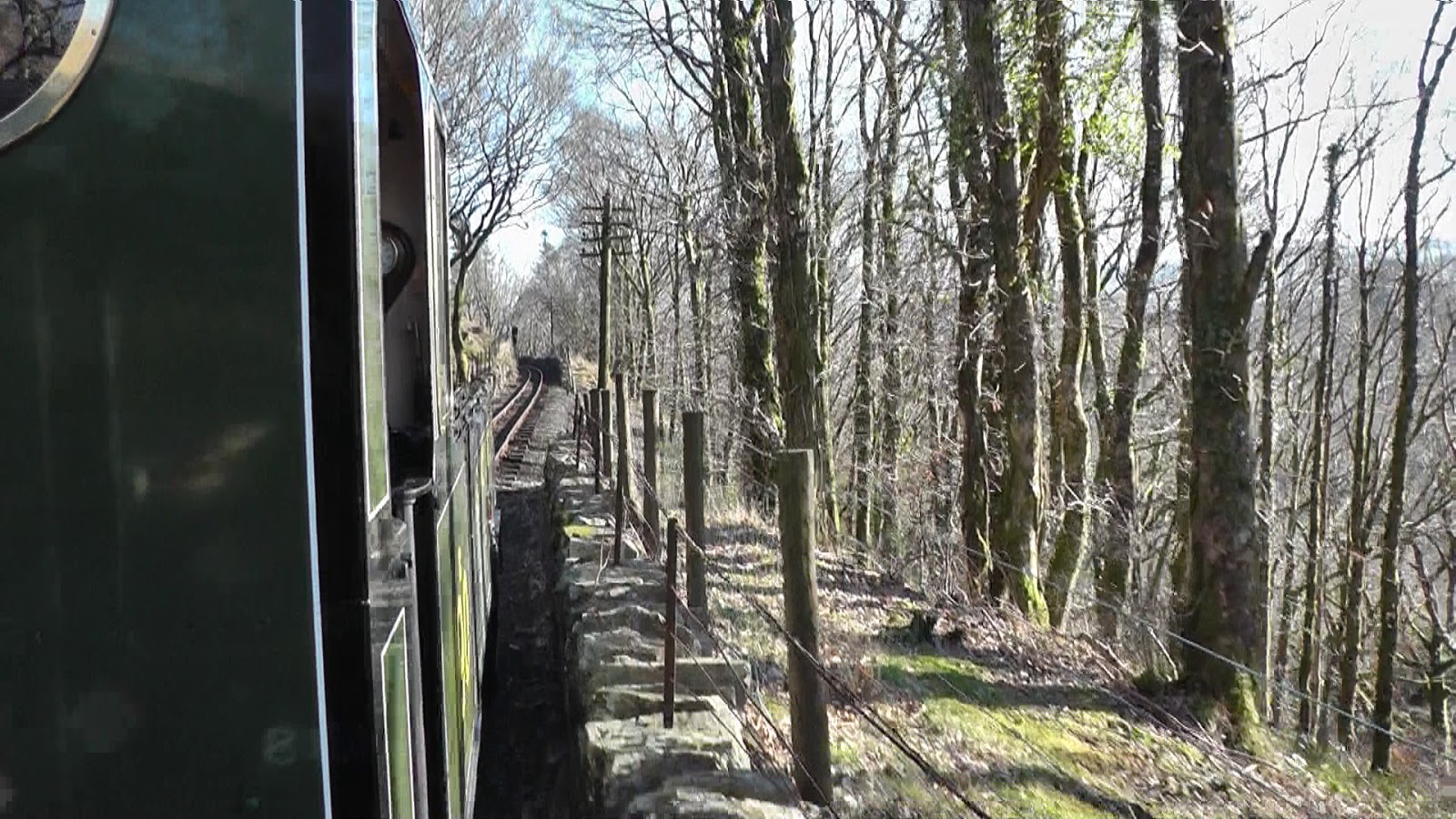
After winding our way through the woodland above the valley we shortly arrived at Penrhyndeudraeth Station. Another short stop to allow some passengers to depart and we were once more on our way.

On the platform at Minffordd were two enthusiasts of a similar age to myself. The guard sold them return tickets enabling them to travel to intermediate stations. I was put in mind of a similar negotiation which took place on this same platform 50 years previously when I was similarly issued with a hand-written ticket for a partial return journey (and somewhere in a forgotten corner, I still have that ticket).

Steaming further down the line, we passed the Boston Lodge Workshops where Lyd was conceived, born and nurtured, and then we chugged across the mile long Cob, with snow-capped Snowdon standing out in the distance.

We paused at Porthmadog Station for around 30 minutes while Lyd was fed and watered.......

..... before running around the train.

Resuming our seats we were now immediately behind the locomotive. With a throaty roar of her exhaust she pulled the heavily-laden train away and across the Cob.

After Penrhyndeudraeth we passed over Cei Mawr, the impressive stone-built embankment.

Steaming up through the woods, the engine laboured up the rising incline before rounding Whistling Curve into Tan-y-Bwlch Station where Lyd took on water once more.

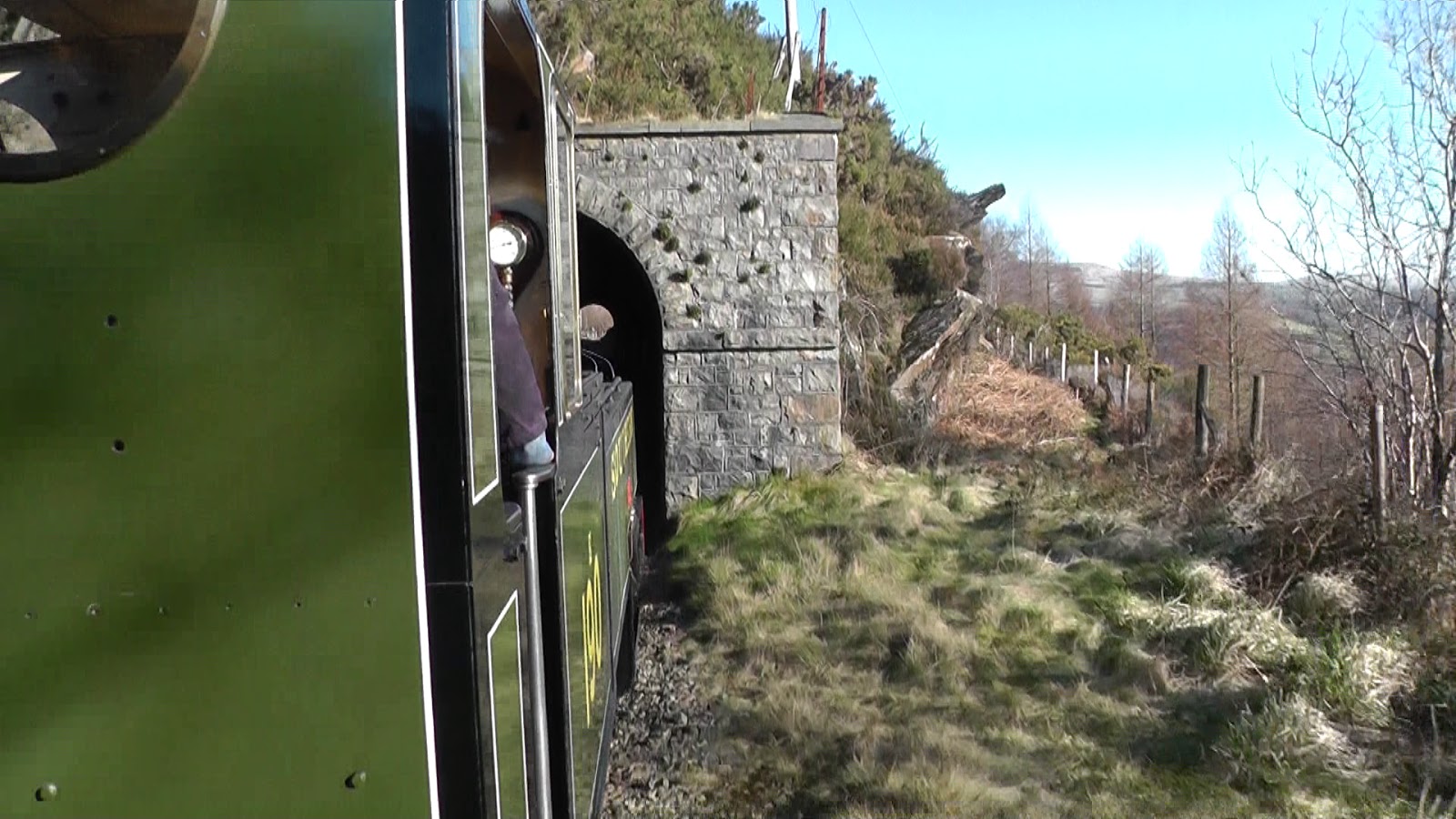
As we approached Garnedd Tunnel I was reminded (almost painfully for my camera) of the very tight loading gauge on the Ffestiniog Railway which led to the butchery of the Welsh Highland Railway locomotive Russell in early days when WHR locos ran for a while on FR metals.

After passing up the spiral at Dduallt, negotiating the new Moelwyn Tunnel and running beside Llyn Ystradau, we steamed into Tanygrisiau Station for a short pause.


In no time at all we were once more in Blaenau Ffestiniog where there was time for a few more snaps of our magnificent locomotive before we left the station to pay a visit to the Lechwedd Slate Caverns.

As indicated above, this will not be my only visit to the railway. I intend to re-visit during one of the railway's festival weekends and take some lineside shots. This railway will always hold a special fascination for me and I never cease to be impressed by its history, its tenacity and its general ambience. For some, the railway has become overly commercialised, but it seems to me that beneath the veneer, the values and soul of one of the leading pioneering volunteer-run narrow gauge railways is still very much in evidence.


Video

Monday, 14 January 2013

Lynton & Barnstaple Railway

Source: http://trainweb.org/railwest/images/stn/chelfham-1.jpg

In a nutshell

Gauge:   1' 11½"

Length: 19 miles 23 yds (0.9 miles now preserved)

Opened: 16th May 1898 (Closed 29 September 1935)

Location:


View Narrow gauge railways Britain & Ireland (closed) in a larger map Web:   


Date of visit: 13th January 2013


Key Facts

  • The railway was opened in 1898 following enthusiastic and material support from local landowner and publisher, Sir George Newnes.
  • There were three stations in Barnstaple. The Lynton & Barnstaple Railway started alongside Barnstaple Town Station which was on the L&SWR Ilfracombe branch line
  • The railway followed the contours of the countryside through which it was built and for much of its length maintained a gradient of 1:50
  • There were 6 stations (Barnstaple Town, Chelfam, Bratton Fleming, Blackmoor, Woody Bay and Lynton & Lynmouth), three halts (Snapper, Parracombe, and Caffyns) and one goods yard (Pilton) along the line.
  • There were 80 bridges over and under the line, the most spectacular of which is the 70 foot high, eight span, Chelfam viaduct which is largest narrow gauge railway structure in the British Isles.
  •  The line had three 2-6-2 Manning Wardle tank locomotives - Exe, Taw and Yeo and a Baldwin 2-4-2T locomotive, Lyn, of a similar design. A fifth Manning Wardle locomotive, Lew, was purchased in 1925.
  • The railway was absorbed into the Southern Railway in 1923 and the locomotives and rolling stock were repainted in SR livery.
  • Much of the trackbed is still in existence, the preservation society (The Lynton and Barnstaple Railway Trust) is in the process of restoring the railway and has relaid 0.9miles of track at Woody Bay. It has also purchased some key features along the line (eg Snapper Halt) and some isolated sections of the trackbed. The plan is to rebuild the majority of the railway in phases. However, four of the stations are presently in private ownership.

Route

Source: http://upload.wikimedia.org/wikipedia/commons/thumb/8/8d/L%26bmapimage.jpg/600px-L%26bmapimage.jpg

My Impressions

This was my first visit to the route of the Lynton & Barnstaple Railway and, as I was in the area for a family event I had only a half day to spare for this initial exploration.

I began my tour of the line by firstly finding the location for line's terminus beside the River Taw in Barnstaple. The station building is still in existence and currently in use as a community centre..

Source: http://www.disused-stations.org.uk/b/batnstaple_town/barnstaple_town_old(alsop9.1967)7.jpg
The yard has now become a public car park adjacent to the town's civic centre and police HQ......

.... and a block of flats has been built where the platform once stood.

Source: http://sphotos-b.ak.fbcdn.net/hphotos-ak-ash3/541715_10200209064449935_1352781858_n.jpg
Source: http://www.disused-stations.org.uk/b/batnstaple_town/barnstaple_town_old(alsop_early20thc)2.jpg

By walking across the car park, I was able to follow the route of the line is it curved to the right alongside the River Yeo, making my way towards the Braunton Bridge.....

 ...... where there was once a level crossing (the railway can be seen curving up towards the centre of this picture)
Source: http://www.explorenorthdevon.org/Images/band/BA437.jpg
Crossing the Braunton Road and looking back, the warehouse beside the wharf is still in existence.......
Source: http://www.trainweb.org/railwest/images/lc/~braunton-rd.jpg
A short walk beside the river followed by a quick a hop across Pilton Causeway (formerly Pilton Road) and I found the entrance to the Pilton Yard is still evident with the caps for the gate posts now mounted on brick pillars.

Source: http://lynton-rail.co.uk/files/images/pilton1930.jpg
As with the station, the yard is now a car park but it is possible to identify some of the features shown in some of the contemporary pictures of the railway. For example, the house-backs beside the yard......
Source: http://www.009.cd2.com/albums/lynbarn/images/16m.jpg

 .... and although the carriage and loco sheds have disappeared, the brick built offices for the original railway are still to be found. The L&B Railway Trust proposes to use these as a museum if they manage to acquire them.
Source: http://www.009.cd2.com/albums/lynbarn/images/62.jpg
With Ordnance Survey Explorer Map OL9 in hand, I returned to my car and set off up the Goodleigh Road to see which other landmarks I could identify. I was unable to find a suitable parking spot near to Snapper Halt but a little further along the road I was able to stop near to Collard Bridge.........
 ....... from which the trackbed leading back towards the site of the bridge across the River Yeo was clearly discernible.

Source: http://www.009.cd2.com/lynton_and_barnstaple_modelling/images/6m.jpg
A short drive and the impressive Chelfam viaduct loomed into view. I parked in its shadow and took a few pictures.......
Source: http://www.009.cd2.com/albums/lynbarn/images/9m.jpg

...... before following the signs and venturing up the hill to Chelfam station ...........
Source: http://www.009.cd2.com/albums/lynbarn/images/68.jpg
....... which is now owned by the L&B Community Interest Company, the trading subsidiary of the L&B Railway Trust.
Source: http://www.009.cd2.com/albums/lynbarn/images/28.jpg
I was fortunate to be treated to a tour of the building and the site by one of the volunteers, Nigel Thompson, who filled me in on the latest developments and plans for developing the line further. I was very impressed by the enthusiasm and dedication shown by this band of stalwarts in rescuing what is considered by many to be the country's most picturesque narrow gauge railway.

In the building (which will shortly be restored to its original state) are a couple of fine 4mm scale models of the the railway as it was. A representation of Lynton Station .......

.... and one which was inspired by Chelfam.........

.... and the viaduct.

In the station yard, there was plenty to see, including the original signal cabin .......

...... and an accumulation of railwayana and equipment,
Source: http://www.009.cd2.com/albums/lynbarn/images/26.jpg
...... some of which is original such as this concrete signal post which they are planning to return to its former position at the north end of the station .......

With a last tantalising glimpse of the viaduct from the station yard........
Source: http://www.009.cd2.com/albums/lynbarn/images/87.jpg
 ..... and with the sun beginning to set in the winter sky, I once more hopped into my vehicle to resume my exploration of the railway's route.

I followed the road to Bratton Fleming, where I turned off towards Rye Park to find the station which was to the north of and below the village. The station site is now privately owned but the former station yard could be seen from the overbridge ........
Source: http://www.009.cd2.com/albums/bratton/4.html
Source: http://www.009.cd2.com/albums/lynbarn/images/59.jpg
.... while to the north, the cutting now seems to house an intriguing length of contractor's track. Apparently, there was recently a private 7¼" railway here which ran a replica of a L&B loco.

 Following a tortuous single track country lane I once more encountered the trackbed for the railway near Narracott. When I had been plotting the route for the railway on Google Maps (see above) I became confused because the trackbed seemed to disappear. Eventually, the only explanation I could reach was that a present-day road had adopted the trackbed. This was confirmed when I encountered the remains of Narracott overbridge...........

........ which was  directly opposite an enticing stretch of road (Twitchen Lane - see below) which could only have been the railway.

The road wound on for a mile or so in cuttings and on embankments with plenty of concrete fencing posts on either side which I assumed dated back to the 1920s.
The last down train approaching Blackmoor on 29 Sept 1935 Source: http://www.009.cd2.com/albums/lynbarn/images/10m.jpg
Further north, the trackbed has been submerged under Wistlandpound Reservoir but for my flying visit my next port of call was the site of Blackmoor Station which now houses a restaurant.

The distinctive shape of the station building was still visible

Source: http://www.halsgrove.com/prodimages/ingdlge.gif
...... and the base of the old water tower has now been converted to a substantial shed, though the pipework is still very much in evidence. The overbridge has been removed but on the other side of the road, beside the Exmoor Park car park, the remains of the cutting can still be made out.
Source: http://www.009.cd2.com/bratton_fleming/images2/2.jpg
Source: http://www.009.cd2.com/albums/lynbarn/images/32.jpg
 I caught occasional glimpses of the railway trackbed on the road towards Parracombe and stopped off at the Rowley Cross picnic site which has been set up by the L&B Railway Trust beside the Parracombe Embankment.
Source: http://www.009.cd2.com/albums/lynbarn/images/34.jpg
If I'd had more time I would have explored Parracombe but I spent a short while at Woody Bay which was closed for the winter period. However, there was plenty on view to whet the appetite for a return visit.
Source: http://www.009.cd2.com/albums/lynbarn/images/33.jpg
Source: http://upload.wikimedia.org/wikipedia/commons/a/a6/L%26Bwoodybay.jpg
Source: http://www.009.cd2.com/albums/lynbarn/images/65.jpg
 My final destination had to be Lynton, the northern terminus for the railway. Perched on the hillside above Lynmouth,
Source: http://www.visitlyntonandlynmouth.com/sites/default/files/styles/large/public/lynton-station_0.jpg
....... the station building is now a private residence
Source: http://upload.wikimedia.org/wikipedia/commons/0/04/Lynton_%26_Lynmouth_Station_2026541_98af1955.jpg
..... and the goods shed has been converted into two cottages.
Source: http://www.oldpicturepostcards.co.uk/lyntonrailway.jpg
 The railway clearly richly deserves the reputation it has accumulated over the years and this little taster has provided me with plenty of incentive to make a return visit in the summer season when it will be possible to take a ride on the preserved section of the line at Woody Bay.
Source: http://upload.wikimedia.org/wikipedia/commons/3/31/L%26Blynton.jpg

 There is also still plenty of the trackbed which I've not yet been able to see which should be accessible from footpaths.
Source: http://www.009.cd2.com/albums/lynbarn/images/29.jpg
I will also follow with interest, developments on the preservation society's plans to extend the line which seem to be ambitious and yet realistic, given the progress they have made so far in acquiring sections of the trackbed.

For more information on the Railway Trust's proposals see - http://www.lynton-rail.co.uk/trust

By the way, all the roads I travelled along on this trip are available in Google Street View, including the stretch of railway which has now become a road (Twitchen Lane, Narracott)

View Larger Map

Click on the image and then use keyboard arrow keys to move forward, back and to rotate left or right

The site of Parracombe Halt showing the remains of the station shelter and the parapets of the bridge in the distance:

View Larger Map

Source: http://farm5.staticflickr.com/4042/4291441682_49f4425680_b.jpg
Source: http://www.009.cd2.com/lynton_and_barnstaple_modelling/images/19m.jpg
 In the meantime, I hope you find these video clips as interesting as I have done....

Videos