Search This Blog

Showing posts with label Isle of Man. Show all posts

Wednesday, 28 June 2017

Progress Report 5

Well, as you can see, it's been quite a while since I posted my previous Progress Report - over three years. I have been making visits to railway in that period but they have been less frequent. Partly, this is because the railways which I have yet to visit are now further away, having visited most of the railways which are within a day's travel of my home in Cheshire.

Since my last report in 2014, I have visited:
So, I've not exactly been idle.

Over the past eighteen months, health problems with various members of my immediate family have restricted my ability to travel far from home. We are hoping that these problems are now becoming resolved and so have plans to visit a few railways in the North East over the next few weeks and maybe take in a couple en route.

There are still plenty of railways on the list which need to be visited, scattered widely across the country from the South West (eg Seaton Tramway and Bicton) to the far North (eg the Alford Valley Railway in Aberdeenshire) and, of course, we've not yet touched any in Ireland.

At least two of the railways on the list seem to have closed but I will leave them in place just in case they are resurrected, as has happened with the Teifi Valley Railway, which is now one of the last railways to be visited on my Welsh list.

I was disappointed that I was denied access to the TwinLakes Leisure Park - because I was a lone adult male unaccompanied by children. Even when I explained that I wanted only to travel on the railway and would be happy to be chaperoned, I was told it was company policy. It does seem to be a sad reflection of our times (and especially galling as I was a primary school teacher for many years). I may have to reconsider visiting the miniature railways which are located inside other leisure parks - or maybe await the arrival of a grandchild .......... !!

Apedale Valley
I am in no mad rush (as yet) to complete my quest - I am presently around 1/3 of the way down the list.  I am still enjoying visiting parts of the country which I might otherwise have never visited ..... and we now have a small caravan, which might help ease the cost of more distant visits.

As indicated, the rate of visitations is inevitably slowing as the unvisited railways become more distant and geographically diverse. In the meantime, I have actually re-visited some of the railways and updated their entries accordingly (eg  Apedale Valley, Ffestiniog, Talyllyn).

I will keep you posted!


Wednesday, 27 August 2014

Snaefell Mountain Railway

In a nutshell

Gauge:         3' 6"

Length:        5 miles (8km)

Opened:      20 August 1895

Location:  


Isle of Man Public Transport
Banks Circus
Douglas
Isle of Man
IM1 5PT

Date of visit:     

Key Facts

  • The line runs from the interchange station with the Manx Electric Railway in Laxey to the summit of Snaefell, which is 2,034 ft (620m) above sea level 
  • It was originally intended to build the railway to a gauge of 3' (the 'standard' gauge for the island) but was eventually built to 3' 6" (1.067m) gauge to accommodate the braking system.
  • The railway uses the Fell Incline Railway System which has a centre rail for braking on steep gradients. The centre rail is not used for traction on this railway.
  • The railway is powered by 550v DC,using overhead wires with bow collectors mounted on the passenger cars.
  • The railway was built in seven months using the Isle of Man Railway's 0-6-0 locomotive Caledonia - an additional rail at 3' gauge was laid on the track for the locomotive
  • The maximum gradient is 1 in 12 - the Fell System is now used only for emergency braking, a rheostat braking system having been installed in all cars 1979.
  • A power station was constructed just below Bungalow Station, half way along the line to minimise voltage drop on the overhead wires. When it was built, the power station was the most powerful on the island.
  • When the railway as opened in 1895 its lower terminus was beside the tramsheds on the approach to Laxey. The line was extended in 1897 to a new terminus opposite Dumbells Row and then again in 1898 to its present location beside the Manx Electric Railway.
  • The line was taken over by the Manx Electric Railway in 1902 and nationalised in 1957
  • The railway has six tramcars which were all constructed in 1895 for the opening of the line. These six cars still provide transportation on the line, though they have been remotored over the years.
  • A hotel was constructed at the summit when the line opened in 1895, it was rebuilt in 1907 and burnt down in 1982. It was reopened as a cafe two years later and then refurbished in 2011. As there is no water supply at the summit, a bowser is attached to the first train of the day to supply the cafe with water.

Route

My Impressions

 We arrived from Douglas on the Manx Electric Railway (MER) on the trailer pulled by Car No. 20 and boarded our car (No.1) for Snaefell at Laxey Interchange Station. Car No. 1 was extensively rebuilt in 2011 and repainted in the original Prussian blue colour scheme with the original wording of Snaefell Mountain Tramway.

 While we were waiting, Car No. 6 departed. This sports the default livery for the line. The car, along with its five predecessors was built in for the railway's opening in 1895. Windows and clerestories were fitted the following year. The rheostatic braking gear on the roof was fitted to all cars in 1979 which makes the Fell centre rail braking system redundant, except for emergencies.

We set off up the line with most of the windows fully dropped as we were experiencing a heat wave during this part of August.

 Shortly after leaving Laxey and passing the tram sheds, the car stopped for a few minutes to allow we passengers to take pictures of the Great Laxey Wheel across the valley. The undergrowth appears to have been cleared at this point specifically to promote this view.

At around the halfway point up the line we could see the remains of the upper section of the Laxey Mines, which, at its peak, was part of the most productive mining system in the UK. It was also at this point that the line's original power station was located.

 After passing Bungalow Station beside the TT race track, the track spirals around the mountain, giving 360 degree views down around the island. Had there not been haze in the distance it would have been possible to have seen the coastlines of England, Scotland, Wales and Northern Ireland.

At the summit, we had around forty minutes to take in the views and sample the coffee and snacks on the cafe.

 I spent the majority of the time watching the train movements at the summit.

Given that the trackwork is minimalistic - with an interesting single switch blade point providing access to Up and Down tracks - the tramcars were juggled on the siding which was just sufficient in length to accommodate two tramcars.

 Eventually, we took our seats aboard Car No. 6 for the descent.

 Just past Bungalow Station we were given a fine view of the summit, before winding down the Laxey River Valley back towards the town.

On reaching the Interchange Station at Laxey, there was an opportunity to indulge in some tram spotting.

 Here we see Car No.1 arriving from the summit. The Up and Down MER lines can be seen to the right of the car heading off in the direction of Ramsey and the green Laxey Blacksmith's shed can be seen in the middle distance. This is where some of the MER vans are being restored and the Great Laxey Mine Railway's replica tub wagons were constructed.

Car No. 4 arrived and departed during this period. Car No. 4 was the last car to carry the green nationalised colour scheme which was given to the entire fleet in 1958. It was repainted in its present livery in 1963.

 Car No. 5 is the only car to show the railway's name in Manx Gaelic. It was extensively rebuilt after being gutted by fire in 1970. Whilst at the summit station there was a short-circuit under the floor which caused the fire which rapidly spread to the superstructure. It was initially thought that the short circuit was caused by the advertising boards which used to be mounted on the roofs of all the tramcars which made them rock from side to side in high winds and thereby lose contact with the overhead wires. However, it was later attributed to the practice of swapping power trucks between this car and Car No.7. When she was rebuilt to re-enter service in 1971, Car No. 5 was not given a clerestory and was initially fitted with aluminium bus-type windows. These were later removed and replaced with replicas of the original windows. The car does retain its cushioned bench seating, however; the only car on the line to have this added level of comfort.

 Until my travels on the MER and the Snaefell Mountain Railway, I had never been particularly interested in trams - much preferring the sights, sounds and smells of steam locomotives. I must confess to being won over by these magnificent vehicles. These two systems run their original Victorian stock with only the power systems having been modified and thereby give an insight as to how this form of transportation has evolved. I am still in awe of the power of electric motors - the cars handling full loads up the 1:12 inclines with apparent ease. I found the staff on the railway to be extremely helpful, providing an interesting commentary on the journey comprising a mix of anecdotes and factual information. There was clearly a blend of pride and affection in the mix which is quite understandable given the unique nature of this form of transportation.


Video

[In preparation] 


Friday, 22 August 2014

Douglas Bay Horse Tramway

In a nutshell

Gauge:          3'

Length:        1.6 miles (2.6km)

Opened:       1876

Location and route


Tramways Office, 
Strathallan Crescent, 
Douglas, 
IM2 4NR.


Web:     http://www.douglas.gov.im/index.php/leisure/horse-trams#.U_OvomM09rs  
Email:  enquiries@douglas.gov.im

Date of visit:     22-26 July 2014

Key Facts

  • The tramway is the oldest horse drawn tramway in the world and is unique in the northern hemisphere
  • The tramway has been run continuously since it opened, apart from during World War II
  • The tramway possesses 45 horses and 21 tramcars of which 14 are operational at present - the rest are in storage or on display in the museum at Jurby
  • Thomas Lightfoot, a retired civil engineer, was responsible for setting-up the railway in 1876
  • In 1882, Lightfoot sold the line to Isle of Man Tramways Ltd which owned the Manx Electric Railway. 
  • When the company went into liquidation in 1900 the tramway was sold to Douglas Borough Council
  • In 1927 it was decided to run the tramway only in the summer
  • The horses complete only three return journeys each day before being changed at the stables which are on the promenade near Derby Castle.
  • The journey from one end of the promenade to the other (1.6 miles) takes around 20 minutes
  • There are various request stops along the route
  • There is a flat fare of £3.00 for the journey

My Impressions

During my week-long stay at a seafront hotel in Douglas, my contact with the tramway was continuous - it was impossible to avoid seeing the tramcars as they plied their trade along the promenade. This account is therefore an aggregation of my various encounters with the trams, horses and personnel over the space of that week.

The tramway runs as a double track along the centre of the road on the promenade in Douglas. There is a terminus beside the seaport terminal in the harbour where there is a crossover to enable the tramcars to change tracks.
Tram 43 pulled by Rocky approaching the seaport terminus
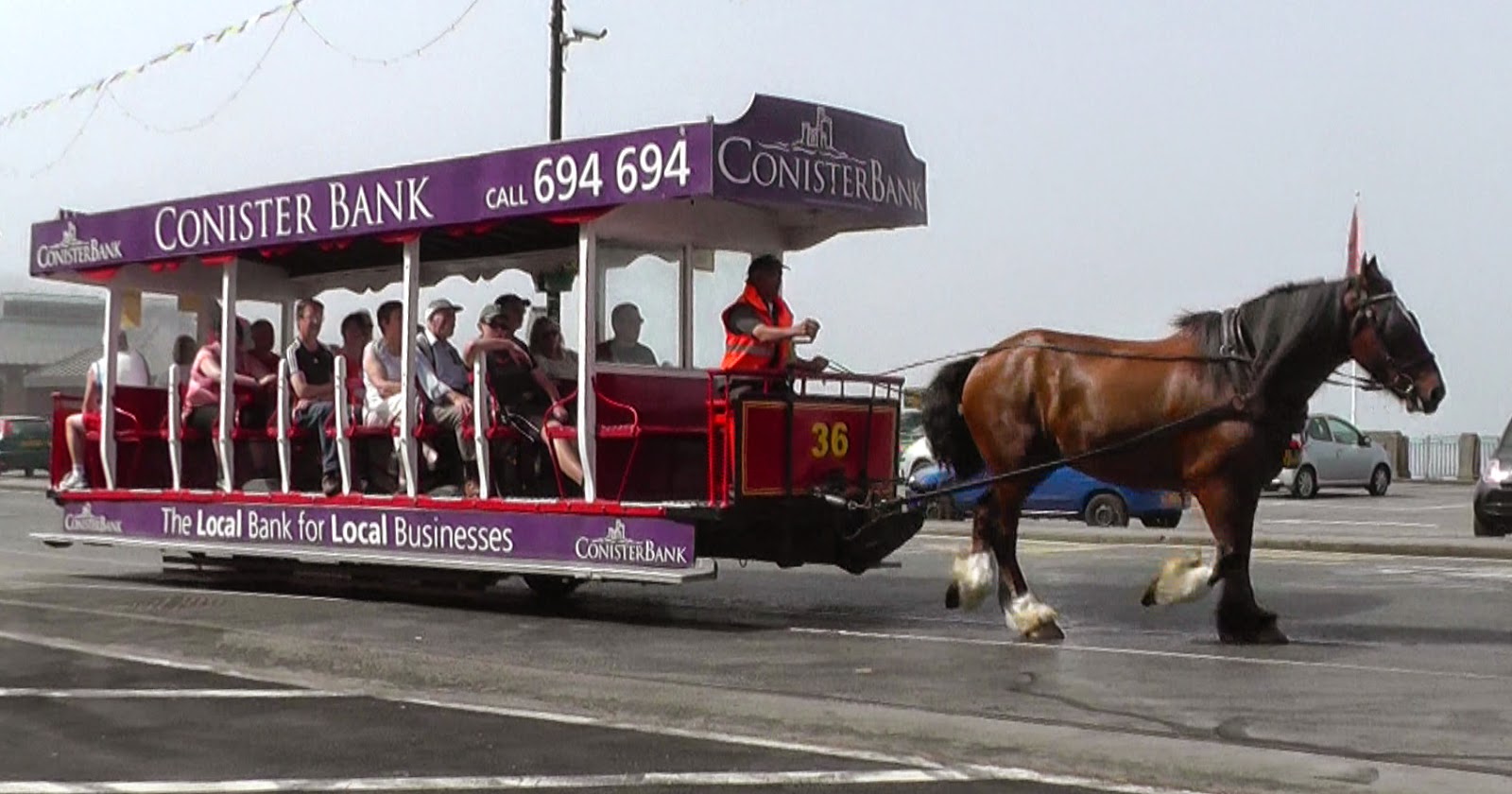
Tramcar 36 arriving at the crossover at the terminus
Car 43 and Rocky negotiating the crossover
Car 43 and Rocky setting out on the return journey up the Promenade
 At various places along the from there are request tram stops where passengers can alight and board the tram, making the tram an ideal form of transportation for guests in the hotels.
Car 43 and Amby picking up passengers outside the Palace Hotel

 The traffic passes by on either side of the tramcars and at times the traffic can be quite heavy.

 The horses seem to be quite immune to the traffic flow around them and trot at a steady pace along the front.

The stables for the tramway horses is located about a mile away from the seaport terminal behind one of the seafront buildings.

The horses are changed after three return journeys and I noticed that the horses seem to be well aware of this practice and come to a halt outside the stables without prompting once their daily tour of duty has come to an end.

At the northern end of the promenade, the terminus at Derby Castle is where the tramcars are stored

 and there is an exchange station for the Manx Electric Railway. The two systems seem to be co-ordinated in that on every occasion I was at the terminus the arrival and departure of the electric and horse drawn trams seemed to coincide.

At the terminus the horses run-round the trams and although they are led, they seem to require very little encouragement to perform the manoeuvre.

The tramcar and horse then set off on the journey back down the seafront to the Seaport terminus

 During the week, the same two tramcars appeared to be on duty continuously, but on the Saturday, the last day of my stay on the island, an open topped tramcar (No. 21) was brought into service. Ironically, the weather was overcast that day whereas there had been glorious sunshine during the rest of the week.

Although there were plans to electrify the route in the early days of the tramway, it is probably to its advantage that these never came to fruition. The horsedrawn tramway seems to be a natural part of the seafront and entirely in keeping with the architecture and pace of life on the island. The horses all appear to be well cared-for and even have a retirement home in the countryside just outside Douglas.

There is only one other functioning horsedrawn tramway which is in Australia and so it is gratifying that his once common form of transportation has been preserved. While for me, nothing quite lives up to the smell of hot oil, coal smoke and steam - this tramway has a unique charm which I am glad I have experienced.

Video

[In preparation] 


Tuesday, 19 August 2014

Manx Electric Railway

In a nutshell

Gauge:         3'

Length:       17 miles (27.4 km)

Opened:      1893 - Douglas to Groudle Glen
                     1894 - Groudle to Laxey
                     1898 - Laxey to Ballure
                     1899 - Ballure to Ramsey

Location:   


Dates of visits:     23, 24, 26 July 2014


Key Facts

  •  The railway possesses the two oldest operational tramcars in the world and is noted for its continued use of its original Victorian and Edwardian rolling stock.
  • In 1892, permission was granted by the Island's government, the Tynwald, to construct an estate above Groudle Glen provided it was connected to Douglas by a roadway. 
  • Final permission was granted with the condition that the roadway was equipped with a tramway to be operated by animal, steam, electric, or any other power
  • Construction commenced in Spring 1893 and completed in September when the first tram ran. Within 17 days the railway had carried 20 000 passengers at a fare of 3d (1.25p)
  • It was decided that the motive power would be electricity and the construction of the tramway was placed in the hands of Mather and Platt of Salford.
  • A power station was built at the northern end of Douglas (now Derby Castle) alongside the railway's tramcar depot
  • Initially, a single line was provided on the seaward side of the road. 
  • The line was doubled and extended to Laxey in 1894. Its terminus being where the tram sheds are sited today.
  • In the Spring of 1898 the railway was extended to the site of its present station in Laxey after completion of the curved viaduct above the Glen Roy River.
  • With two gangs working on the extension to Ramsey (one from the north and the other from the south) the line was opened as far as Ballure in August 1898 and then to Ramsey in July 1899.
  • After periods of success and decline in the inter-war period the railway was in a poor state of repair by 1955 when the MER company felt unable to continue running the railway. It was sold and nationalised in 1957.
  • A steady period of refurbishment continued until the MER was merged with the nationalised Isle of Man Railway in 1978
  • The majority of services are now operated by a Motor car and a Trailer, with some single-Motor operations during periods of low demand. 
  • The ‘Winter Saloons’, Nos.19, 20, 21, and 22. are mainly used for passenger services with ‘Tunnel Cars’, Nos. 5, 6, 7 and 9 used when demand increases. The ‘Crossbench’ cars Nos. 32 and No.33 are used during the Summer months together with ‘Paddlebox’ car No.16. 
  • Enclosed Trailers Nos 57, 58 and 59, and 60 are used when the weather deteriorates and Trailer No.56 is used for disabled passengers.
  • The railway is usually operations from March to November. 
  • During the summer the railway usually has 4 to 5 sets working from Derby Castle to Ramsey, with one set stopping over at Laxey during the day. 
  • The busiest period for the MER each year is during the Isle of Man T.T Period (the end of May to the start of June) when all available tram-sets are in use.

Route


My Impressions

During my week-long stay on the island, I travelled on the MER five times, once for pleasure and the other occasions as a means of transport (and also of course for pleasure - I could have taken the bus).

My first encounter with the tramway was as a means of transportation from Douglas to Groudle Glen to enable me to travel on the Groudle Glen Railway during their midweek open evening event. My arrival at the Derby Castle terminus on the north end of the Douglas promenade coincided with the arrival of MER tramcar no. 7 which was part of the second batch of tramcars delivered in 1894, and known as 'Tunnel Cars' because their seating was longitudinal giving the inside of the car a tunnel-like appearance. The original seating was replaced with the more conventional reversible transverse style of seating when the tramcar was restored in 2010.

 We boarded the tram ......

..... and took our seats as the motor car took off smartly up the incline towards Onchan Head .......

 ...... passing the tramcar sheds of the line's main depot on the way.

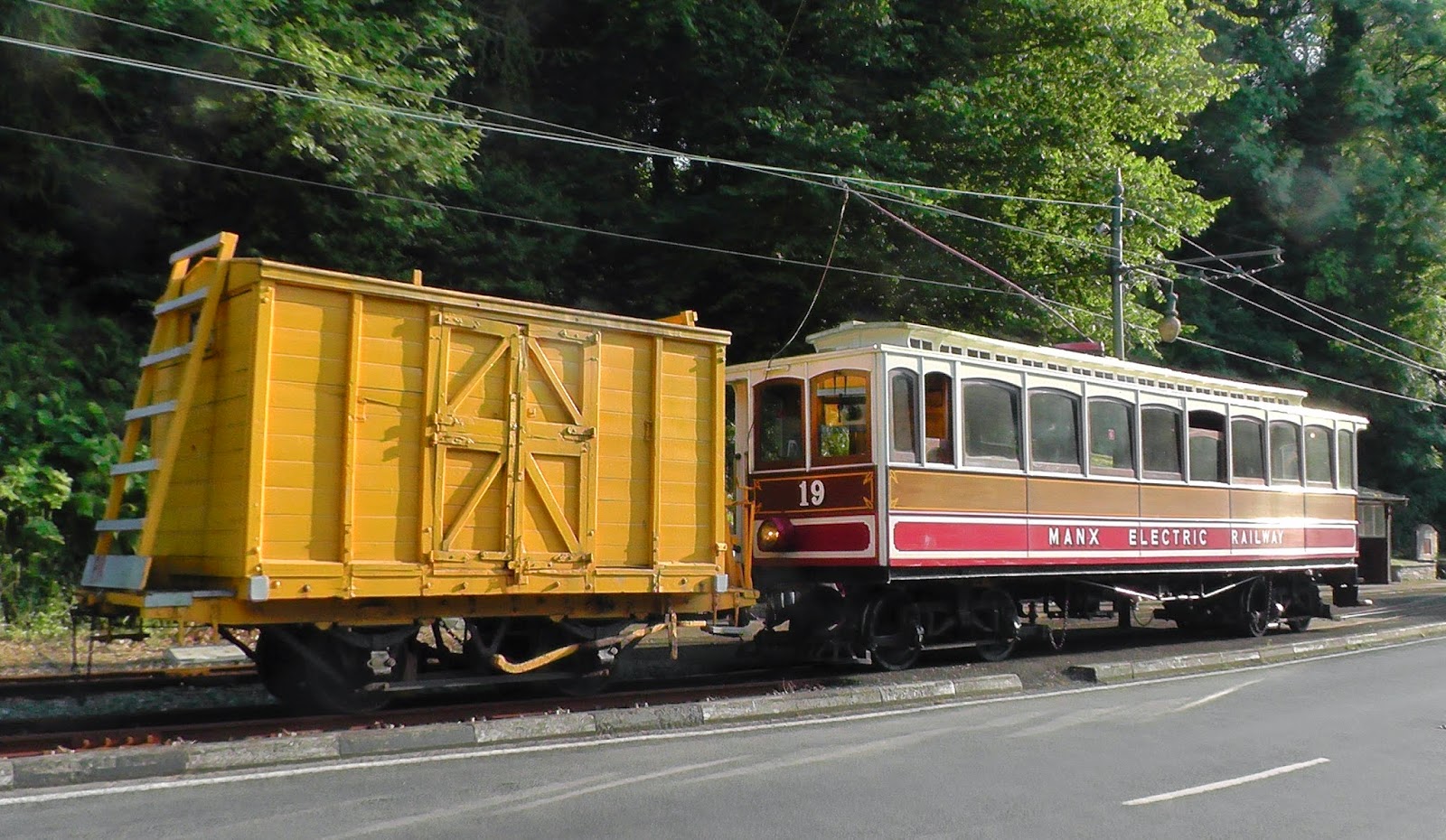
 Before long we arrived at Groudle, where 'Winter Saloon' No. 19 (built in 1899) was waiting on the Up line with one of the line's vans in tow (Van No.12 built in 1898-9)

 No. 7 departed on its way to Laxey ........

..... only to provide our transportation for the return journey 2½ hours later. As the sun set behind Douglas we made our descent from Onchan Head back towards the terminus.

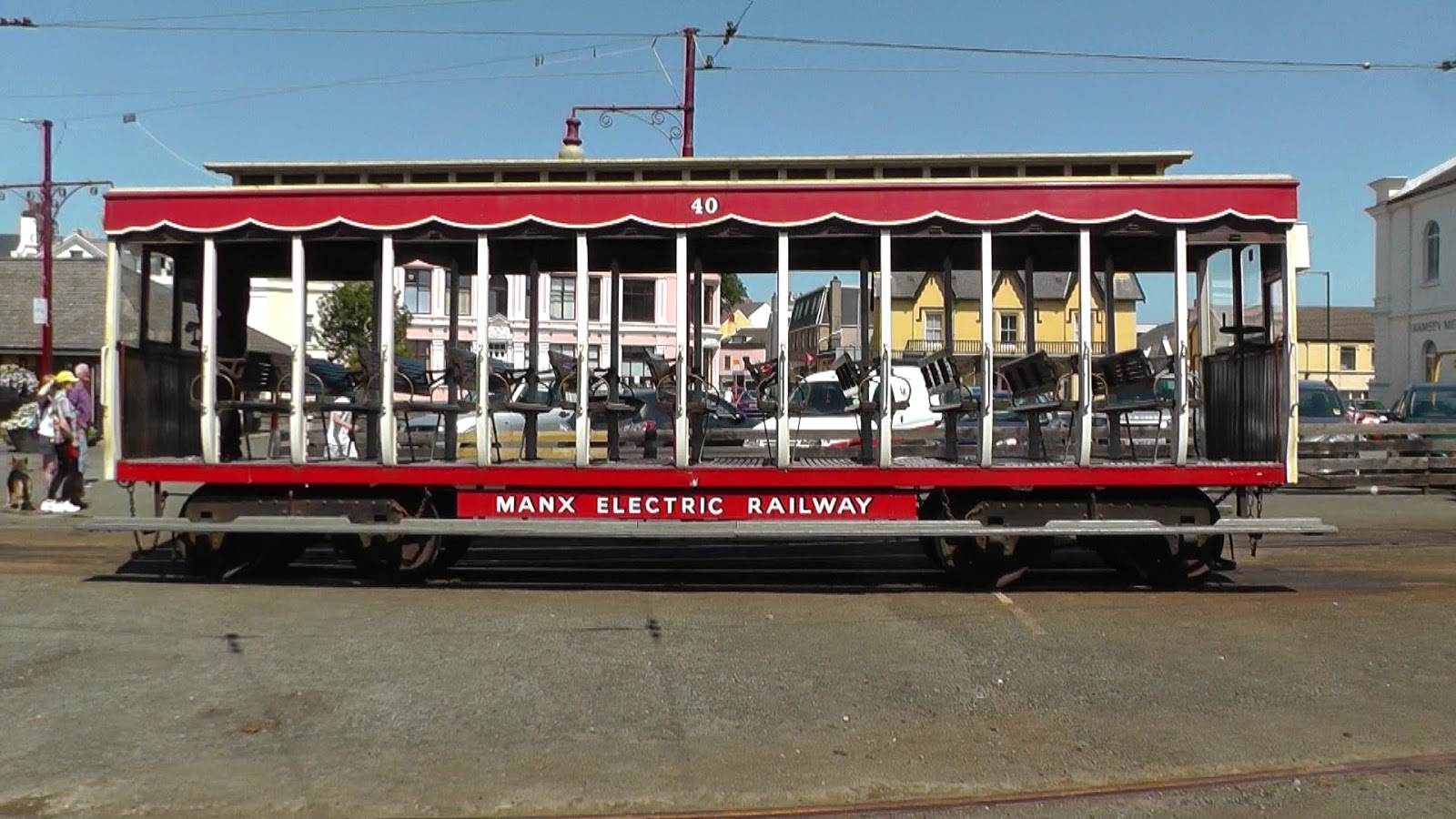
My second trip on the MER was the following day, as part of an organised trip from Douglas to Laxey (and thence on to the Snaefell Mountain Railway). Our transportation for the journey turned out to be another Winter Saloon, No. 20 with a trailer No. 40, which dates from 1930.

Our reserved seats were aboard the trailer car which we boarded, ready for the off.

Even with a fully laden trailer, the motor car had no hesitation in climbing the 1:20 gradient towards Onchan Head.

 On this occasion we passed the stop at Groudle and then negotiated the viaduct over Groudle Glen which includes the sharpest curves on the railway at each end.

 It became apparent why it is called a railway on the approach to Laxey as the railway separated from the road and struck out across the fields .......

..... and passed one of the halts on the railway at Baldrine.

Before long, we crossed the Glen Roy viaduct .......

.... and pulled into Laxey .......

..... where we disembarked.

Before and after travelling to the summit of Snaefell, there was an opportunity to do a bit of tram-spotting at Laxey. Waiting on the Up line was Tunnel car No. 6 with its modified front windscreen, pulling 1930 trailer No. 41.

A little later, 1899 Winter Saloon No. 22 passed through on the Down line.

In 1990, the overheating of a resistor caused Car 22 to catch fire and its bodywork was largely destroyed . A replica body was constructed in 1991 and, it returned to service in 1992. Although the new body matches the original, it now has slightly different headlights and sports a P.A system.

En route to the car park I espied three MER vans being restored in the blacksmith's yard (the blacksmith can just be seen under the green wagon, No. 16 which was built by the MER in 1908 and was used as a mail van. The sister van to No. 12 (above) was also looking resplendent in her restored condition. It's assumed that under the tarpaulin was van No. 3, awaiting its turn for restoration by the Laxey and Lonan Heritage Trust.


My next encounter with the MER was at Ramsey. Rather than taking the tram, our organised trip took us by coach to Ramsey where we had an hour or so to take in the sights (had I known I'd have taken the tram and met them there). I made my way immediately to the tram station to watch the comings and goings.

First to arrive was our transportation for the trip to Laxey; motor car No. 20 with trailer No. 40. After disgorging its passengers, the trailer was uncoupled from the motor car .......

.... and the motor car pulled forward. It then reversed over the crossover on to the Up line.

The brakes were then released on the trailer car .......

........ and it was allowed to roll forward over the crossover.

The motor car was then recoupled to the trailer and shortly afterwards departed. Winter Saloon No. 22 arrived shortly before Car 20 departed and as it was trailer-less was reversed without complication.

My penultimate encounter with the MER was on Saturday 26 July. I had decided to stay on an extra night beyond the allocated time for the organised trip to enable me to visit the Great Laxey Mine Railway which runs only at weekends as it is staffed solely by volunteers.

My transportation for the trip from Douglas to Laxey on this occasion was Winter Saloon No. 19 with trailer No. 40.


Before departure, I took a few shots inside the car to show the driver's compartment .....

...... and pressure gauges for the braking system,

 .... some detailing on the sides of the reversible seating, .......

...... the interior of the passenger compartment, ..........

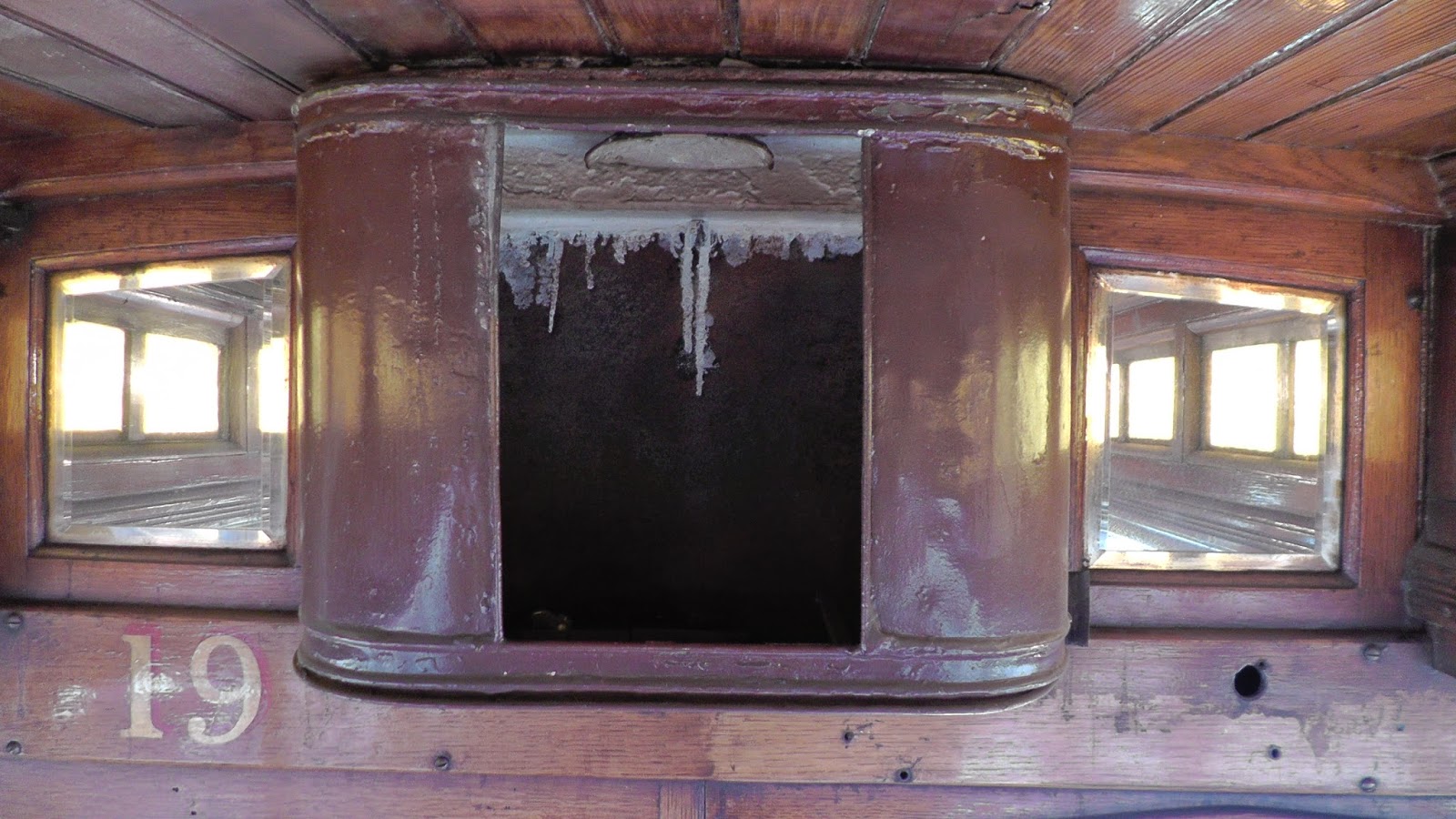
...... what I assumed to be the enclosure for some sort of emergency lighting system, .......

 .... and a light fitting which seemed to show some sense of economy by sharing the lighting in the passenger compartment with the driver's compartment.

The journey to Laxey was uneventful but when we arrived at Laxey there was an opportunity for a fine shot of the motor car alongside two of the Snaefell Mountain trams before it departed

 As the tram and trailer traversed the end of the valley it became visible once more on the other side as it started its ascent towards Ramsey.

 Meanwhile, Tunnel Car No.5 was preparing to depart for Douglas. This was the first of the Tunnel Cars to have its bench seating replaced by the more conventional transverse reversible seating - which happened during its refurbishment in 1932. In 1969, its double front windows were replaced with with a single window (as with No. 6 above)

After visiting the Great Laxey Mine Railway I saw my transportation for the return journey arriving; car 20 with trailer 41 in tow.

 I made my way to the tram station and boarded the trailer car to make my way back to Douglas

 There was an opportunity to catch a last glimpse of the headland above Laxey ......

...... before we passed Car 19 on one of the level crossings. At first, I couldn't understand why our car had stopped in the middle of the crossing, but when Car 19 and its trailer arrived I realised that our car was holding the traffic until the other car had passed. Some motorists may have assumed that once our car had cleared the crossing it would be safe to proceed, not realising another car was approaching.

After passing through Groudle, we were given a view across the cliffs to the Groudle Glen Railway terminus at Sea Lion Cliffs.

We then descended back towards Douglas, passing the tramcar depot at Derby Castle shortly before reaching the terminus.

Before making my way to the ferry terminal, I took a short walk back up to the tram depot where I could just see the two original tramcars. No.1 entered service in 1893 and is in the Guinness Book of Records as the oldest operational electric tramcar in the World.

Its sister, tramcar No.2 (also of 1893), was also evident - both being prepared for an outing the following day.

Also peeping out from its shed was open 'Crossbench' car 33 which was the last motor car to be delivered to the railway in 1906.

Until my visit to the MER, I was not a great fan of tramways - preferring steam motive power for its atmosphere and nostalgia. However, to see tramcars in their original state, still running on their original trackbed has been a real treat and a great eye-opener for me. It's clear why electricity was chosen as the power source for this steeply graded line as the tramcars tackle the gradients with alacrity. The railway runs a regular and efficient service and as the railway hugs the coastline for much of its length, the views are spectacular. I found all the staff I met to be helpful and proud of their part in keeping the railway operational.

What a great way to travel around the island!

Video

[In preparation]