In a nutshell
Gauge: 18"
Length: ½ mile
Opened: 1883 (Standard gauge branch opened)
1967 (Standard gauge branch closed)
1985 (Narrow gauge railway opened)
Location:
Date of visit: 24 August 2014
Key Facts
- The railway is built on the site of a branch line to Middleton Quarry from the junction with the Cromford and High Peak Railway at Steeplehouse. The line was known locally as the 'Killer Branch' after the surname of the brothers who owned the quarry
- The Cromford and High Peak Railway was constructed in 1831 to to carry minerals and goods between the Cromford Canal wharf and the Peak Forest Canal at Whaley Bridge
- The first part of the 'Killer' branch, which is now the mainline for the Steeple Grange Light Railway, has a gradient of 1:27
- There is also has a short branch leading to the limestone quarry adjacent to the station
- A gauge of 18" was chosen to provider more variety than the more usual gauge of 2' for preserved and heritage narrow gauge industrial railways
- The railway presently possesses sixteen former industrial locomotives
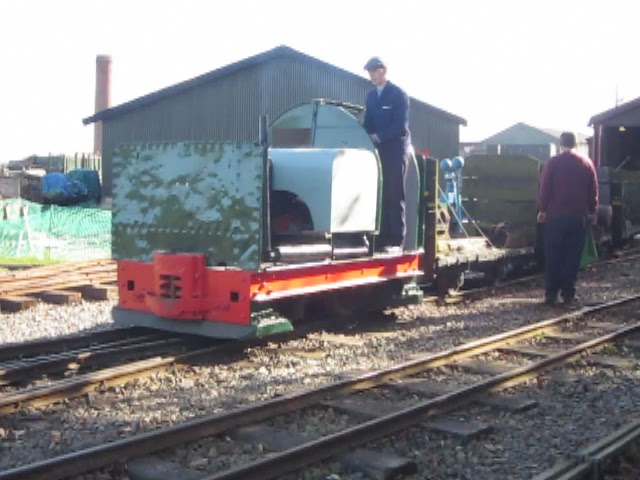
- The Greenwood and Batley battery electric locomotive, Greenbat, is the mainstay of motive power on the railway
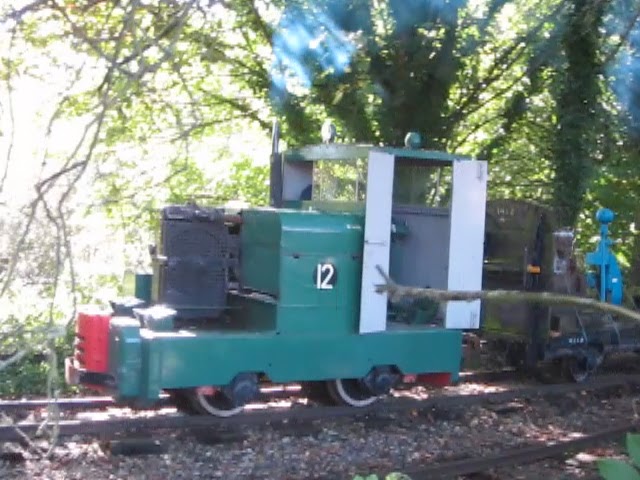
- For passenger dutues, the railway also often uses a Ruston Hornsby diesel locomotive named Horwich after the BR locomotive works where she was based. She is the only surviving 18" gauge Ruston Hornsby diesel and is now in lined BR green livery
- The line also possesses several passenger and goods vehicles in various stages of restoration
- There are plans for the railway to be extended for another ½ mile to Middleton quarry. There is also a possibility that a branch could be laid to the National Stone Centre and Ecclesbourne Railway
- The railway is open between midday and 5pm on Sundays and Bank Holidays from Easter Saturday to the end of September and on Saturdays in July and August. The line is also open on some days during the Autumn Half Term holiday.
- Hot drinks and some light refreshments are available at the main station.
Route
My Impressions
When we arrived at the railway we found the main terminus to be a modest affair but nonetheless a hive of activity. On the mainline, Greenbat was quietly ticking over - which I found intriguing for a battery electric locomotive - and its single manrider coach was awaiting its first passengers of the day.
In one of the sidings, the anatomy of a Simplex diesel was being discussed and analysed,

..... and one of the line's Clayton battery electrics, Peggy, was parked, ready for action later in the day,

.... and another Clayton, Peter, was awaiting its first passengers on the railway's branchline which runs beside and parallel with the Cromford and High Peak Trail.

Another mainstay of the line's passenger motive power, the Ruston Hornsby, Horwich, was also pottering about.

After buying our modestly priced ticket (for both the mainline and the branchline), we stepped aboard the manrider on the mainline and without further ado, set off towards the 1:27 incline.
We passed the railway's lower stock sheds situated immediately behind the main station building, where another Lister was poised and ready for action - presumably when demand rose later in the afternoon.


The sheds are served by an interesting-looking traverser which appears to have been tailor-made onsite.

Further up the line, we passed beneath one of the railway's overbridges,

..... which is also used for stock storage. Some fascinating items of rolling stock were evident suggesting the railway would be able to run a range of passenger and goods trains on gala days.

Just beyond the bridge was another set of sidings leading to a stock shed. I found the frogless turnout to be fascinating and worthy of being modelled, particularly if my plans for a large scale indoor narrow gauge layout ever come to fruition.

Rounding a shallow curve and Killer's Dale Halt hove into view. As we were the only passengers on the first run of the day there were no requests for stopping and we pressed on up the incline.

Just beyond another overbridge .....

we came to Recreation Ground Halt. Again, we didn't stop.

A little further down the line (but up the gradient) we came to a passing loop and shortly beyond this .......

....... we reached the road leading to the quarry.

With the guard suitably positioned to warn approaching drivers, we passed over the level crossing and ........

....... soon reached the current end of the line. As can be seen, the existing trackbed is somewhat higher than the original (since the road crossing was installed) and the railway company is presently seeking additional funds (and foundations) to extend the line to the eventual quarry terminus.
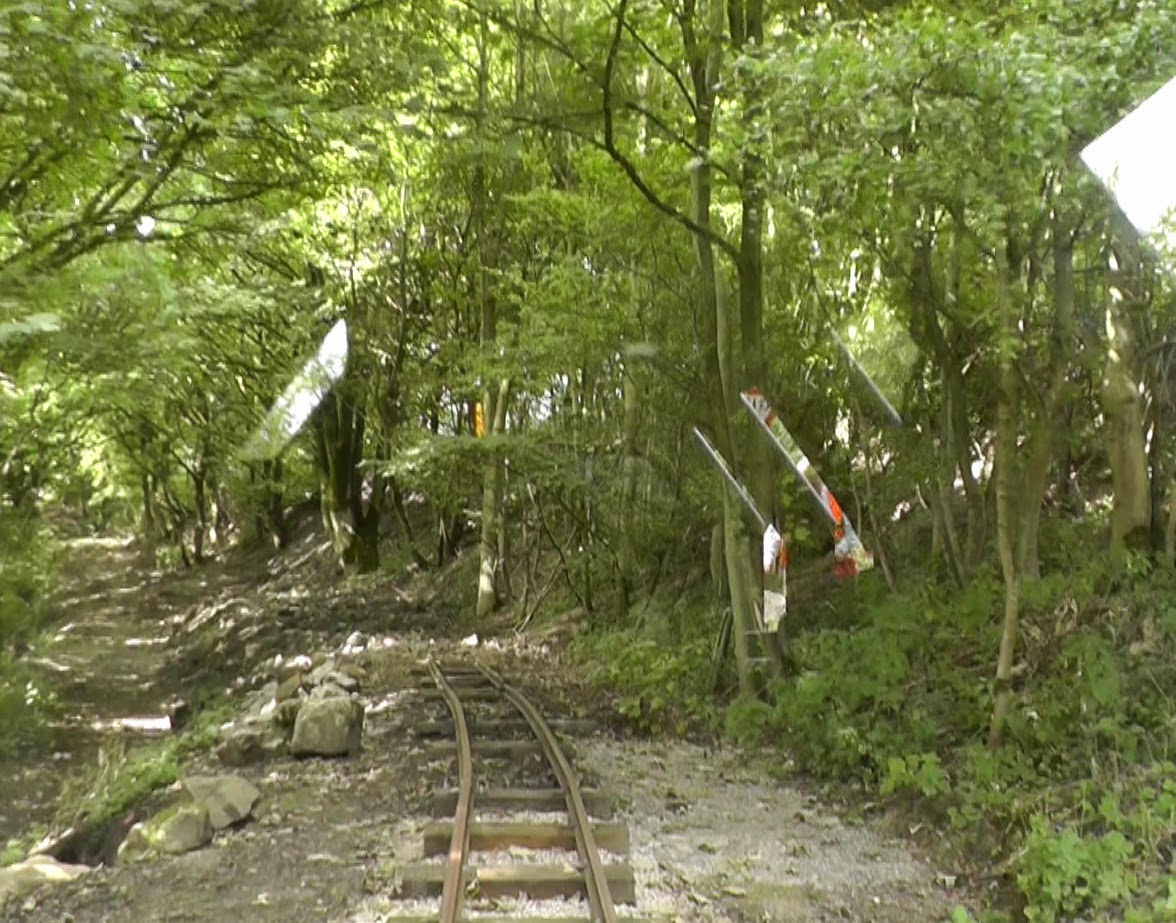
After watching our train re-cross the road ........

.... we boarded once more for the descent. Across the passing loop ......

..... and back to the main station, where more passengers were waiting.

We used the other half of our combined ticket to board the branchline train to the limestone quarry.

The short trip took us into the heart of the once thriving quarry ........

.... where our driver gave us a very informative and illustrated talk about the geology, history and technology of the quarry, its stone and its workings.

Not only were the fossils in the limestone highlighted, their origins were explained - including how iron pyrites (Fool's Gold) came to be formed.

We then re-boarded our train for the return journey......


The members of the society which operates the railway are clearly accumulating a considerable store of 18" rolling stock to populate the line and also to preserve what remains of this aspect of our industrial heritage. The rolling stock is all in very good condition and as such is a credit to the dedication of the volunteers who must devote much of their spare time to working on the railway and maintaining and restoring its collection. It looks as if the railway has steadily grown in size and scope since it was established around thirty years ago and it also looks to have a secure future, with not just one but two proposals on the books for extensions. The personnel I met on my visit were extremely helpful and very obliging - I felt I'd almost become one of the extended family during my visit. The fare was well worth paying to enjoy the experience and also to gain a well informed insight into the operation of this type of stock and its infrastructure.
Video