 In a nutshell
Gauge: 3'
Length: Originally approx. 46 miles - now 15.3 miles
Opened: 1873 (Peel line)
1874 (Port Erin line)
1879 (Manx Northern line)
1885 (Foxdale branch)
Location:
Dates of visits: 22 and 25 July 2014
Key Facts
- The 'standard' gauge for the island was set at three foot when the railways were first planned in the 1870s.
- The first railway opened ran from Douglas to Peel (1873) which boasted a flourishing fishing port
- The second line to open was the one from Douglas to Castletown (1874). This was quickly extended to Port Erin to serve the recently completed deep water harbour. The harbour was destroyed by a storm in 1884.
- The Manx Northern Railway built a further line from St John's on the Douglas to Peel railway in 1879. This was never entirely successful owing initially to competition from the Manx Electric Railway and later from road transport.
- A further branchline was opened from St Johns to Foxdale in 1885. This was primarily to serve the lead mines, but again was never entirely successful. This line was taken over by the IMR in 1904.
- In its heyday, the railways operated five trains each way per day - with additional services added on holidays and special occasions.
- The railway had sixteen steam locomotives - mostly built to a similar 2-4-0 design by Beyer Peacock. Two of the original MNR locomotives were constructed by Sharp Stewart, but these were scrapped when the MNR was absorbed by the IMR. A Dubs & Co 0-6-0 locomotive (Caledonia) was purchased by the Manx Northern Railway in 1885 to handle the mineral traffic on the steeply graded Foxdale Branch. This is still very much in use (see below).
- When the County Donegal Railway closed in the early 1960s, the railway bought two of their most modern diesel railcars
- At its height, the railway possessed up to 115 passenger coaches - of which around 30 remain (with 18 in service) - and around 175 items of goods rolling stock (open wagons, flat wagons, vans, a well wagon and two mobile cranes).
- The Peel, Foxdale and Ramsey lines ceased operation in 1971 and the track was lifted in 1975. In 1975, train services ran only from Port Erin to Castletown. Running was extended to Ballasalla in 1976 and finally returned to Douglas in 1977 after much lobbying of the island's parliament.
- Services now run regularly in the summer months to and from Douglas and Port Erin, and the railway infrastructure has been steadily improved since the 1970s.
- There are currently five steam locomotives in service on the railway No. 4 Loch, No. 8 Fenella, No. 10 G. H. Wood, No. 12 Hutchinson and MNR No. 4 Caledonia. Loco No. 13 Kissack is awaiting a new boiler.
- Loco No. 11 Maitland is being rebuilt and locos No. 6 Peveril and No. 16 Mannin are on display in the museum at Port Erin.
- The railway also possesses three diesel locomotives; No 17 Viking (Schoma - under repair), No. 18 Ailsa (Hunslet, used originally for construction of the Channel Tunnel), No. 21 unnamed and currently on trial, plus two Simplex locomotives and two Wickham permenant way railcars. The former Donegal Railcars are presently being restored.
- The two terminus station are well equipped with very good cafés where a good range of refreshments can be purchased. I can thoroughly recommend the vegetarian Lasagne which I had at Douglas Station and the Manx Cheese sandwich which I had at Port Erin.
Route
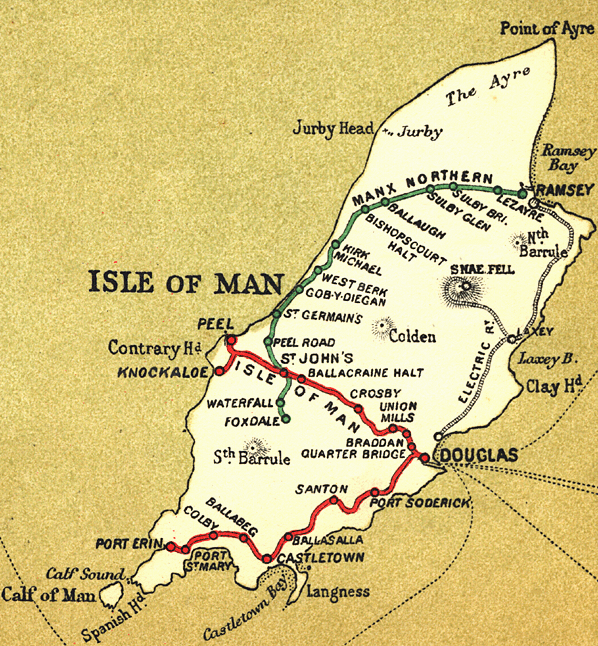 |
| Isle of Man Railways - Source: http://www.disused-stations.org.uk/i/isle_of_man/ |
My Impressions
It has long been an ambition of mine to visit the Isle of Man and travel on what remains of the island's steam railway. My greatest regret is not realising in the 1960s that I was missing an opportunity then to see the railway in its entirety. My first encounter with the railway was as part of an organised coach tour of the island, though I took the opportunity to arrive at Douglas station early to see what was happening prior to our departure.The station building is quite impressive for a narrow gauge railway. Having already partaken of breakfast at the hotel, the reasonably priced and very tempting 'fireman's breakfast' on offer in the cafe was resisted.

From the end of the main platform, I could see that Loco No 18, Ailsa, the Hunslet diesel was shunting in the yard and our train loco,No. 4 Loch, was being prepared in the shed.

....... whilst our coaches were being prepared on the platform.

Eventually, as the sun emerged from the clouds, Loch emerged from the shed, with the driver's lunch pack slung from the handrail.

It made its way to the head of the train.

At 09:50 on the dot, the train pulled out of the station. After pulling up the 1:65 gradients out of Douglas we steamed into Port Soderick and Santon, where we paused to drop off and pick up passengers.

We passed the Up train at Ballasalla and then drew into Castletown, where I was able move into the guard's compartment at the head of the train.

After pausing at Colby, the train coasted down the line through Port St Mary to Port Erin

where Loch took on water and ran round her train.


After a sandwich and a cup of coffee in the cafe on the platform......

..... I ventured into the railway museum which is in a converted goods shed adjacent to the station.

The museum is well equipped with exhibits of rolling stock .....

....... lineside paraphernalia .......

..... and information.

I then took the opportunity to watch the departure of the 11.50 Up train .....

......before travelling by road to Castletown.

I took the opportunity to study the signalling systems ......

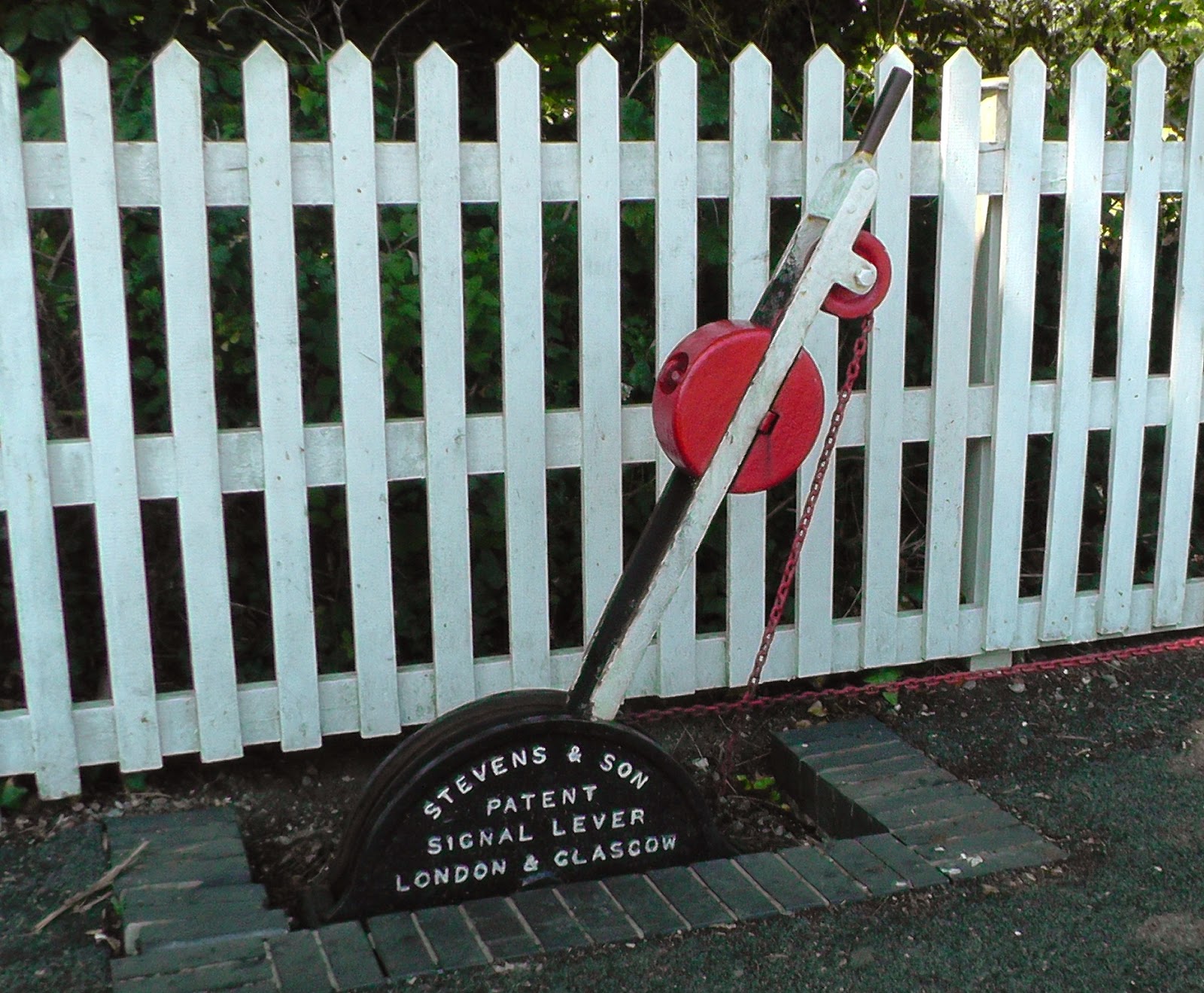
.... before the arrival and departure of the 14:27 down train from Douglas.

My next encounter with the railway was on Friday 25 July. I was treated to the sight of former MNR 0-6-0 Loco No. 4, Caledonia, steaming quietly in the station .........

...... and also its counterpart, IMR No. 4, Loch (this time without driver's lunch-pack)

Caledonia joined the front of the ten-coach train and steamed partly out of the station .......

..... to allow Loch to couple up at the rear, acting as a banker. With much whilst-blowing and flag-waving, we set off.

Apart from a little wheel slippage under the trees at the very start of the journey, the two locos handled the heavy load up the gradients very competently.

We passed the Up train at Ballasalla, with barely enough room for our train on the loop.

Before we eventually steamed through Port St Mary and on into Port Erin ........

..... where our train was split into two five-coach units .....

.... and the locos took on water.

After another excellent coffee in the cafe, I took the train back to Douglas, hauled by Loch.


After a very pleasant cooked lunch in the cafe in the station, I watched some of the train movements on the platform. Loco No. 12, Hutchinson, departed with the 13:50

and Loch arrived with the 14:50, while Loco No. 10, GH Wood pottered around in the yard.


Unfortunately, as there was a lineside fire further down the line, there were no more train movements that day.
Even though the IMR has been scaled back since the height of its operations it seems to be thriving and there is plenty to see and do. The standard of the stock and railway infrastructure is very high, which is a testament to its nationalisation - the island's government having taken responsibility for the whole island's public transport system both ancient and modern.
Whilst on the island, I took the opportunity to walk the trackbed of the abandoned Douglas to Peel line which is now a heritage trail (see IMR - Douglas to Peel - pending). I couldn't help feeling as I trudged the trackbed, that it could easily be re-opened - or was that just wishful thinking?


