Search This Blog

Thursday, 12 September 2013

Southend Cliff Lift

In a nutshell

Gauge:          4' 6"

Length:        130' (40m)

Opened:       1912 (replacing moving walkway opened in 1901)

Location:    


View Narrow Gauge Railways in a larger map  

Date of visit:     9 September 2013

Key Facts

  • The cliff railway or 'cliff lift' takes passengers vertically 57' (17m) from the Western Esplanade to the Cliffton Terrace rising at gradient of 43.4% (1:2 or 26 degrees)
  • It is a funicular railway, being operated by a cable attached to a counterbalance weight which lowers as the passenger car rises.
  • The passenger car can hold up to 18 passengers
  • It is fairly unique in design as the tracks run on steel girders mounted in parallel with the cliff face
  • The lift has been renovated four times, in 1930, 1959, 1990 and more recently in 2010 (at a cost of £3m)
  • The lift was built originally by Waygood & Co. which is now part of of the Otis Elevator Company
  • The journey costs £1.00 (50p concessions).
  • The lift operates daily from May to September and at weekends between October and April.

Route


My Impressions

The railway is in a commanding position, a short walk from Southend Pier. As it has been recently refurbished (in 2010) through a Lottery Grant, it is in very good condition.

The passenger car was at the summit when I reached the lower station, but after pressing the button (as one would do to summon a lift) it began its descent.


Access to the lift is well considered for wheelchair users. The lift is operated by an attendant, who informed me that I was his first passenger of the day (it was now 3:00pm), which seems a great pity as the fare is not particularly large and the experience of riding in such an interesting piece of technology is well worth it.


Perhaps the lift would get more custom if it was closer to the pier or at the end of the main street in Southend. However, as it has been on the site for over 110 years it's probably too late to move it now.

The ride was very smooth and, despite the weather, there was a good view along the sea front as we reached the summit. 

The architecture retains its Edwardian elegance and the refurbishment has done a great deal to enhance its appearance.

Possibly not as exhilarating as a ride on a roller coaster, but to lend support for the continuation of a piece of our transport heritage, £1.00 does seem a small price to pay.

Video

[In preparation] 


Wednesday, 11 September 2013

Southend Pier Railway

In a nutshell

Gauge:          3'

Length:        1.34 miles

Opened:      1851 - Horsedrawn tramway
                     1890 - 1978 - Electric railway (3'6" gauge)
                     1986 - Diesel railway (3' gauge)                  

Location:    


View Narrow Gauge Railways in a larger map  


Date of visit:     9 September 2013


Key Facts

  • The first pier at Southend was built in 1830 and in 1851 a horsedrawn tramway was added to take passengers to and from the jetty at the end of the pier.
  • The original wooden pier was replaced in 1888 by the existing pier which is still the longest in the world at 1.34 miles
  • In 1891, a 3'6" gauge railway was completed, operated by electrically powered toast-rack coaches (two of which were transferred in 1950 to the Volks Electric Railway in Brighton)
  • By 1930, the line had been doubled along its entire length and was operated by four seven-coach trains
  • In 1949 the rolling stock was replaced with four new seven coach trains similar to those on the London Underground. Each train comprised three motor cars and four trailer cars which could carry up to 260 passengers, at a top speed of 18 mph.
  • This 3'6" gauge electric powered railway was closed in 1978
  • It was rebuilt as a single 3' gauge line with a midway passing place and two Deutz engined, diesel-hydraulic powered trains and re-opened in 1986
  • The railway runs throughout the year (apart from Christmas Day - or if the weather is exceptionally bad).


Route


My Impressions

The last time I travelled on the Southend Pier Railway was approximately 50 years ago, when it was still electrically operated. I still remember the distinctive clack-clack-clack of the trains which could be heard all along the sea-front.

On this occasion, when we reached Southend sea-front, the rain was beating down and the end of the pier was only just discernible through the haze.

I made my way to the main entrance to the pier and duly paid over £4.00 for a return ticket. Despite the weather the train was still running at half-hourly intervals and so before long the regular beat of the wheels and a quick toot on the horn announced the arrival of our train. It pulled into the platform and we waited behind the barrier until the passengers from the pier-head had disembarked. We were then allowed on to the platform to board the train.

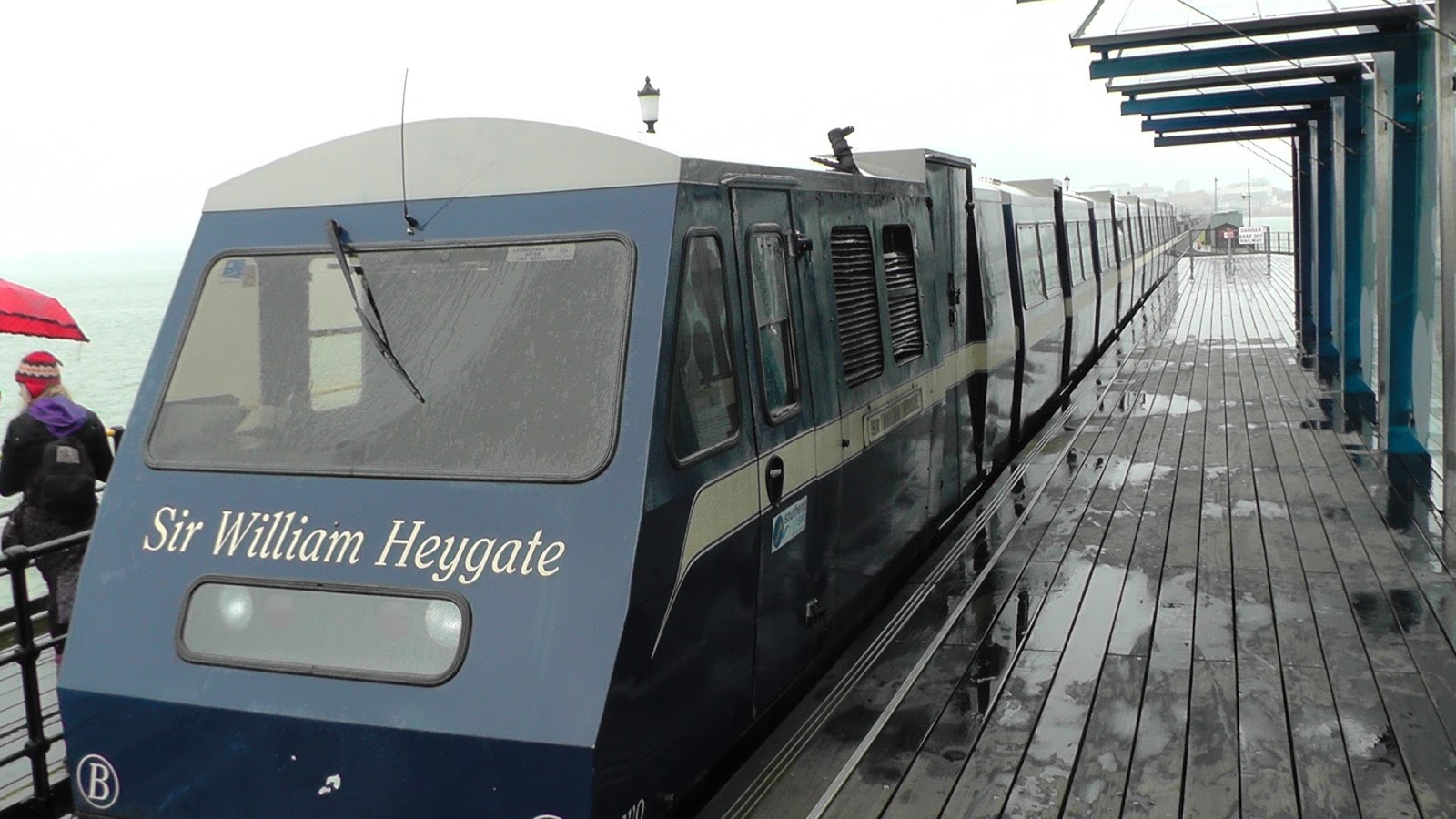
There are two platforms, but as only one train was running today, the other (Sir John Betjemen) was parked in the other bay.

The coaches are utilitarian, being finished inside with wipe-clean glass fibre panels.

The turn-round time is fairly brief and so, before long, we were on our way. The view from the carriage window on this wet September day was not particularly edifying, .......

......... but within ten minutes the head of the pier came into view.

We disembarked and made our way up the platform,......

...... with the skyline of Southend, visible in the distance, about a mile away.

There was time to admire the diesel loco and peer through the louvres at the Deutz diesel engine.

Despite the weather, I ventured to the head of the pier and then sought refuge in the cafe, availing myself of a cup of coffee and peering out along the pier to check on the progress of the train as it made its way back up towards us.

Eventually (about 25 minutes later), the train pulled back into the platform and we made our way to the carriages.

The driver's compartment was neatly laid-out and businesslike - though the persistent rain made conditions for photography less than perfect!

The line stretched back towards the mainland. If the weather had been more conducive, I would have walked back, catching a few lineside shots on the way. However, the rain was relentless and I decided that maybe discretion was the better part of valour - and rode back.

When we arrived back at the main (Shore) station, I checked out the two power cars of the line's trains ........

....... before making my way through the amusement arcade and out on to the seafront.

The railway has been constructed for a particular purpose and so its trains are designed to make life easy for the staff and appropriate for the passengers. On the journey, I caught a glimpse of the battery-powered car which is used during the winter months, parked on the other line at the Shore Terminus. The line also owns a couple of flat trucks which are used for maintenance and to transport items to the pierhead but these were not in evidence during my visit.

The museum was not open on the day I visited and so I was unable to see one of the 1949 coaches which it holds, but there are plenty of images of these on the internet.
Southend Pier - 1949 electric train-set - Source: http://i206.photobucket.com/albums/bb303/piermaster/Southend%20Pier%20Railway/00301949trainalongpier.jpg
By coincidence, I travelled on the Volks Electric Railway in Brighton the following day, seeing one of the original former Southend Pier power cars.

Maybe, one day I will return when the sun is shining and get a few lineside shots of the train in action. But I have now filled the gap of a 50 year absence.

Video

[In preparation] 


Tuesday, 3 September 2013

Vale of Rheidol Railway

In a nutshell

Gauge:       1' 11¾" 

Length:      11¾ miles

Opened:     1902

Location:    

        Vale of Rheidol Railway,
        Park Avenue,
        Aberystwyth,
        Ceredigion,
        SY23 1PG


View Narrow Gauge Railways in a larger map  


Date of visit:     30 August 2012


Key Facts

  •  The main purpose for the railway when it was built was to carry timber and lead ore from workings along the Rheidol valley to the main line railway at Aberystwyth and to shipping.
  • With a decline in industries in the valley, the railway was soon promoted as a tourist attraction to picturesque Devil's Bridge with its three bridges and waterfall
  • The railway as absorbed into Cambrian Railways in 1913 and into the Great Western in 1922
  • There were plans to use electrically powered locomotives prior to its takeover by the Cambrian Railways using hydro-electricity from the River Rheidol
  • Under the Great Western, goods services were removed and the branch to the harbour dismantled
  • The railway was closed during World War II but re-opened in 1945 and was then transferred to the ownership of the newly nationalised British Railways
  • In 1968, the railway was re-routed to its present terminus alongside the abandoned platforms of the mainline railway. The former main line engine sheds were converted for use by the VoR.
  • For a while, the VoR Railway was the only steam hauled railway under the ownership of British Rail. The locos and rolling stock were painted in BR colours.
  • The line was sold off in 1989 and is now under the ownership of Peter Rampton and the Phyllis Rampton Narrow Gauge Railway Trust
  • The railway runs from Easter through to October, with some specials being run during the winter months (eg Santa specials)
  •  The railway does not have its own catering outlet at Aberystwyth but there are a couple of places to eat on the mainline station. There is a small cafe at Devil's Bridge Station and, as the train waits there for 30 minutes, there is time for a coffee and a snack.

Route

Source: http://www.rheidolrailway.co.uk/Images/routemap.jpg

My Impressions

It must be around 50 years ago I last rode on the Vale of Rheidol. My impressions then were that the start of the journey was a bit ordinary but once the train started the climb up the side of the valley it got a lot more interesting. Somehow, I had forgotten just how spectacular the journey was.

There was a generous sized car park at Aberystwyth beside the VoR station. What's more it is free and provides easy access to the station and also to the town. We bought our tickets but as there was around an hour before the train departed we had an opportunity to enjoy a leisurely coffee and a breakfast bun at the Wetherspoons in the main station building.

The line's Baguley/Drewry 0-6-0 diesel shunted the coaches for our train into the platform .........

....... while our loco, Swindon-built 2-6-2T No. 8 Llewellyn was being prepared .......

..... before backing on to its train.


 With a few toots on the whistle, the train steam off down the line, leaving the station yard behind.

After crossing the main road and the River Rheidol, the train passed through the suburbs and then the farmland of the lower valley, before eventually steaming into Capel Bangor. After a brief pause, we ventured forth once more.

We then started the early part of the climb towards Devil's Bridge ........

..... and entered woodland.

We paused briefly at Nantyronen to allow some walkers to disembark. As with all other stations and halts on the line, there is evidence of recent construction work - with a new platform, railings and a corrugated iron station shelter in the style of GWR buildings.

The climb now began in earnest, with the regulator open wide and impressive beats and the whistle echoing across the valley.

In recent years, the company has cleared some of the trees and undergrowth to allow increasingly impressive views of the valley and the river below.

About three quarters of the way up the valley, a view is gained of the Cwm Rheidol reservoir and the Rheidol Falls.

Above Rheidol Falls is a halt, which like all the other stations is getting a makeover. We paused briefly to allow a member of the railway staff to hop off, paintbrush and paint-pot in hand.

We then continued up the valley, with increasingly sharper curves and even more impressive views down into the valley.

Ultimately, we steamed into Devil's Bridge Station .........

..... where the train paused for around half an hour.

There was plenty to see and do. We decided not to explore the views of the waterfall and the three bridges, instead opting for a more leisurely cup of coffee and Welsh cakes in the combined cafe and shop. There was also a display of wood carving (with a chain -saw) and an opportunity to drive a Kerr Stuart Wren class loco for the princely sum of £5.00. As you can see, this particular young lady was none too impressed with her brother's passion on sounding the whistle at regular intervals.

After taking on water ...


..... our loco ran round its train

..... and then took the train on its descent down the valley.

This time, I decided to travel in the open coach at the rear of the train.

On the way down the valley we often saw Red Kites circling on the up-currents - but I was never quick enough with the camera to snap them.

Eventually, we re-crossed the river and hove back into the station at Aberystwyth......

 ........ where there was another opportunity to admire the loco as she ran round the train to take on more water in preparation for the afternoon service.

After travelling on Aberystwyth's cliff railway and grabbing some lunch in one of the small cafes off the main street .......

 ....we decided to drive the route up the valley in the afternoon. The Ordnance Survey map showed there were numerous footpaths along and up and down the valley and so we parked up and took one of the paths leading down to Rheidol Falls Halt, where we were in time to see the afternoon train making its way back down to Aberystwyth.

The locomotives are very powerful, well maintained and impressive in the way they tackle the steeply graded line. The 11¾ mile journey to my mind is about right for a half day excursion, though in future I would like to return and explore some of the footpaths, maybe taking more photos during the summer operating season when there are twice the number of train services up and down the valley.

I would also like to spend more time exploring the history of the railway, particularly the short-lived lineside industries of lead ore extraction and timber felling - and somewhere there must be some remains of the harbour branch.
Source: http://www.francisfrith.com/devils-bridge/photos/narrow-gauge-railway-1925_77696/
 I am very glad that I have re-acquainted myself with this railway which has quite a unique feel about it - its locos are certainly very different from those found on the other railways in Wales - it's reassuring to see that they are now resplendent in their original GWR livery - though I think it would be interesting to see one in BR Blue - with the large double arrow in white on the side - the only steam locos ever to have sported this livery.
Source: http://www.transport-of-delight.com/UK/UKMinorRailways/jpgs/Vale%20of%20Rheidol-1.jpg


Video

[In preparation]