Search This Blog

Showing posts with label pier. Show all posts

Tuesday, 2 October 2018

Hythe Pier Railway

In a nutshell

Gauge:         2' (610mm)

Length:       700 yards (640 m)

Opened:     1922

Location:    


Blue Funnel Ferries Ltd,
Hythe Ferry Office,
Prospect Place,
Hythe,
Southampton
SO45 6AU

Web:           http://hytheferry.co.uk/
Email:        ticketoffice@hytheferry.co.uk
 

Date of visit:     25 September 2018


Key Facts

  • The railway is the oldest continuously operating pier railway in the world
  • The pier was opened in 1881 and the first railway along it was constructed in 1909. However, the wagons on it, which were used carry passengers' luggage, were propelled by hand
  • The present railway was constructed in 1922. It was and always has been electrically powered. 
  • The 250v to power the line's two power cars is supplied via a third rail which runs alongside the track, on the seaward side.
  • The four-wheeled power cars were built by Brush in 1917
  • There are no passing loops but there is a non electrified siding at the landward end of the pier leading to the railway's workshops.
  • The line has four passenger carriages, two of which have a driving compartment at their seaward end. A train usually comprises two normal carriages plus one with a driving compartment. The power car is positioned at the landward end of the train.
  • A four wheeled luggage wagon is usually marshalled at the seaward end of the train.
  • The line also has a four wheeled tanker wagon used to carry fuel for the ferries.
  • The ferry carries passengers across Southampton water to Southampton. The journey takes ten minutes.

Route


My Impressions

Hythe itself is a pleasant little town with a couple of good places to enjoy a decent cup of coffee or tea. After parking in the main car park, we wandered along the main street to the pier.

The entrance is quite unimposing, considering it houses the world's longest running pier railway. After purchasing a ticket, we made our way along the platform to one of the carriages.

We noted that one of the compartments included a small plaque to commemorate a journey made by King George VI.

Before taking our seats, I had took a quick look at the power car on our train.


It was certainly not built for comfort, the driver having to perch on a wooden seat above the electric motor which takes up most of the floor space.

The seating for the passengers is similarly Spartan - wooden slatted seats. But then the journey is fairly short and the rolling stock has been unaltered since it was built in the early 1920s. And authenticity is a watchword for this historic railway.

Before long, more passengers joined us and the train set off along the pier.

Trains are scheduled to coincide with the arrival of the ferry at the pierhead, but there was sufficient time to take stock of the station as one set of passengers disembarked and the new passengers boarded the ferry. The line's tanker wagon was parked at the end of the line, ready for refuelling the ferry boat.

The luggage wagon was also in view, in front of the driver's compartment at the end of the train.

The power car was also more readily accessible for scrutiny. There can't be many narrow gauge locomotives which are equipped with a life belt in case of emergencies.

Ere long, we commenced our return journey.......

.... and arrived back at the main station.

There was an opportunity to watch a couple more trains come and go, .......

...... clanking their way methodically up and down the pier.

Everything seemed so orderly and constrained. The rolling stock did appear to be slightly dog-eared and timeworn - but then, salt-sea air is not kind to ageing infrastructure and the railway is certainly nothing but utilitarian. It bears its place in history with a quiet and unassuming dignity - and left me with warm and abiding memories.


If you are in this part of the country, then a visit should surely be obligatory - your fare will help to keep this admirable piece of living history alive.

Video

[In preparation] 


Tuesday, 24 September 2013

Southport Pier Tramway

In a nutshell

Gauge:         3' 6"

Length:       3600 feet (1100m)

Opened:      1863 - 3' 6" gauge
                     1950 - 1' 11
½" gauge
                     2005 - 3' 6" gauge

Location:    

Southport Pier
Promenade
Southport
Merseyside
PR8 1QX


View Narrow Gauge Railways in a larger map


Date of visit:     22 September 2013


Key Facts

  • When it was built in 1860, the pier at Southport was the longest pier of iron construction in the world. It was soon overtaken by its rival, the pier at Southend but remains the second longest in the country.
  • The first tramway on Southport Pier was opened in 1863 and was used for carrying baggage for passengers arriving by steamer. Initially it was unpowered but in 1865 it was operated by a cable powered by a steam engine.
  • The railway was electrified in 1905.
  • The rolling stock was replaced in 1936 when it was taken over by Southport Corporation
  • The pier was closed during the second world war but although the pier reopened whan the war ended, the tramway was not reopened until 1950 to a gauge of 1' 11½"with a diesel powered train built by Harry Barlow who also built stock for the adjacent Lakeside Miniature Railway
  • For safety reasons the pier closed in 1998. It was rebuilt and re-opened in 2002. The present tram first ran in 2005.
  • The tramcar was built by UK Loco Co, is battery powered and can carry 74 passengers at half hourly intervals.

Route

The tram runs the length of the pier with no intermediate stops

My Impressions

Having spent some time studying and riding on the adjacent 15" gauge Lakeside Miniature Railway, I took time out to explore the pier tramway.

After boarding the tram at the landward end of the pier

I settled into a seat near the front of the two-car articulated tram.

Sedately, the battery-powered tram made its way up the track laid along the centre of the pier to the end of the pier around 2/3mile distant. As the tram is fairly quiet, it has a constant low-powered beeper to alert pedestrians, with a louder horn for those whose minds are elsewhere.

The journey takes around ten minutes and the tram runs at half hourly intervals and so it waits eat each end for around twenty minutes.

Walking back along the pier, the construction looks quite spindly - but as this Grade II listed structure has been here for over 100 years, the design has clearly stood the test of time.

The tram then made its stately way back along the pier ........

...... with the final part of the pier spanning the Marine Lake.

I was intrigued as to where the tram is housed, there being no pointwork and no shelter evident along the length of the pier. The rails come to an abrupt stop at the end of the pier, so it can only be assumed that the tram is run on to a transporter when it needs to be taken off for maintenance or repair.

The tram runs throughout the year (weather permitting) and the fare is quite modest. There is plenty of parking nearby (though this varies in price from free (for two hours) to £5.00 for the whole day. There are plenty of refreshment outlets nearby, including a cafe at the end of the pier.


Video

[In preparation] 


Wednesday, 11 September 2013

Southend Pier Railway

In a nutshell

Gauge:          3'

Length:        1.34 miles

Opened:      1851 - Horsedrawn tramway
                     1890 - 1978 - Electric railway (3'6" gauge)
                     1986 - Diesel railway (3' gauge)                  

Location:    


View Narrow Gauge Railways in a larger map  


Date of visit:     9 September 2013


Key Facts

  • The first pier at Southend was built in 1830 and in 1851 a horsedrawn tramway was added to take passengers to and from the jetty at the end of the pier.
  • The original wooden pier was replaced in 1888 by the existing pier which is still the longest in the world at 1.34 miles
  • In 1891, a 3'6" gauge railway was completed, operated by electrically powered toast-rack coaches (two of which were transferred in 1950 to the Volks Electric Railway in Brighton)
  • By 1930, the line had been doubled along its entire length and was operated by four seven-coach trains
  • In 1949 the rolling stock was replaced with four new seven coach trains similar to those on the London Underground. Each train comprised three motor cars and four trailer cars which could carry up to 260 passengers, at a top speed of 18 mph.
  • This 3'6" gauge electric powered railway was closed in 1978
  • It was rebuilt as a single 3' gauge line with a midway passing place and two Deutz engined, diesel-hydraulic powered trains and re-opened in 1986
  • The railway runs throughout the year (apart from Christmas Day - or if the weather is exceptionally bad).


Route


My Impressions

The last time I travelled on the Southend Pier Railway was approximately 50 years ago, when it was still electrically operated. I still remember the distinctive clack-clack-clack of the trains which could be heard all along the sea-front.

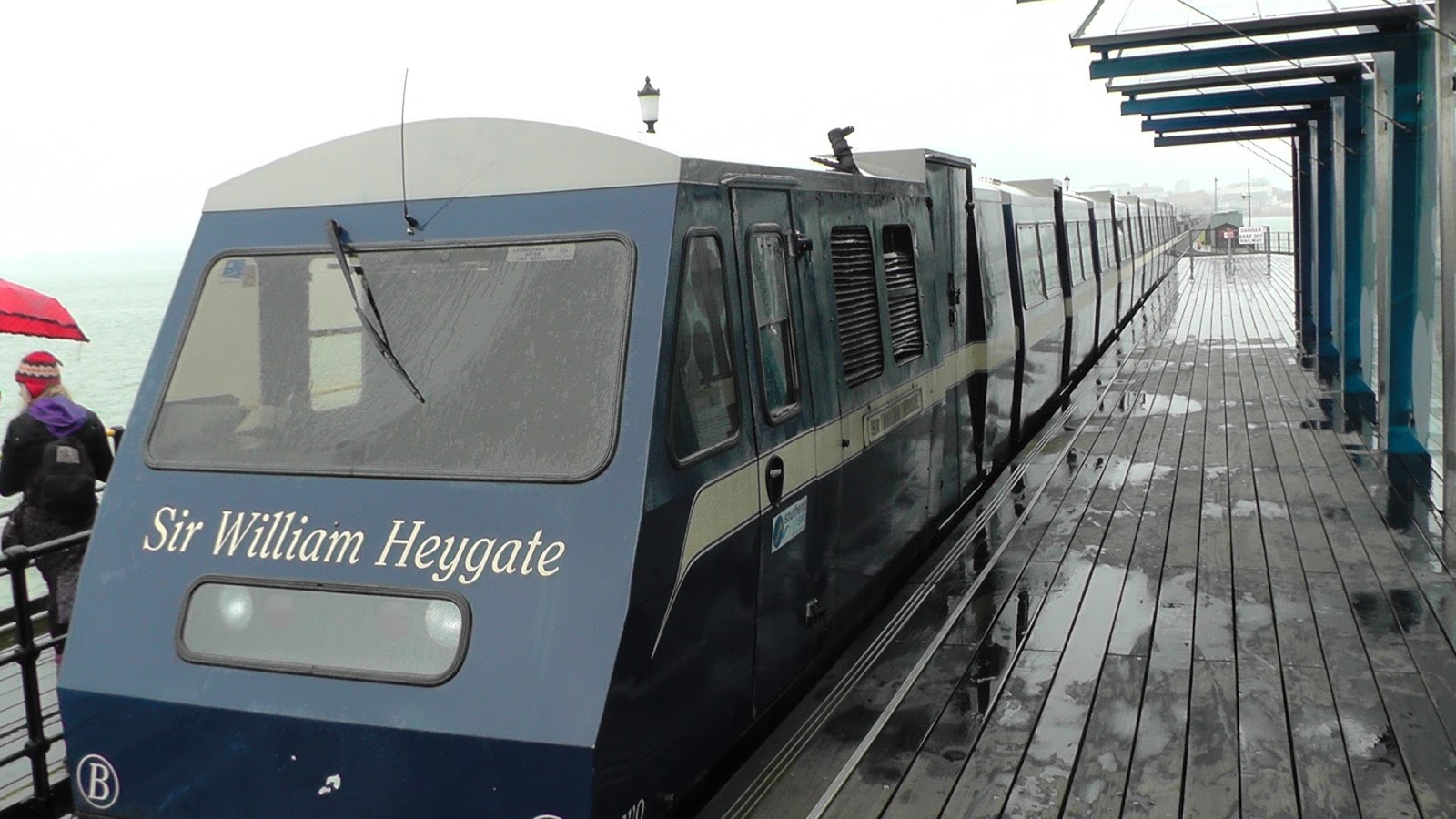
On this occasion, when we reached Southend sea-front, the rain was beating down and the end of the pier was only just discernible through the haze.

I made my way to the main entrance to the pier and duly paid over £4.00 for a return ticket. Despite the weather the train was still running at half-hourly intervals and so before long the regular beat of the wheels and a quick toot on the horn announced the arrival of our train. It pulled into the platform and we waited behind the barrier until the passengers from the pier-head had disembarked. We were then allowed on to the platform to board the train.

There are two platforms, but as only one train was running today, the other (Sir John Betjemen) was parked in the other bay.

The coaches are utilitarian, being finished inside with wipe-clean glass fibre panels.

The turn-round time is fairly brief and so, before long, we were on our way. The view from the carriage window on this wet September day was not particularly edifying, .......

......... but within ten minutes the head of the pier came into view.

We disembarked and made our way up the platform,......

...... with the skyline of Southend, visible in the distance, about a mile away.

There was time to admire the diesel loco and peer through the louvres at the Deutz diesel engine.

Despite the weather, I ventured to the head of the pier and then sought refuge in the cafe, availing myself of a cup of coffee and peering out along the pier to check on the progress of the train as it made its way back up towards us.

Eventually (about 25 minutes later), the train pulled back into the platform and we made our way to the carriages.

The driver's compartment was neatly laid-out and businesslike - though the persistent rain made conditions for photography less than perfect!

The line stretched back towards the mainland. If the weather had been more conducive, I would have walked back, catching a few lineside shots on the way. However, the rain was relentless and I decided that maybe discretion was the better part of valour - and rode back.

When we arrived back at the main (Shore) station, I checked out the two power cars of the line's trains ........

....... before making my way through the amusement arcade and out on to the seafront.

The railway has been constructed for a particular purpose and so its trains are designed to make life easy for the staff and appropriate for the passengers. On the journey, I caught a glimpse of the battery-powered car which is used during the winter months, parked on the other line at the Shore Terminus. The line also owns a couple of flat trucks which are used for maintenance and to transport items to the pierhead but these were not in evidence during my visit.

The museum was not open on the day I visited and so I was unable to see one of the 1949 coaches which it holds, but there are plenty of images of these on the internet.
Southend Pier - 1949 electric train-set - Source: http://i206.photobucket.com/albums/bb303/piermaster/Southend%20Pier%20Railway/00301949trainalongpier.jpg
By coincidence, I travelled on the Volks Electric Railway in Brighton the following day, seeing one of the original former Southend Pier power cars.

Maybe, one day I will return when the sun is shining and get a few lineside shots of the train in action. But I have now filled the gap of a 50 year absence.

Video

[In preparation]