Search This Blog

Showing posts with label Bassett Lowke. Show all posts

Friday, 25 May 2018

Saltburn Miniature Railway

In a nutshell

Gauge:         `15" (381mm)

Length:         5/8 mile (1 km)

Opened:     1947

Location:    

Saltburn Miniature Railway,
Saltburn-by-the-Sea,
UK


Email:      info@saltburn-miniature-railway.org.uk 
Tel:           01287 622712
  

Date of visit:     23 July 2017

Key Facts

  • The railway was first set up in 1947 by Mr. H. Dunn and was then only 300 Yards long.
  • In 1949 the railway obtained  4-4-4 tank loco "Blacolvesley", which was built in 1909 by Bassett-Lowke and is the oldest workable internal combustion locomotive in the world. It is now in private ownership and resides at the Ravenglass and Eskdale Railway.
  • In 1953, the railway was modified to allow for the running of two trains, with a passing siding.
  • By 1983, the railway was more or less derelict and was acquired by the Saltburn Miniature Railway Association, a group of volunteers
  • During 2000 - 2003, the railway was rebuilt in its present form.
  • The railway currently has three steam outline diesel powered locos (4-6-2 DE Prince Charles, 0-4-0T DH George Outhwaite, 4-6-2 DH Saltburn 150) and a live steam loco, 4-4-2 Blacklock R
  • The railway runs at weekends throughout the year, opening at 1.00pm
 

    Route


    My Impressions

    After a quick tour of the town and a ride on the Cliff Lift, I walked the length of the railway, taking various video shots and photos.

    On  the siding leading to the engine sheds, they were swapping over locos. 4-6-2 DH Saltburn 150 was being replaced by 4-6-2 DE Prince Charles.

     This provided me with an opportunity to see Saltburn 150, before she retired to the shed.

    The furthermost terminus of the railway is Forest Halt, where there is a platform and run-round loop.

    I walked back up the line to the main terminus, Cat Nab, which is very close to the sea front, behind a large car park.

    I bought my modestly priced return ticket and boarded the train. Before long it set off.

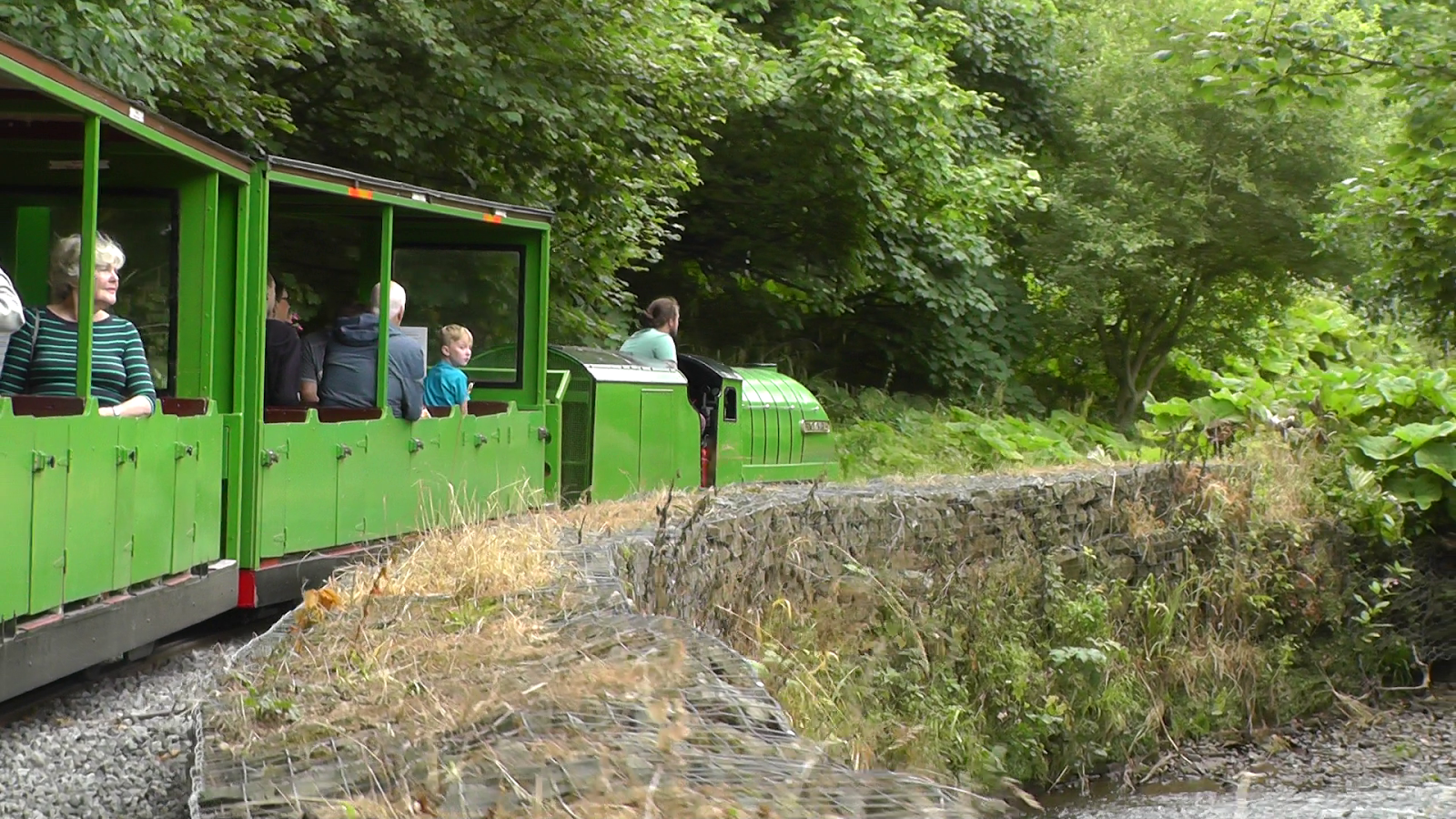
    After rounding a 90 degree bend, the line ran parallel with Skelton Beck, passing the engine sheds and carriage sidings, before taking a right hand curve on the banks of the beck.

    At Forest Halt, the loco ran round her train ......

    .... before proceeding back up the line.

    The track, locos and stock appeared to be in tip-top condition and the line seems to be thriving, thanks to the efforts of the volunteer workforce. Although the railway itself does not have a tea room, there are cafes within five minutes' walk at each end of the line serving a good range of refreshments. There is wheelchair access and the staff are on hand to enthusiastically answer questions.

    This railway is one of the original miniature railways, most of which adopted the then popular gauge of 15 inches (see 15" gauge railways - a short chronology). Although this railway is quite short in comparison to other 15" gauge railways, it is well worth a visit as is the town of Saltburn which retains its original feel of a Victorian seaside resort.

    Video


    Monday, 23 September 2013

    Southport Lakeside Miniature Railway

    In a nutshell

    Gauge:          15"

    Length:         1 mile (1.5km)

    Opened:        1911

    Location:      

    Lakeside Miniature Railway
    Esplanade, 
    Southport, 
    Merseyside, 
    PR8 1RX


    View Narrow Gauge Railways in a larger map


    Date of visit:     22 September 2013


    Key Facts

    • The railway is the oldest continuously running miniature railway in the world (others closed during war years, eg Rhyl Miniature Railway which was built in the same year)
    • The railway was opened on 25 May 1911 and ran alongside the Marine Lake with run-round loops at each end. It was extended in 1938 with a tight left-hand turn at the Northernmost end to a new terminus (Marine Parade Station) beside the pier.
    • When first opened, the railway was operated by two Bassett-Lowke 4-4-2 steam locomotives, King George and Princess Elizabeth. These locomotives are still in existence, in America.
    • The original locos were joined in 1919 by one of Sir Arthur Heywood's locomotives, Katie  which had previously run on the Eaton Hall Railway and the Ravenglass & Eskdale Railway (see A chronology of Minimum Gauge railways). Katie was sold to the Fairbourne Railway in 1923.
    • In 1948 a steam outline 4-6-2 petrol-electric tender locomotive (The Duke of Edinburgh), based on Gresley’s streamline A4 Pacifics, joined the railway. It was built by Harry Barlow who became the owner of the railway in 1945.
    • Harry Barlow also built the locomotives for the Far Tottering and Oyster Creek Railway, based on the cartoons of Roland Emett, which appeared at the 1951 Festival of Britain.
    •  Two further petrol locomotives of a similar design were added in 1954 (Prince Charles) and 1963 (Golden Jubilee).
    • A further loco, Princess Anne, a diesel hydraulic co-co loco similar to a Western diesel and built by Severn Lamb, joined the railway in 1971.
    • The railway was taken over by Don Clark in 2001.
    • Another loco, a 2-6-2 steam outline diesel hydraulic called Jenny, was added to the fleet in 2006. This loco was built for the LMR by Austin Moss at nearby Windmill Farm.

      Route


      My Impressions

      After solving the first problem of finding somewhere to park (see below), my first objective was to get the lay of the land at Marine Parade Station. The station is located between Marine Parade and the pier.

      Walking around the station, it's possible to take some pictures of the station from the first overbridge, which leads to a skateboard and BMX bike park. A little further along Marine Parade, it's possible to gain access to the pier .......

      ..... from which other views of the station can be gained.

      As can be seen, the layout at the station provides for two platforms with separate run round loops on each.

      Heading back to the station, I took a snap of the impressive station building which dates back to the days when the line was extended to its present position in 1938. After chatting with the owner's wife, Jenny, I made my way on to the platform to await the arrival of the next train.

      Only one platform was in use - in fact the track to the other was quite overgrown, suggesting it had not been used for some time. A rake of two articulated open coaches was parked beside the main platform to be available should traffic demand their use.


      At the other end of the platform, the line could be seen stretching out through a cutting towards the 90 degree right-hand bend which takes the railway alongside the lake. The overbridge to the skateboard park was clearly made from cast iron plates which bear the initials of the railway (LMRly).

      Before long, there was the sound of a horn in the distance and the train came into view, the loco propelling the train of two articulated open coaches into the station.

      The loco on duty for the day was Jenny, a 2-6-2 steam outline diesel hydraulic loco which was constructed in 2006.

      Talking with the driver, it seems that this loco is used when traffic is likely to be fairly light. The older, larger locos are pressed into service on a rolling basis during the season, dependent on anticipated traffic.

      We clambered aboard and paid the modest fare (£1.50 single for me) .......

      and within a short period we departed.

      After passing beneath the bridge to the skateboard park .......

       ...... we rounded the curve to pass under the bridge giving access to the park, and then under the pier.

       We then ran on a fairly straight route between the park and the lake. Looking back towards the pier, the lake can be seen on the right.

      We passed beneath another bridge (under repair) ...........

       ....... before passing the stock sheds.

       We then pulled into Pleasureland Station where there is an island platform with two
      faces.

      In addition to the two run round loops there is a carriage siding leading to another stock shed.

      As with Marine Parade Station, it's clear that only one platform is in regular use, which presumably reflects the lack of demand for this type of seaside attraction these days.

      I decided to walk the mile back to Marine Parade Station, to grab a few lineside shots. The entrance to the station announces as clearly as possible the presence of the railway.

       As does the nameboard on the platform for those walking in the park beside the Marine Lake.


       The walk along the path between the lake and the railway is quite pleasant, punctuated occasionally by the passing of a train. Here we see Jenny passing over the points leading to the stock sheds  .........

      ...... and here further along the line towards Marine Parade.


       The track is quite well maintained though a covering of weeds gives it that Light Railway look .........

       As the line begins it curve towards Marine Parade Station, the line towards Pleasureland Station can be seen almost in its entirety.

       ..... while the other end of the curve beside the skateboard park shows the width of the cutting.

      As the afternoon wore on the number of passengers increased meaning that the second rake of  coaches was pressed into service and the loco was required to run round its train at each end.


      It was satisfying to see the railway attracting more passengers .......

       ..... though it is doubtful as to whether it will ever become as popular as it was in its early days, as evidenced by these pictures on display in the station building at Marine Parade . Clearly, the novelty of seeing a train in miniature was a great attraction.

       It seems a great pity that many of the visitors strolling along the pier and catching a glimpse of the railway are probably blissfully unaware of its fascinating history and its contribution to the world of miniature railways. However, even at the end of the season, the railway was carrying a fair number of passengers. I overheard one passenger enquiring, "Where does it go?" and when told it went up to Pleasureland he replied, "Oh, that's all right then" suggesting that the length of the ride was about right for a day out at the seaside.

      Practicalities

       Parking

      There are no parking facilities specific to the railway at either end but there are several public car parks. We discovered that we could park in the car park on the right hand side of Marine Parade opposite the station for two hours without charge (or longer if something was purchased in the shops.

      Refreshments

      Apart from selling sweets, ice cream and hot drinks at Marine Parade Station, the railway does not have a cafe. However, there are many and varied sources of refreshment within a short distance of the two stations.

      Disabled Access

      There are no steps to access the platforms at either station which are both approached by ramps. On the day I visited, there was no carriage which could accommodate wheelchairs available. There is a telephone number on the railway's website to which enquiries could be made.

      Video

      [In preparation] 


      Friday, 30 August 2013

      Ravenglass and Eskdale Railway

      In a nutshell

      Gauge:         15"

      Length:      7 miles

      Opened:     1875 - 3' gauge (closed 1913)
                          1915 - 15" gauge

      Location:    


      View Narrow Gauge Railways in a larger map  


      Dates of visits:     9 May 2010, 26 July 2013


      Key Facts

      • When the railway opened in 1875 it was 3' gauge.
      • Its original purpose was primarily to transport iron ore from quarries and mines to the mainline railway at Ravenglass
      • When it was given permission to carry passengers in 1876, it became the first public narrow-gauge railway in England
      • The first incarnation of the railway closed in 1913 as the income from iron ore and passengers declined making the railway unviable
      • The line re-opened as a 15" 'minimum gauge railway' in 1915 under the ownership of W. J. (Wynne) Bassett-Lowke and Robert Proctor-Mitchell who were interested in demonstrating the potential of 15" gauge as a commercial venture, based on the earlier work of Sir Arthur Heywood (see A Brief History of Minimum Gauge Railways)
      • Initially, trains were hauled by one of Bassett-Lowke's  4-4-2 locomotives (Sans Pareil) which was a miniaturised version of a full scale standard gauge loco.
      • More rolling stock was provided from Sir Arthur Heywood's Duffield Bank Railway, following his death in 1916.
      • Whilst summer passenger tourist traffic was the mainstay of the line, it also transported granite from Beckfoot Quarry to a crushing plant at Murthwaite. 
      • The railway ran one of the first diesel locomotives in 1929 
      • The railway closed to traffic during the years of the Second World War
      • In 1959 the railway was threatened with closure but was bought by a preservation society in 1960 which has remained in ownership ever since
      • Around 120,000 passengers are carried on the railway each year
      • The railway is open throughout the year though there is usually a brief closure for maintenance during the month of January

      Route

      Source: http://www.rerps.co.uk/images/main_map_672x199.gif

      My Impressions

      I have visited and travelled on the Ravenglass & Eskdale (L'al Ratty) on several occasions but my first visit in 2010 ,laid the foundations for my desire to create this blog. It was my first attempt to properly document a visit.

      As we were staying with relatives not far from Ravenglass, we arrived at the station fairly early and so there was time to watch the trains being prepared for the day and have an opportunity to partake of one of the station cafe's fine breakfasts - which is somewhat of a feast.

      River Mite was built by the Preservation Society in 1966
      Originally built as a 2' gauge 0-4-0WT by Kerr Stuart in 1900 for Dundee gasworks, Bonnie Dundee is now an 0-4-2 tender engine
      Our locomotive for the trip down the line was River Irt which had been renamed Greendale Rocket as part of the line's Postman Pat event for that weekend. River Irt is one of the line's original 15" gauge locomotives, it's chassis coming from Sir Arthur Heywood's 0-8-0 locomotive Muriel which was built in 1894.

      We boarded the train and made our way down the line taking in the views as the train took the 1:55 gradients to the furthermost terminus at Dalegarth.

      We spent a while at Dalegarth, watching the train movements and had a light lunch in the cafe which is situated in the station building.

      Meanwhile, 2-8-2 River Esk arrived with a full train from Ravenglass. Built by Davy Paxman in 1923 to a design by the renowned Henry Greenly, she is a very impressive and powerful locomotive.

      As there are turntables at each end of the line, the locos always run chimney-first up and down the line and the turning of the locos usually seems to attract a great deal of interest.


      We then boarded the train and were fortunate enough to have a seat directly behind the locomotive.

      After watching the arrival of River Irt, we made our way back up the line to Ravenglass.

       As this was a special Postman Pat themed day, there were events organised at the stations for children and a busy schedule of trains running in each direction. There was plenty to see and do, for children and adults alike. It's unsurprising this this is one of the Lake District's leading visitor attractions.

      Return visit - 26 July 2013

       On arrival at Ravenglass Station, we exchanged the pre-booked ticket voucher which we had bought online for our tickets and then retired to the station café for their slap-up breakfast - which has become a bit of a tradition when we visit the line.


      While my wife ordered breakfast, I had a few minutes to wander around the station forecourt, where I discovered the outcome of the devastating fire which had led to difficulties for the railway in providing a full complement of locomotives.

      However, the 15" narrow gauge railway community is close-knit and, thanks to loans of locos from the Bure Valley and the Romney, Hythe & Dymchurch, the railway has been able to continue running its services through the summer. Waiting in the station for the right of way was the Bure Valley loco, Wroxham Broad

      Our loco was the RH&DR 4-8-2, Hercules but there was no time for a picture and so, with a slice of toast still in my hand, we boarded the train to set off up the valley.


      The first part of the journey takes the train beside the estuary of the River Mite before turning inland to pass under the main A595 road beside which is Muncaster Mill - a request stop.

      The line then begins a gentle ascent up the valley, winding its way through woodland and passing the site of the granite crushing plant at Murthwaite.

      Sometimes trains pass each other at Irton Road, but not on this occasion - we passed the Up train at Miteside Loop.

       After passing under the road bridge at Irton Road which was built to clear the height and width of the line's original 3' gauge trains, we continued our journey.

      We chugged through The Green station which serves the community of Eskdale Green and climbed up Eskdale Valley, passing the site of Beckfoot Quarry .......
      Model of Beckfoot Quarry in the museum at Ravenglass

      ....... the source of the granite which was transported down the valley to the crushing plant.

      After a stiff climb of 1:38, the train crossed the River Esk and pulled into Dalegarth Station where Wroxham Broad was awaiting the off.

      As Hercules was too long to fit on to the turntable with her tender, they each had to be turned separately.

      There was an opportunity to take a few shots of this impressive Greenly designed and Paxman built locomotive.

      .... and watch the arrival of the next train behind the railway's 2-6-2 locomotive, Northern Rock, built in the line's workshops in 1976.

      We decided to walk along the road down the valley to Eskdale Green, passing on the way the one of the line's B-B diesels, Douglas Ferreira, on its way up the valley.

      By the time we reached The Green, Douglas Ferreira, was returning Up the line and so we flagged it down and boarded the train.


      At Miteside Loop, we passed Northern Rock on the Down Train.

       On arrival at Ravenglass, we visited the museum where there are some photos of the railway in its early days - such as this picture of Eskdale Green station when the railway was 3' gauge........

       .... and this photo of Sir Arthur Heywood's 0-8-0T loco, Muriel running on the railway before she was converted into 0-8-2 tender loco River Irt.

      After a quick snap of Douglas Ferreira, we hopped in the car and reluctantly left the railway behind.


      As can be seen from both the visits. There is always plenty to see on the R&ER and there are plenty of walking routes which start and finish at stations along the line. The quality and range of food available at the cafés at each end of the railway is very good and the staff are happy to explain to visitors what they are doing and how the railway operates.

      Hopefully, the locos which were affected by the fire will soon be back in service but it was interesting to see visiting locos hauling service trains.

      Video

      [In preparation]