Search This Blog

Showing posts with label station. Show all posts

Wednesday, 18 December 2019

Snowdon Mountain Railway

In a nutshell

Gauge:          2'  7½"(800cm)

Length:        4 2/3 miles (7.5km)

Opened:      1896

Location:   

Email:     info@snowdonrailway.co.uk 
Tel.:         +44 (0) 1286 870 223

Snowdon Mountain Railway
Llanberis
Gwynedd
LL55 4TT 


Date of visit:     20 September 2019

Key Facts

  • The Snowdon Mountain Railway is the only rack assisted railway in the UK
  • There has only been one accident on the line, on the day it first opened when one passenger died after the first downward train became derailed probably because it was overloaded
  • The line was constructed between December 1894 and February 1896
  • The rack system used by the railway was devised by Roman Abt, a Swiss locomotive engineer. Two racks are positioned between the rails, staggered by half a tooth to ensure there is always a complete tooth on the pinions engaged with the rack
  • The locomotive is not coupled to the carriage, so that the carriage would not be dragged down the mountainside if the locomotive became derailed
  • Gripper rails are fitted to either side of the rack to prevent the pinion from disengaging with the rack
  • Each locomotive and carriage has a manual brake which operates on the pinion
  • The locomotives also have a compression brake which uses air in the cylinders to slow the descent
  • The locomotives and carriages also have automatic brakes which engage if they exceed a certain speed
  • The railway has eight steam locomotives, five of which were built for the line's opening.
  • There are also four diesel hydraulic locomotives, powered by Rolls Royce engines
  • The line has ordered a diesel/battery hybrid locomotive which is intended to enter service in 2020. The batteries will be recharged on the descent.
  • There is a cafe and visitor centre at the summit (3560ft (1085m) above sea level) which was opened in 2009
  • There is also a cafe and toilet facilities at Llanberis station
  • During the winter or bad weather, trains will only run to Halfway station
  • It is advisable to book in advance as the number of tickets are limited each day

Route

Source: By MickMacNee at en.wikipedia - I created this work entirely by myself., Public Domain, https://commons.wikimedia.org/w/index.php?curid=13430621

My Impressions

The last time I travelled on the Snowdon Mountain Railway was over fifty years ago, so I was anxious to see how things had changed.

We arrived at Llanberis in good time to pick up our pre-booked tickets. While waiting we indulged in a cup of coffee and a snack, sitting outside in the early September sunshine.

There was a good selection of food available at the cafe and so we were spoiled for choice.

There was time to watch the departure of one of the diesel hauled trains ......


 ..... and our train being marshalled from the sheds. We were booked on one of the vintage steam services. We figured that as this was likely to be a one-off, we would travel in style.

Before long, we boarded. Although not first in the queue, we were able to get a good seat at the rear of the carriage close to the loco.

After crossing the Waterfall viaduct, we soon left the treeline......

......  and reached the first station / passing place at Hebron.

After passing a downward diesel train, we progressed further, the mountain scenery becoming more rugged, until we reached Halfway Station, where we paused to wait for another downward train.

Our guard/train manager took the opportunity to point out some of the scenic features observable from our vantage point ......

..... until the downward train passed us on the loop.

We continued upwards, allowing a fine view of the downward train and the emerging landscape towards Anglesey.

As we laboured further up the mountain, the views began to open out, here looking towards the Rivals on the Lleyn Peninsula.

As we approached Clogwyn Station, the train traversed a stretch of line on a ridge, which permitted views down to the left of the Llanberis Pass in the valley below. Apart from the summit, this is probably the most spectacular view on the trip.

We paused again at Clogwyn Station to await another downward train which we could see approaching from further up the line. There seemed to be a considerable number of people walking the path from Llanberis to the summit, hardly surprising as the weather was unseasonably warm and the sky very clear.

Eventually, the train came nearer, passing over the curve on which the first passenger carrying train derailed on the line's opening day.

Then it was our turn to tackle the last section of the railway to the summit. The views opened out even more, giving a fine view out of the whole island of Anglesey .......

..... and along the north coast of the Lleyn Peninsula ......

....... before our train gently eased itself into the station at the summit.........

............  where the loco was given a well deserved rest

 We were given 30 minutes at the summit which allowed plenty of time to browse through the souvenirs and walking equipment in the shop, ...

.... grab a cuppa and a pie in the cafe .......

 ...... and join the crowd at the summit.

The views from the summit were spectacular in all directions.

Looking North West ........

...... looking East

...... South West .....

..... South East.

.... and West.

It was very blustery at the top and so it was somewhat of a relief to re-board our train and start the descent. With our destination visible in the distance .....

..... we passed many walkers toiling their way towards or away from the summit.

At Hebron, we met another steam heritage train making its way up towards the summit.

Eventually, we arrived at Llanberis ......

...... where our train was shunted back into its siding.......

..... and we could watch the departure of another train towards the summit.

Passing through the railway's shop on the way towards the exit, I bought a handy little guide on the railway's history but avoided the temptation of buying a snow globe or fridge magnet.

I was impressed by how efficiently the railway is operated and also by the enthusiasm and willingness of the staff to help and/or discuss the railway.

The stock was scrupulously clean and well maintained, particularly considering the age of the steam locomotives and the heritage carriages. The fare is not cheap, but then it is a unique experience in the UK and presumably the cost of maintaining the track and railway infrastructure.

It is possible to take a one way journey, but I would advise you to check the long term weather forecast. We were extremely fortunate in having booked the perfect day for viewing the landscape. This was partly luck and partly due to careful scrutiny of the weather forecasts by my partner - who, incidentally, funded the trip as part of an unexpected Christmas present two years ago. It took us that long to find the ideal conditions in relation to weather and our availability. A previous booking we had made a year earlier had to be cancelled because steam hauled trains had been withdrawn owing to fire risk during the drought at the start of the 2018 summer season.

It pays to be patient!

Video


Friday, 25 May 2018

Saltburn Miniature Railway

In a nutshell

Gauge:         `15" (381mm)

Length:         5/8 mile (1 km)

Opened:     1947

Location:    

Saltburn Miniature Railway,
Saltburn-by-the-Sea,
UK


Email:      info@saltburn-miniature-railway.org.uk 
Tel:           01287 622712
  

Date of visit:     23 July 2017

Key Facts

  • The railway was first set up in 1947 by Mr. H. Dunn and was then only 300 Yards long.
  • In 1949 the railway obtained  4-4-4 tank loco "Blacolvesley", which was built in 1909 by Bassett-Lowke and is the oldest workable internal combustion locomotive in the world. It is now in private ownership and resides at the Ravenglass and Eskdale Railway.
  • In 1953, the railway was modified to allow for the running of two trains, with a passing siding.
  • By 1983, the railway was more or less derelict and was acquired by the Saltburn Miniature Railway Association, a group of volunteers
  • During 2000 - 2003, the railway was rebuilt in its present form.
  • The railway currently has three steam outline diesel powered locos (4-6-2 DE Prince Charles, 0-4-0T DH George Outhwaite, 4-6-2 DH Saltburn 150) and a live steam loco, 4-4-2 Blacklock R
  • The railway runs at weekends throughout the year, opening at 1.00pm
 

    Route


    My Impressions

    After a quick tour of the town and a ride on the Cliff Lift, I walked the length of the railway, taking various video shots and photos.

    On  the siding leading to the engine sheds, they were swapping over locos. 4-6-2 DH Saltburn 150 was being replaced by 4-6-2 DE Prince Charles.

     This provided me with an opportunity to see Saltburn 150, before she retired to the shed.

    The furthermost terminus of the railway is Forest Halt, where there is a platform and run-round loop.

    I walked back up the line to the main terminus, Cat Nab, which is very close to the sea front, behind a large car park.

    I bought my modestly priced return ticket and boarded the train. Before long it set off.

    After rounding a 90 degree bend, the line ran parallel with Skelton Beck, passing the engine sheds and carriage sidings, before taking a right hand curve on the banks of the beck.

    At Forest Halt, the loco ran round her train ......

    .... before proceeding back up the line.

    The track, locos and stock appeared to be in tip-top condition and the line seems to be thriving, thanks to the efforts of the volunteer workforce. Although the railway itself does not have a tea room, there are cafes within five minutes' walk at each end of the line serving a good range of refreshments. There is wheelchair access and the staff are on hand to enthusiastically answer questions.

    This railway is one of the original miniature railways, most of which adopted the then popular gauge of 15 inches (see 15" gauge railways - a short chronology). Although this railway is quite short in comparison to other 15" gauge railways, it is well worth a visit as is the town of Saltburn which retains its original feel of a Victorian seaside resort.

    Video


    Saturday, 6 August 2016

    Leighton Buzzard Narrow Gauge Railway

    In a nutshell

    Gauge:          2'

    Length:         3 miles (4.8km)

    Opened:       20 November 1919 - closed 1969 (for commercial traffic)
                         Reopened 1968 (first preservation train)

    Location:    


    Web:      http://www.buzzrail.co.uk/

    Tel:       01525 373888


    Date of visit:     31 July 2016


    Key Facts

    • The railway was built just after the First World War to link the Double Arches sand quarries with the mainline railway south of the town at Grovebury sidings. 
    • It was constructed using surplus equipment from the War Department.
    • Two Hudswell Clarke 0-6-0T locomotives were originally used on the line but they were unable to cope with the sharp radius curves in the railway and so were sold in 1921. 
    • It then became one of the first railways in Britain entirely operated by internal combustion locomotives (mostly Motor Rail / Simplex locos).
    • After WWII, most of the sand traffic was handled by road vehicles and so the railway declined. It closed to commercial traffic in 1969.
    • It was immediately taken over by a Preservation Group which had started running trains along the tracks in 1968
    • The present terminus, Page's Park, was where sand trains waited in sidings before crossing the road to the washers and transhipment sidings for the mainline railway
    • The route now passes through housing estates which were built in the 1970s before striking out into open country, passing some of the now disused sand quarries on the way
    • The line terminates at Stonehenge Works where the line's workshops are based. Beside the station is the brickworks after which the station takes its name
    • The railway houses one of the largest collections of narrow gauge locomotives in the country - and recently ran a train headed by sixteen of their internal-combustion powered locomotives.

    Route


    My Impressions

    Having never been to Leighton Buzzard before, I was pleasantly surprised by the location of the main terminus for the railway, being situated at the edge of a park. The first thing I noticed was the impressive, recently opened main building - very grand for a preservation railway.

    After buying my ticket and browsing through the secondhand railway books, I made my way to the platform for the first train of the day.

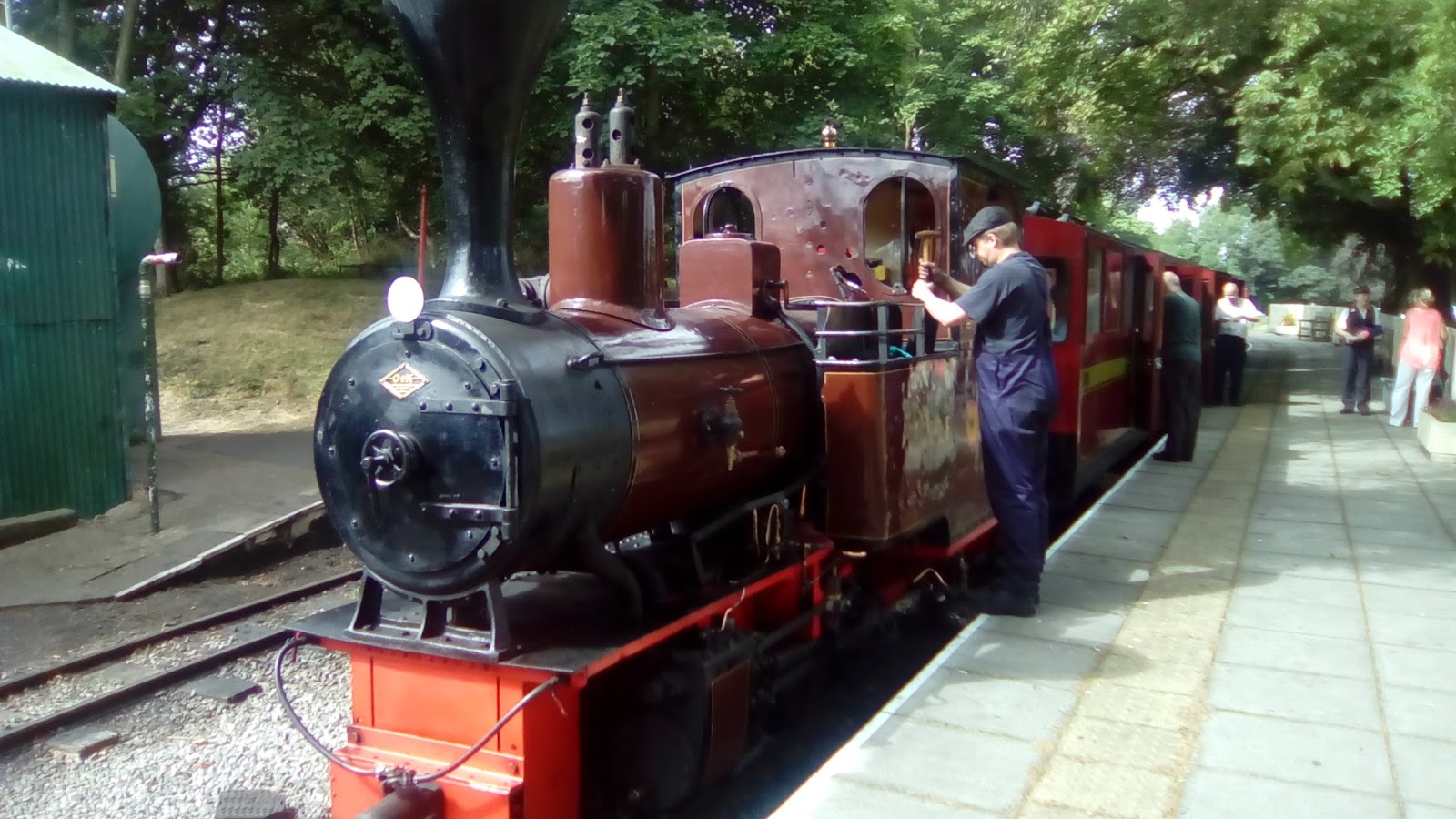
    Our locomotive was one of the line's O&K 0-6-0WT locos, Elf. She was being made ready before departure.

     I boarded one of the open-sided bogie coaches and before long we were chugging along the line. After skirting Page's Park ......

    ..... we very soon started making our way through various housing estates, which must make this railway fairly unique in the UK. We then crossed one of the many level crossings on the route - Stanbridge Road.

    At  Leedon Loop, the driver exchanged tokens .......

    ....... before we once more passed through housing estates and level crossings.

    On reaching the edge of the town we passed over Vandyke Road.....

    .... after which the line took an abrupt right turn. While pausing for the guards to reboard the train we could admire the recently landscaped wild flower meadow .....

    ..... before running alongside Vandyke Road and out into the countryside.

    After a mile or so we reached the Redland Brickworks ......

    .... before rolling into the line's terminus - Stonehenge Works.

    Here there were opportunities to view some of the exhibits and browse the exhibition showing the history of the railway and its connection to the World War I Light Railways.

     After watching the loco take on water .....

    and run round its train ....


    ..... I boarded once more for departure.

    Passing the wildflower meadow once more, we re-entered the outskirts of the town .......

    ...... passed the spur showing one of the branches to a former sand quarry .......

    ...... before passing Beaudesert (an Alan Keef diesel) on a Down train at Leedon Loop.

    We ultimately steamed back into Page's Park station to terminate our journey.

    After watching Elf run round her train ......

    ..... receive some ongoing maintenance ....

     ..... before departing once more, .....

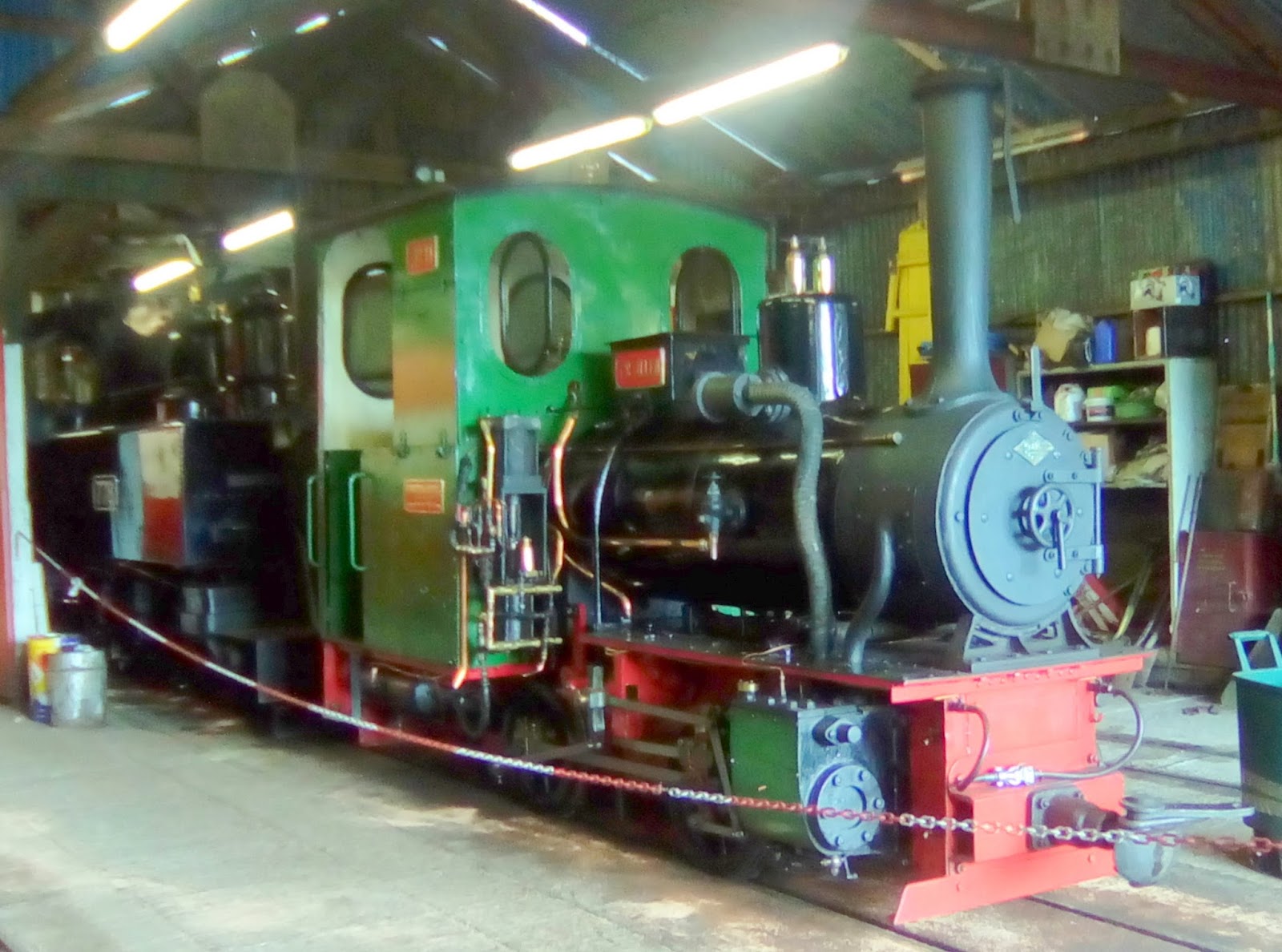
    ..... I partook of an excellent lunch of omelet and chips in the cafe and then wandered around the engine sheds where Chaloner (a de Winton vertical boilered loco) was on show .....

    ...... together with some of the line's other locos - another O&K 0-6-0 and a Baldwin tank.

     After another visit to the bookshop, I was able to watch the departure of Beaudesert, before hitting the road back to Cheshire.

    This is a remarkable little railway with an interesting history. I would like to revisit when it holds one of its galas to view some of the line's Simplex locos 'in steam'. Presumably, in a couple of years' time, when it reaches its 50th anniversary, there will be a special event or two. Well worth a return visit.

    Video