Search This Blog

Showing posts with label locomotive. Show all posts

Wednesday, 1 July 2026

Amberley Museum

In a nutshell

Gauge:          2' (610mm)

Length:      500 yd (460m)

Opened:     1982

 Location:   New Barn Road, 
                    Amberley, 
                    Near Arundel, 
                    West Sussex, 
                    BN18 9LT


Tel:         01798 831370     


Date of visit:     25 June 2026


Key Facts

  • The railway is based at Amberley Museum, in Amberley, West Sussex.
  • The museum is located in what was formerly a 36 acre chalk quarry.  
  • It currently has 45 locomotives - five steam powered (only one of which is in service), 29 internal combustion and four battery electric locos.
  • It also has around 80 items of rolling stock, mostly goods wagons
  • Its collection ranges from 18 in (457 mm) gauge to 5 ft 3 in (1600 mm) gauge
  • The site also houses a collection of Southdown buses, located in a reconstructed 1920s Southdown bus garage.
  • The site also boasts a "Connected Earth" telecommunications exhibition, an Electricity Hall, a machine shop, a wheelwright's shop, a vintage wireless and communications exhibition including an amateur radio station, a reconstruction of Ockenden's Ironmonger's shop from Littlehampton, a timber yard and steam crane, a reconstructed 1930s village garage, the Paviors Hall of Road Making with a display of road construction techniques from Roman to contemporary, a cycle exhibition, a railway hall of exhibits (mostly from industrial railways), 'Billingshurst' Signal Box, a contractors' monorail, a rural telephone exchange, the Arundel Gin Building housing a lead working and plumbing display, a late 19th century brickyard drying shed, a 1930s roadside (Fairmile) Café,  the Dover Cottage Pump House and water pumping display, a stationary engine shed, a typical 1950s fire station, a toll bridge hut,  a working print shop, a cobbler's shop, and the Hall of Tools, with associated demonstrations by the Tools and Trades History Society
  • In addition, periodically there are demonstrations of woodturning, broom-making, walking stick-making and the work of a blacksmith and potters
  • On site there is also the quarry tunnel, which appeared as Mainstrike Mine in the James Bond film A View to a Kill
  

Route


My Impressions

I visited on what was one of the hottest days of the year and so spent most of the time trying to find shade. Fortunately, the site of the museum has plenty of trees and some of the buildings were cool inside.

Being a fan of industrial archaeology, I found plenty to capture my interest on the site but, after a few enquiries as to how long the trains would be running, I decided I needed to get my train rides in early before the heat of the day defeated them.

A Hunslet diesel loco was sitting by the platform with a couple of small bogie coaches in tow, and so I boarded. The trains were supposed to be running every half hour, but it was quickly established that, because of the weather, they would run as and when they were needed.


The route meandered along one side of the former quarry, steadily gaining height as the train progressed.

 We stopped briefly at the intermediate station at Brockham, ......
 

........before pressing on past the tunnel (featured in a James Bond movie) and past a collection of sheds housing the railway's collection of locomotives and stock.

We passed over some fairly complex pointwork and ran alongside a section of dual gauge track before eventually arriving at the furthermost terminus of the line, Cragside.

 After touring the Railway Hall ......


 ...... and viewing some of the many exhibits, and also trying out many of the hand-on exhibits in the Electricity Centre, ......


....... I reboarded the train for the return trip.

After a refreshing cuppa and a cake in the site's café, I had another wander around some of the exhibits. There were no live demonstrations of crafts as it was mid-week outside the school holidays, but it was clear that there was likely to be a good range of fascinating displays of expertise and talent on offer.

Source: Wikimedia

I spent only around three hours at the museum, but I could easily have filled a whole day - particularly when displays of craftwork were scheduled. However, the extreme heat (c36C) defeated me, and I was forced to seek refuge in my air-conditioned car.

The site is well laid out and most of the displays have been well curated and made accessible for a range of interests and ages. Even on the wettest of days, there are plenty of indoor exhibits to pass the time.

To my mind, the entrance fee is extremely good value, given the range of what is on offer.


Video

Wednesday, 29 September 2021

The Wells and Walsingham Light Railway

In a nutshell

Gauge:          10¼" (260mm)

Length:       4 miles (6.4km)

Opened:      1857 (Standard gauge) 6 April 1982 (present railway)

Location:   

Wells & Walsingham Light Railway
Stiffkey Road
Wells-next-the-Sea
Norfolk
NR23 1QB


Web:      https://www.wwlr.co.uk
Tel:         01328 711630
 

Date of visit:     24th - 25th September 2021

Key Facts

  • The railway claims to be the longest 10¼ inch gauge railway and the smallest gauged public railway in the world
  • The trackbed for the line was once the standard gauge railway which ran from Wymondham to Wells where there was a terminus
  • Wells on Sea Station was also the terminus for the Heacham to Wells branchline
  • The original railway was built quite cheaply and so follows the undulations of the landscape and hence includes some fairly stiff gradients (up to 1 in 66)
  • The Wells and Walsingham Railway was established by Lieutenant-Commander Roy Wallace Francis  (1922 - 2015) a former British naval office
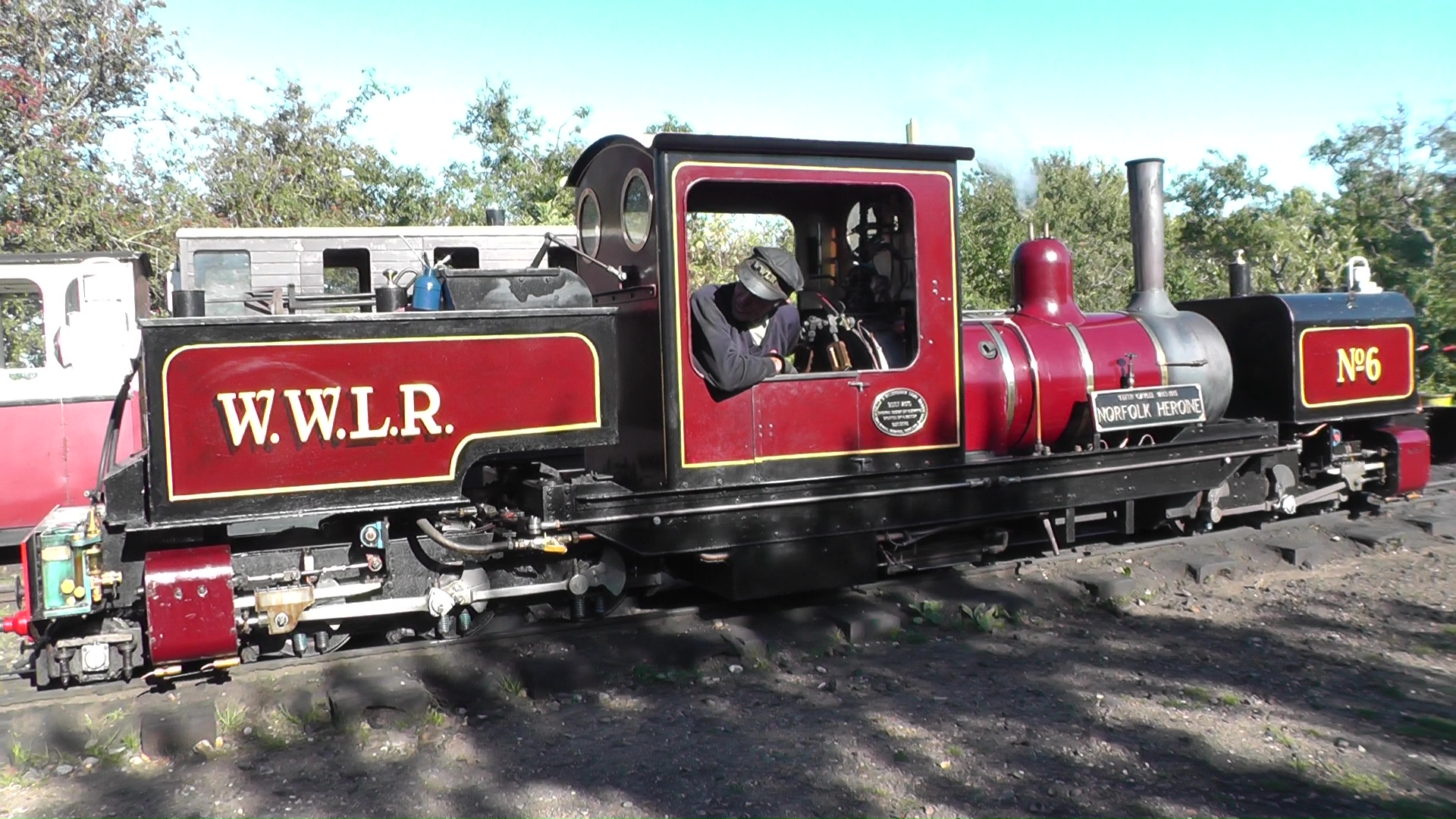
  • The railway's principal locomotives are two 2-6-0+0-6-2 Garratt steam locomotives (Norfolk Hero and Norfolk Heroine) and a Bo-Bo diesel loco (Norfolk Harvester)
  • The railway runs five trains each way during the summer season and four trains each way during the spring and autumn
  • There is a shop with a small range of refreshments available at Wells on Sea station
  • There is a large, free car park at Wells and the village (pay and display) car park at Walsingham is a five minute walk from the station
 

Route


My Impressions

I started my visit by going straight to the main station at Wells, where I familiarised myself with its layout and facilities.

The ground floor of the signal box includes a shop and a café serving a basic array of drinks and snacks.

Immediately behind the signal box is the engine shed and turning to the opposite end of the platform is the carriage shed. Spare stock is also stored on the siding behind the platform loop.


There is a large grassy car park, picnic facilities a play area for children and a gift shop selling locally produced paintings, ornaments and clothing accessories.

Ere long, a steam whistle announced the imminent arrival of a train from Walsingham.

I watched the train disgorge its passengers and the rather magnificent Garratt loco (Norfolk Heroine) run round its train.....


A few minutes later, the train departed for Walsingham

Most of the passengers decided to sit in the open topped carriages to make the most of the gorgeous late September sunshine with which we were blessed during my visit.

The following day, I revisited the line. This time going straight to Walsingham station where a large group of passengers was patiently awaiting the arrival of the first train of the day.

Once more, Norfolk Heroine had been rostered ......

.... and, after running-round, ........


...... she made a swift and efficient departure with quite a heavy train.


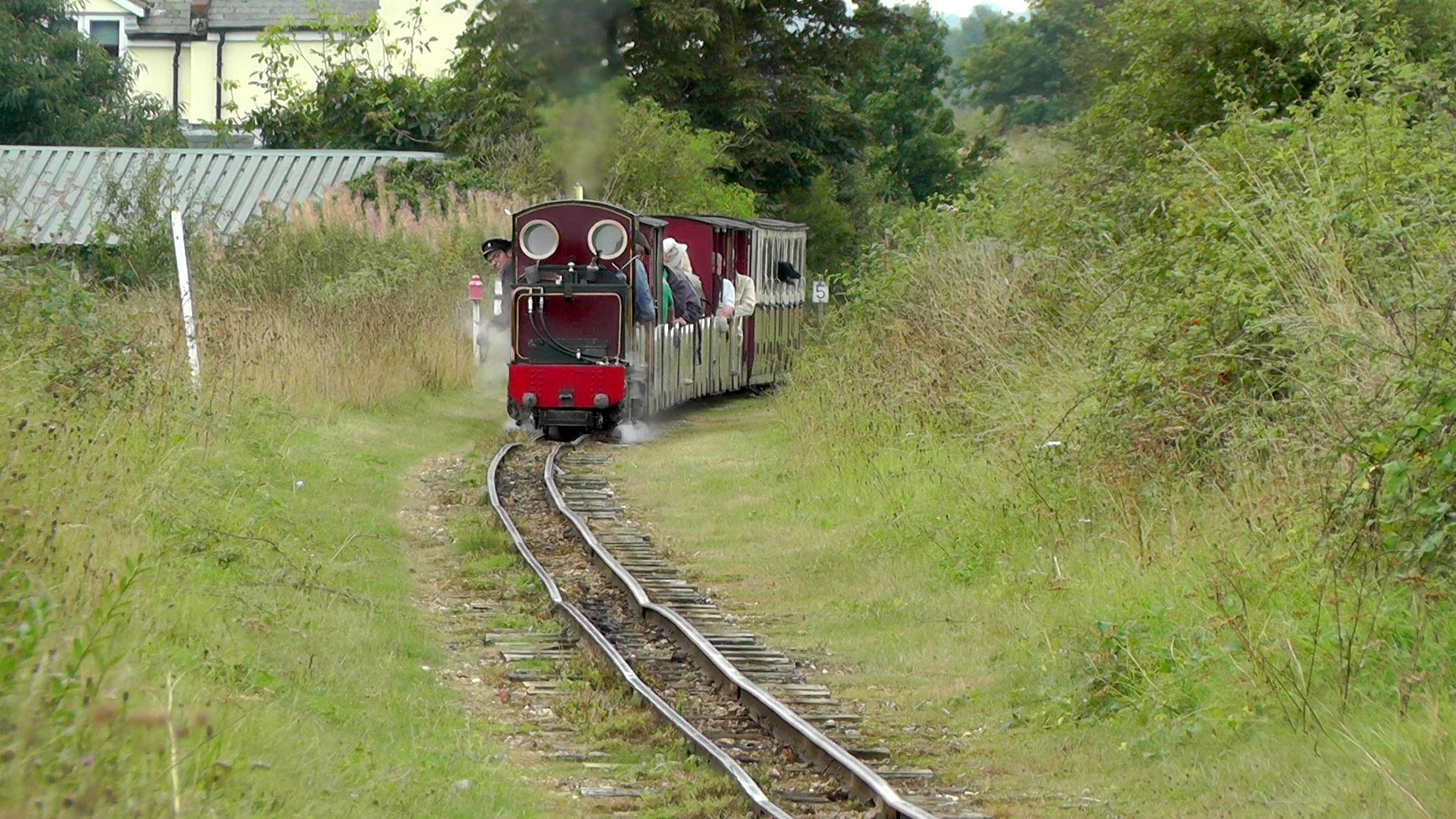
I hastened back to my car and then sped up the road, parked and was able to observe the train passing through Wighton

Returning to the car, I was then able to watch the train climbing the bank out of Warham


Another short car journey and I was able to catch the train's arrival into Wells, where the loco ran round and took on more coal and water.

Before long, the train departed once more.


I then drove down to Wells harbour where I found a very pleasant eatery and bought a few essential supplies, before returning to the station for my afternoon's adventure. .......

..... a cab ride!

Despite its diminutive size, the cab, while cosy, was sufficiently large to accommodate myself and the driver who described in detail the actions required to keep the locomotive performing at its optimum.

A 1 in 80 gradient out of the station is followed by a very short 1 in 440 gradient .........

...... then another 1 in 76 gradient - all within the first mile!

There then followed a 1 in 66 decent then a 1 in 96 ascent, and so the driver (who acts as fireman) has his work cut out ensuring the correct balance between fire and water level, as it runs from one end of the boiler to the other, maintains sufficient steam pressure for the climbs, without wasting steam on the descents.

In addition, there are five ungated level crossings and two intermediate halts to contend with so the train's speed has to be optimised for the conditions and there is much rather creative use of the whistle to alert drivers and warn potential passengers of the train's imminent arrival.

After three miles, there is a long and steady 1 in 80 climb .........

...... into Walsingham station, where a knot of passengers was awaiting our arrival.

After a sprightly run-round, we departed ......

There was time to admire the surrounding landscape which, at this time of year is quite picturesque with the lengthening shadows from the afternoon sun.

The passengers also seemed to be enjoying the sunshine and vistas of the Norfolk countryside - not to mention the ride!

As we approached Wells, I was alerted by the driver to a local avian resident perched on a branch just above the track.

On cue, the buzzard swooped down the track ahead of the train before swerving off to the left. A rather poignant and impressive end my rail-borne experience.

We slowly and, to my mind, rather majestically, coasted into the station.


This is an experience which will live with me for a long time. What a lovely little railway in a beautiful setting and an extremely picturesque part of the world. 

I can thoroughly recommend this railway for a visit. There is plenty to see and do in the area for all ages - and I can also endorse the quality of the dressed crab sandwiches available from the eateries in the town.

Video


Tuesday, 9 October 2018

Bicton Woodland Railway

In a nutshell

Gauge:         18" (457 mm)

Length:        1359 yards (¾ mile - 1242m) - 1½ mile journey out and back

Opened:       1963

Location:    


Bicton Park
East Budleigh
Budleigh Salterton
Exeter Devon
EX9 7BJ


Email:    https://www.bictongardens.co.uk/index.php?route=information/contact  
Tel.:       01395 568465 
 

Date of visit:     28 September 2018


Key Facts

  • The original 1963 trackplan included the station and a return loop through the Pinetum. The extension to the Hermitage was added in 1976.
  • The original rolling stock for the railway came from the Royal Arsenal Railway in Woolwich which, as it was 18" gauge, dictated the track gauge for the Bicton Woodland Railway.
  • The original locomotives were Woolwich (an Avonside 0-4-0T steam loco built in 1915), Bicton (an 0-4-0 Ruston Hornsby diesel built in 1942) and Carnegie (a Hunslet 0-4-0 0-4-0 articulated diesel loco built in 1954).
  • Another diesel loco joined the fleet in 1974 - a Ruston Hornsby 0-4-0 which was renamed Budley.
  • Seven goods wagons were also acquired from the Royal Arsenal and were subsequently converted into passenger carriages. Additional rolling stock was acquired from RAF Fauld and the Wolverton railway works which had 18" railways.
  • In 2000, three locomotives and much of the rolling stock was sold to the Royal Gunpowder Mills at Waltham Abbey and a new locomotive was commissioned from Alan Keef Ltd. - an 0-4-0 steam outline diesel locomotive called Sir Walter Raleigh. 
  • Four new carriages were also purchased from Alan Keef and Bicton was refurbished to match the steam outline appearance of Sir Walter Raleigh.
  • The journey lasts about 25 minutes
  • There is a well stocked restaurant and shop at in the gardens and plenty to see

Route


My Impressions

After paying my entrance fee to the gardens and passing through the shop and acknowledging the whereabouts of the toilets and restaurant, I made my way to the station. There was already a small queue of people awaiting the train's departure which, at this time of year, was every hour.

I showed my ticket and boarded the train, choosing the tail-end compartment in the last carriage.

With a toot, the Alan Keef diesel powered, steam outline loco pulled out. We very quickly entered a slightly wooded area on the banks of the dam which had been built for the ornamental lake.

Passing over the dam, we had a good view of Bicton House standing above the lake.

We then negotiated a triangular wye junction, .......

...... before heading out through the trees of the Pinetum.

At intervals, the driver tooted the whistle to alert us to points of interest printed on a card which we were loaned at the beginning of the journey.

At the furthermost end of the Pinetum, the track curved around and back on itself to give us an alternative perspective on the gardens.

The grounds are extremely well tended and clearly laid out. One day I must return and explore everything more thoroughly; this was a flying visit to give time to travel on the nearby Seaton Tramway in the afternoon.

We headed back towards the triangular junction ........

.... crossing over the junction for the loop, and then .......

...... taking the other branch at the wye junction.

We headed up the side of the lake towards the Hermitage, ........

..... where the line terminates with a loop.

Our loco (Sir Walter Raleigh - who was born nearby) ran round the train, .......

...... and then we set off once more.

We took the left-hand branch of the wye, .......

...... to cross the dam once more.


..... and then pulled back into the station.

I spent a short while watching the loco run round the train .........

chatting with the driver and snapping the older rolling stock, which dates from the time when the railway acquired its stock from the Woolwich Arsenal Railway.

I then made my way back to the car park and thence on to Seaton.

As can be seen from the photos and video, the railway is well established and follows an interesting route through the grounds. There is plenty more to see; not just the gardens and the house, but also a museum housing artefacts from the locality.

Given more time, I would have explored further, so it looks as if I will have to make a return visit - something I will look forward to doing.

Video