Search This Blog

Showing posts with label two foot. Show all posts

Wednesday, 1 July 2026

Amberley Museum

In a nutshell

Gauge:          2' (610mm)

Length:      500 yd (460m)

Opened:     1982

 Location:   New Barn Road, 
                    Amberley, 
                    Near Arundel, 
                    West Sussex, 
                    BN18 9LT


Tel:         01798 831370     


Date of visit:     25 June 2026


Key Facts

  • The railway is based at Amberley Museum, in Amberley, West Sussex.
  • The museum is located in what was formerly a 36 acre chalk quarry.  
  • It currently has 45 locomotives - five steam powered (only one of which is in service), 29 internal combustion and four battery electric locos.
  • It also has around 80 items of rolling stock, mostly goods wagons
  • Its collection ranges from 18 in (457 mm) gauge to 5 ft 3 in (1600 mm) gauge
  • The site also houses a collection of Southdown buses, located in a reconstructed 1920s Southdown bus garage.
  • The site also boasts a "Connected Earth" telecommunications exhibition, an Electricity Hall, a machine shop, a wheelwright's shop, a vintage wireless and communications exhibition including an amateur radio station, a reconstruction of Ockenden's Ironmonger's shop from Littlehampton, a timber yard and steam crane, a reconstructed 1930s village garage, the Paviors Hall of Road Making with a display of road construction techniques from Roman to contemporary, a cycle exhibition, a railway hall of exhibits (mostly from industrial railways), 'Billingshurst' Signal Box, a contractors' monorail, a rural telephone exchange, the Arundel Gin Building housing a lead working and plumbing display, a late 19th century brickyard drying shed, a 1930s roadside (Fairmile) Café,  the Dover Cottage Pump House and water pumping display, a stationary engine shed, a typical 1950s fire station, a toll bridge hut,  a working print shop, a cobbler's shop, and the Hall of Tools, with associated demonstrations by the Tools and Trades History Society
  • In addition, periodically there are demonstrations of woodturning, broom-making, walking stick-making and the work of a blacksmith and potters
  • On site there is also the quarry tunnel, which appeared as Mainstrike Mine in the James Bond film A View to a Kill
  

Route


My Impressions

I visited on what was one of the hottest days of the year and so spent most of the time trying to find shade. Fortunately, the site of the museum has plenty of trees and some of the buildings were cool inside.

Being a fan of industrial archaeology, I found plenty to capture my interest on the site but, after a few enquiries as to how long the trains would be running, I decided I needed to get my train rides in early before the heat of the day defeated them.

A Hunslet diesel loco was sitting by the platform with a couple of small bogie coaches in tow, and so I boarded. The trains were supposed to be running every half hour, but it was quickly established that, because of the weather, they would run as and when they were needed.


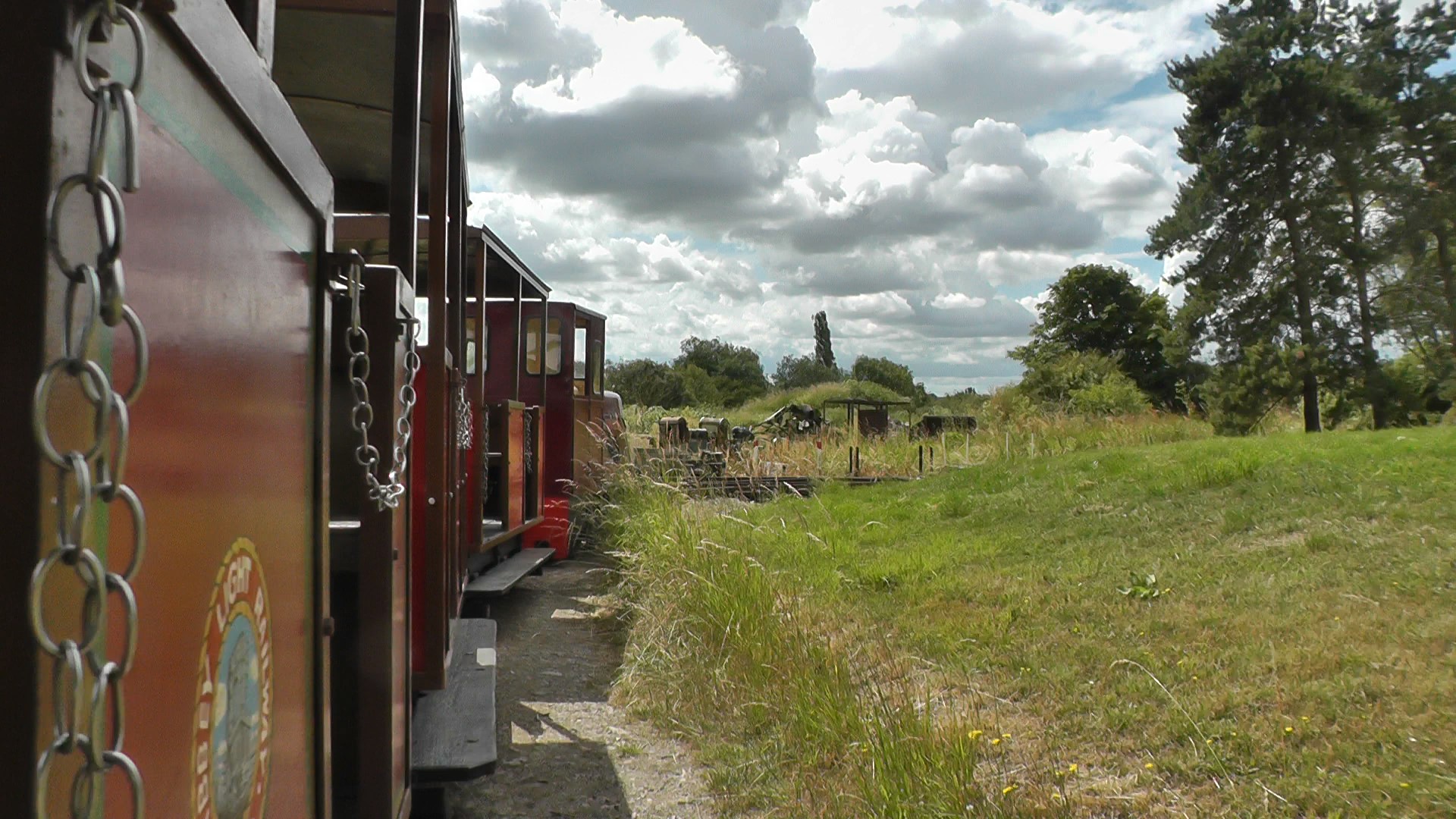
The route meandered along one side of the former quarry, steadily gaining height as the train progressed.

 We stopped briefly at the intermediate station at Brockham, ......
 

........before pressing on past the tunnel (featured in a James Bond movie) and past a collection of sheds housing the railway's collection of locomotives and stock.

We passed over some fairly complex pointwork and ran alongside a section of dual gauge track before eventually arriving at the furthermost terminus of the line, Cragside.

 After touring the Railway Hall ......


 ...... and viewing some of the many exhibits, and also trying out many of the hand-on exhibits in the Electricity Centre, ......


....... I reboarded the train for the return trip.

After a refreshing cuppa and a cake in the site's café, I had another wander around some of the exhibits. There were no live demonstrations of crafts as it was mid-week outside the school holidays, but it was clear that there was likely to be a good range of fascinating displays of expertise and talent on offer.

Source: Wikimedia

I spent only around three hours at the museum, but I could easily have filled a whole day - particularly when displays of craftwork were scheduled. However, the extreme heat (c36C) defeated me, and I was forced to seek refuge in my air-conditioned car.

The site is well laid out and most of the displays have been well curated and made accessible for a range of interests and ages. Even on the wettest of days, there are plenty of indoor exhibits to pass the time.

To my mind, the entrance fee is extremely good value, given the range of what is on offer.


Video

Tuesday, 30 June 2026

The Old Kiln Light Railway

In a nutshell

Gauge:        2'

Length:      ½ mile (0.8km)

Opened:     1982 (at present site) 1971 (as Wey Valley Light Railway)

Location:   Old Kiln Light Railway
                    Rural Life Living Museum
                    Reeds Road
                    Tilford
                    Farnham
                    GU10 2DL


Web:          https://oklr.org/
Email:         info@oklr.org

Date of visit:     21 June 2026

Key Facts

  • Located at the Rural Life Living Museum in Tilford, near Farnham in Surrey.
  • It was originally founded in the early 1970s as the 150 yard long Wey Valley Light Railway which ran around the grounds of the Moor Park Venture Scout Unit.
  • The track and equipment were moved to the Old Kiln Museum, now known as the Rural Life Centre in 1982 when the land at the original site was sold for housing.
  • The line has since lengthened around the centre
  • A small stretch of track serves the museum's heritage timber yard demonstration area
  • The railway has two steam locomotives and currently a third is on loan from the Moors Valley Railway
  • It also has sixteen internal combustion powered locomotives and an other on loan
  • It has six coaches and around a dozen wagons, mostly former RNAD or RAF stock.
  • It is run by a team of dedicated volunteers and received the "Surrey Industrial History Group Conservation" award in 1994
  • It has four stations: Reeds Road, Old Kiln Halt, Oatlands and Mills Wood 

Route


My Impressions

The 21 June 2026 was one of the hottest days of the year and so when we arrived, we made immediately for the café and sat with a soft drink under the trees.

Source: Simon Burchell

 After a brief tour of the museum we settled down to watch the Berkshire Bedlam Morris Dancers who were staging a performance for visitors. The railway had suspended the running of trains while the morris dancers were performing. The quality of the morris dancing was superb - a series of Fieldtown dances some of which were very complex.

 While the dancers were resting, I was able to grab a quick train ride, down and back up the line. I was the only passenger.

 The dancing resumed and then a few more train rides were organised, one of which was a special train for the morris side and their families.

The line travels around three sides of the site, mostly through woodland ......

........ and then between a campsite and the edge of the museum grounds. 

There are extensive workshops and sheds housing most of the railway's collection of stock which can be glimpsed through the open doorways as the train passes by.

 The two through stations are request stops, but most of the passengers were content to travel from one end of the line to the other.

The staff were very friendly and informative, willing to answer questions and demonstrate their knowledge of the railway and its stock.

 Unfortunately, there were only sandwiches and cakes available in the café during our visit as the cook was on holiday, but I understand there is usually a fairly comprehensive menu of hot meals available in addition to hot beverages and cold drinks.

 The exhibits around the site are interesting and well laid out. Often there are demonstrations of, for example, blacksmithing. It would be advisable to check what events are planned before making a visit.

Source: https://www.visitsoutheastengland.com

 There are play areas for children and plenty of places undercover and outside for picnics.


Video

Tuesday, 5 July 2022

North Ings Farm Museum

 In a nutshell

Gauge:          2 foot (610cm)

Length:        600 yards (548m)

Opened:       1972 (Private railway) - 1990 (Public railway)


Location:    

Fen Rd, 
Dorrington, 
Ruskington, 
Lincoln 
LN4 3QB


Web:      https://northingsfarmmuseum.co.uk/
Email:    https://northingsfarmmuseum.co.uk/contact-us/
Tel.:        01526 833100


Date of visit:     3rd July 2022


Key Facts

  • The railway was first established in 1972 to provide transportation for the farm's chicken and egg production facilities
  • By 1981, poultry farming on the site had ceased and the railway and collecting agricultural equipment became a hobby
  • In 1990, the local council suggested that the museum's collection of artefacts should be opened to the public
  • The railway has eight industrial diesel locomotives and two further locos on loan from the Talyllyn Railway's Narrow Gauge Railway Museum
  • There is also a freelance vertical boilered steam locomotive which is currently out of action awaiting a new boiler
  • The three passenger coaches were acquired from the Abbey Light Railway after its closure in 2012
  • The signal box, which is prominent on the site, was acquired from Holmes Yard at Lincoln, where it was used as a paraffin store. The lever frame inside the box is from  Skellingthorpe near Lincoln.
  • The farm site is a treasure trove of farming and construction machinery and industrial narrow gauge wagons
  • The museum opens on the first Sunday of each month from April to October.
  • The modest entrance fee allows you to roam freely over the site and have unlimited rides on the railway.
  • Hot and cold drinks and biscuits and confectionary are available


Route


My Impressions

After Google maps navigated me down various narrow winding lanes I had very little idea of where I was. Fortunately, there was a reassuring sign at the end of a farm track informing me that I had arrived and, furthermore, that the museum was open.

There was a pleasing air of informality about the museum with the owners and volunteers clutching mugs of tea, discussing the relative merits of dog clutches and the intricacies of gearboxes, or demonstrating and explaining the exhibits to visitors.

I was invited to wander the sheds and the grounds at my leisure. I started with the sheds, wherein were stored an impressive array of industrial locos .....


...... tractors of various vintages ......

..... and a lightweight Commer truck.


The grounds proved equally intriguing, with a vast array of industrial narrow gauge wagons and locos in various states and stages of renovation.


After a chat with the staff who were keen and well informed to answer any questions I posed, I took a ride on the train.

After curving round beside the signal box, the train made a descent .......

..... to the nether regions of the site.

We wound our way through the lush undergrowth ....

.... passing by the lake and then made a 1:35 climb back up towards the main part of the museum


......  and passed through the station (Pear Tree Junction), .....

before repeating the journey and then arriving back at the start.

I spent a very pleasant morning at the Museum and gained considerable knowledge of industrial locomotives and the history of the museum from the well informed and helpful staff who were in attendance.

I can thoroughly recommend a visit if you happen to be in the area on the first Sunday of a summer month. It's far more interesting than an impersonal, regimented and formalised railway museum. Particularly if you want to get down to the nitty gritty of how these things work.


Video


Tuesday, 30 September 2014

London Museum of Steam and Water - Waterworks Railway

In a nutshell

Gauge:         2'

Length:      400 yards

Opened:     2009

Location:    

Green Dragon Lane,
Brentford,
Middlesex,
TW8 0EN


Web:        http://www.waterandsteam.org.uk/our-engines/waterworks-railway
                
www.facebook.com/waterandsteam
                 www.twitter.com/waterandsteam
Email:     learning@waterandsteam.org.uk
Tel:           020 8568 4757  


Date of visit:     6 September 2014


Key Facts

    • The railway is situated on the site of the Kew Bridge Water Works which was opened in 1838 with Boulton & Watt and  Maudlsay, Sons & Field beam engines to pump the water
    • The museum has a collection of ten pumping engines of various sizes and vintages, including the  world's largest working beam engine built in 1846
    • The museum was refurbished in 2013 and includes an impressive array of interactive educational exhibits designed to inform children and adults about the workings of steam engines and waterworks
    • This company did not operate its own internal railway system but when it opened as a museum, a 2' narrow gauge railway was built to represent the type of railway which could be found in other waterworks. Waterworks railways were used to transport coal for the pumping engines and sand for the filter beds
    • The railway has two locomotives; a replica Wren locomotive, Thomas Wicksteed, built by Hunslet in 2009 and a 1957 three cylinder internal combustion Lister railmotor, 'Alister'.
    •  The railway usually runs at weekends when the pumping engines are also in steam - see calendar for more details - http://www.waterandsteam.org.uk/Events/Calendar
    •  The is a cafe on site which serves a selection of hot food and snacks.


    Route


    My Impressions

    I travelled overland by train from Waterloo to Kew Bridge station and took the short walk around the corner to the museum (see above Google Map). The museum is easily recognisable by the Victorian standpipe tower which dominates the skyline.

    The building from the outside didn't look particularly inspiring,

    but passing inside, through the pleasantly appointed cafe and bookshop.....

     ...... I immediately encountered the museum's collection of working pumping engines.

     I passed quickly through the main hall to make my way outside to find the museum's 2' narrow gauge railway. The train was waiting at the platform with the line's 3 cylinder Lister locomotive, Alister coupled up the the railway's open carriage and ready to depart.

     At the other end of the train, the railway's Hunslet-built Wren class locomotive, Thomas Wicksteed, was quietly steaming.

     I boarded the train and we departed.

     We chugged around to the rear of the museum and came to a halt.

     Within a short while. Thomas Wicksteed, chuffed around after us and pulled up to couple to the coach.

     The driver then opened the regulator and the train set out for the return journey.

    We steamed back around the rear of the museum and cruised back beside the platform where we disembarked and had an opportunity to admire the locomotives.

    The replica Wren locomotive, constructed in 2009, is a masterpiece of small scale engineering.

     Its anatomy is readily accessible. I was particularly interested in the functioning of the injector as this was something I was representing on a 16mm scale model locomotive I was constructing at the time. The driver was happy to not only explain how it worked but to demonstrate its operation which was especially helpful.

     Since my visits to the Apedale Valley Light Railway and more recently to Steeple Grange, I have become increasingly captivated by small industrial narrow gauge internal combustion locomotives. Lister locomotives have been constructed since 1926 and this particular model was built in 1957. I was interested in seeing how the design had changed over the years, since the earliest model.

    Having sated my appetite for narrow gauge rail travel, I turned my attention to the other exhibits in the museum. As a former primary school teacher, I was particularly interested in how the museum's exhibits were presented for a younger audience - and I was not disappointed. As them museum depicts the relationship between water and steam, there is an instant appeal for children which the museum appears to have exploited to the full. In the outdoor area beside the railway, there was a play area where children (and their parents, of course) can play and experiment with water - pumping it, damming it, re-directing it.

     Behind this area is a water is the Hindley Water Wheel which was constructed in 1902 to pump water from the River Frome to the Duke of Somerset's estate. It was interesting to see how water power was being used to pump water.

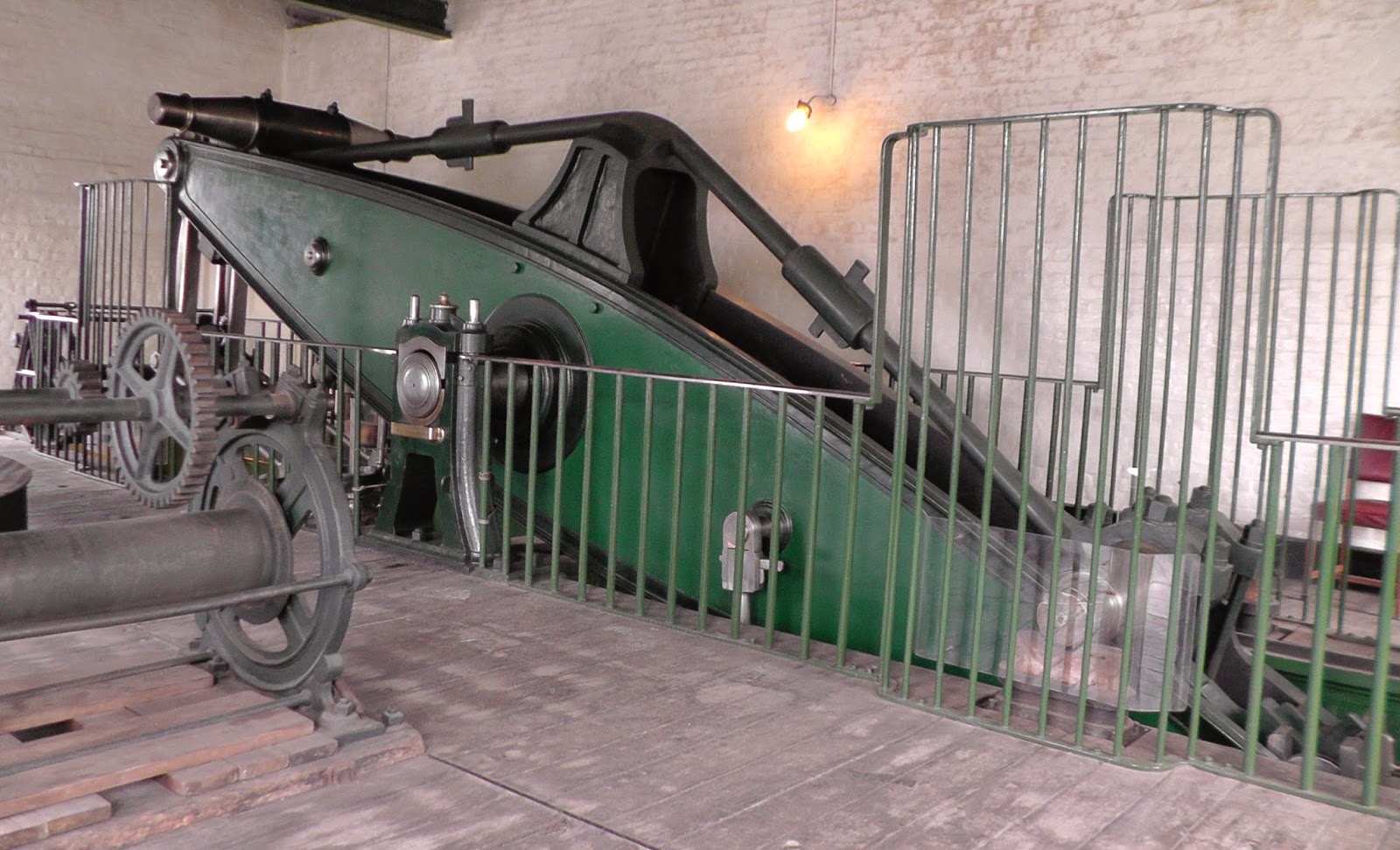
    Inside the museum, four of its steam engines were functioning at various intervals during the day.

    The Easton and Amos Engine (1863) was quite different to the museum's large Cornish beam engines by having one end of its beam connected to a crank to produce rotary motion rather than the reciprocating motion needed for pumping. This engine came from the Cliftonville Pumping Station in Northampton where it drove a set of pumps from an extension to the crank shaft.

    The Hathorn Davey Triple Expansion Engine (1910) shows how steam powered pumping engines developed in the early 20th century. The three cylinders are inverted and placed in a line directly over the crankshaft in much the same way as a modern car engine. It came from a pumping station in Newmarket and was in motion throughout my visit.

    The Waddon engine was built by James Simpson & Company in Pimlico in 1910. The high and low pressure cylinders are horizontal with a flywheel between them.

    The last engine which I saw functioning during my visit was the The James Kay engine or Dancers End engine, as it came from the Rothschild Dancer's End Estate near Tring. It was used to pump water from a well. The engine was built in 1867 by James Kay of Bury. The engine differs from all the other engines in the museum as it has two high pressure cylinders, each connected to its own beam and crank with a common flywheel. It's though that this engine was originally used in a textile mill and was later converted to pump water.

    As the museum hosts the world's largest operating steam engine, I took some time to view the enormous engines which are housed there.

    Although they weren't operational on the day I visited, there was plenty of information and video screens showing how the machines worked.

    The operational 90 inch Engine was built in 1846 by Sandys, Carne & Vivian of Copperhouse Foundry, Hayle, Cornwall and was the first engine built in Cornwall specially for waterworks duty.

    The 100 inch engine was built by Harvey & Co of Hayle in 1869, and is the largest surviving single cylinder beam engine in the world. When it was running it was synchronised with the 90 inch engine. It was used until 1958, when the chimney stack became unsafe and was demolished and the boilers decommissioned.

     Before leaving, I quickly toured the other exhibits which seemed extremely well organised, providing visitors with plenty of hands-on experience.

    Clearly, a lot of thought has gone into how the exhibits are organised to ensure they are informative and motivating for both adult and child audiences.

    I think it's still true to say that children enjoy paling with water. And from my observations, it would seem their parents have just as much interest and enthusiasm to participate in the activities.

    I would imagine that children of all ages would be fascinated by many of the features in this museum. And, of course, there is the added bonus of a working narrow gauge railway!


    Video

    [In preparation]