Search This Blog

Showing posts with label 2' gauge. Show all posts

Thursday, 11 October 2018

The Gartell Light Railway

In a nutshell

Gauge:         2' (610 mm)

Length:       ¾ mile (1.2 km)

Opened:     1991

Location:   

Common Ln,
Yenston,
Templecombe
BA8 0NB


Web:         http://newglr.weebly.com/
Email:      http://newglr.weebly.com/contact-us.html
Tel.:          01963 370752


Date of visit:     30 September 2018


Key Facts

  • The railway is owned privately by John and Christine Gartell
  • It is open through the main summer season (March to October), usually on the last Sunday of each month and on Bank Holidays
  • The line is run by volunteers and the owners
  • The main terminus for the railway is at a former farm adjacent to the now closed Somerset and Dorset Junction Railway. The line then joins the old trackbed of the railway by a flying junction.
  • On Open Days, there are usually three locomotives and trains in steam, with departures every 20 minutes.
  • The railway is fully signalled, with signals and signal boxes rescued from various parts of the country.
  • At the time of writing, the railway has five locomotives: two steam locos, built locally for the line, and three diesels acquired from Southend Pier Railway, Baguley & Drewry and Alan Keef Ltd.
  • In addition to the passenger stock, the railway also has some interesting goods rolling stock, built specially for the line.
  • There is a large restaurant with a good selection of hot and cold food, including gluten free cakes. There is also a small shop with a range of souvenirs, secondhand books and magazines and modelling items.
  •  

Route


My Impressions

Wow!! What an interesting little railway! This railway is an Enthusiasts' Delight and a credit to the owners and the band of volunteers who run it.

My initial impression, after turning down an insignificant little country lane, was how well laid out everything was and how well organised and efficiently everything was being run. There was a large car park with easy access to the main station, where we paid our modest entrance fee and surveyed what was on offer in the restaurant. The menu wasn't extensive but more than sufficient to meet our needs - I opted for the all day breakfast which was well cooked and served on a generous plate.

I then made my way across one of the two footbridges to the departure platform.

I boarded the train and waited a short while before we received the off.

 My loco was the line's bo-bo diesel hydraulic, Amanda (previously from Southend Pier but rebuilt in the line's workshops).

We stormed up the 1:32 gradient, passing under the main line, ........

 ...... and then climbed parallel to the main line up the 1:50 gradient .......

..... to pull into Pinesway Junction.

Here, intriguingly, the loco ran round its train, .....

....and another train pulled in alongside us. After a pause, both trains pulled out together, the other train descending the 1:50 while we climbed the 1:38 gradient on the mail line to the flyover

..... where we passed over the other train.


...... which then proceeded onwards to  the main station at Common Lane.

We pressed on and shortly arrived at Tower View, .......

..... where we halted and the loco once more ran round its train.

After a few minutes' wait, we departed .......

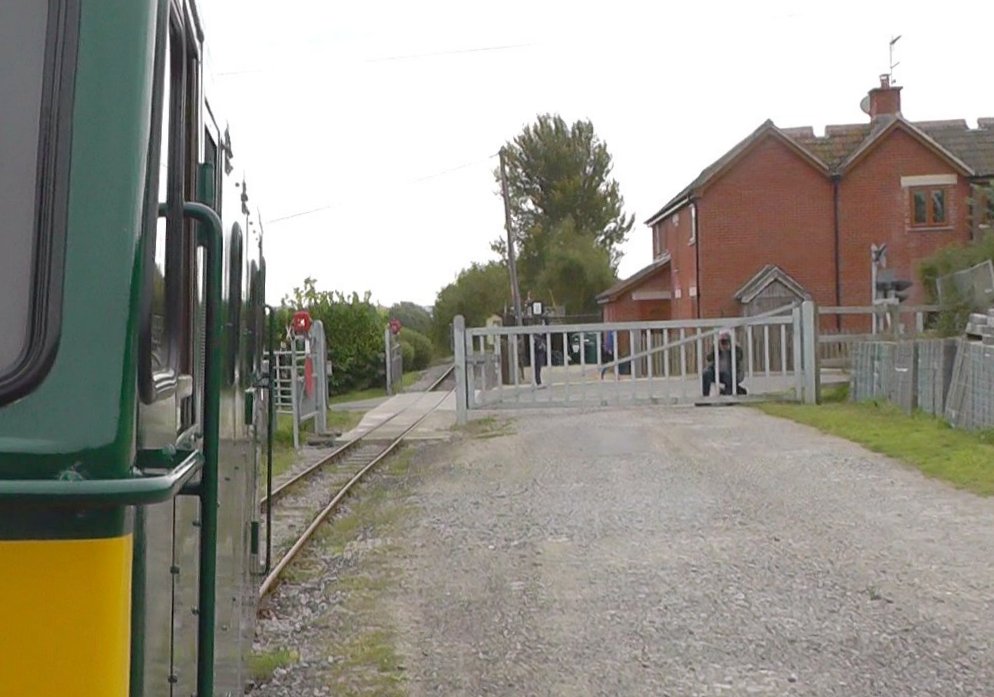
 .....  descending the main line, passing over Common Lane Level Crossing, ......
..... passing over the flyover ..........

..... and on through Pinesway Junction without stopping.

We then struck out into open countryside ..........

...... before pulling into Park Lane.

 ..... where I alighted to watch the loco running round.

A few minutes later, .......

...... and we were off once more, ascending the 1:132 gradient back towards Pinesway Junction.

Another train was awaiting us as we pulled in.

 As previously, both trains waited a short while and then pulled out together. We descended, while the other train climbed ........

 ..... until we passed beneath the flyover.

We then pulled back once more at the main Common Lane station.

 After a cuppa in the restaurant, I made my way over the meadow to Pinesway Junction where I was in time to see Amanda and one of the line's two steam locos, North Dorset Loco Works, Mr G departing in parallel

A few minutes later, Amanda 'hurtled' non stop through the station beneath the railway's impressive signal gantry.

After a wait of about ten minutes, the line's second steam loco, No. 9 Jean, powered up the gradient from beneath the flyover hauling the Pines Express.

After running round, ........

..... Amanda pulled in from Park Lane.

The two trains pulled away simultaneously,  with Amanda dropping down and Jean rising up over the flyover.

It was then Jean's turn to race through the station .......

...... before Mr G, was heard and seen charging up the 1:32 gradient from Common Lane station with John Gartell at the regulator.

After watching her arrive and run round ......


 ...... I was treated to the spectacle of two steam locos pulling away in tandem.

I then went back down to Common Lane station to watch a few train movements ........

 ....... and inspect the rolling stock in the sidings. The Baguley Drewry 0-4-0 diesel hydraulic (Andrew) was an impressive looking loco......

 .... and the railway's collection of good rolling stock was charming, .......

..... beautifully constructed ........

....... and utilitarian.

After browsing the shop and purchasing some secondhand model railway magazines for a modest sum, I bade my farewell to this wonderful little railway.

I would certainly like to return one day. Everyone I encountered was welcoming, helpful and busy. Trains departed every twenty minutes and so it would have been possible to travel the railway behind al three locomotives had I wished, and it was possible to visit the signal cabins by request. The sounds of the locos was constantly backgrounded by the clunk of signals - a very satisfying sound.

This is a gem of a railway which has clearly been created and is maintained with loving care and exquisite attention to detail. There is plenty to occupy and maintain the interest of both the casual visitor and the ardent enthusiast.

Video


Thursday, 11 August 2016

Morwellham Quay - Copper Mine Tramway

In a nutshell

Gauge:         2'

Length:       Approx ¾ mile overall

Opened:     Originally mid 19th century
                   Visitor tramway - early 1970s

Location:   


Morwellham Quay
Morwellham
Tavistock
Devon
PL19 8JL
United Kingdom

Web:       admin@morwellhamquay.org 
                https://www.morwellham-quay.co.uk/
Email:     https://www.morwellham-quay.co.uk/index.php?route=information/contact
Tel.:        01822 832766 


Date of visit:     9 June 2015


Key Facts

  • Morwellham Quay was established in at least 1105 and remained important as a harbour well into the 19th century when it became the biggest exporter of copper in the British Empire with vessels of up to 300 tonnes using the quays.
  • The George and Charlotte copper mine through which the railway runs was opened in 1718 when it was known as the Providence Mine.  The George and Charlotte Mine is first mentioned in documentary sources from 1775.
  • The tramway runs 460 metres into the Deep Adit of the mine and passed an underground waterwheel which was used to pump water out of the lower levels of the mine 350 feet below.
  • In addition to copper and arsenic, the mine yielded a number of rare minerals including the largest known crystals of childrenite in the world.
  • Between 1862 and 1867 the mine reached its peak production, but it closed in 1868. It was reopened from 1869 to 1871. 
  • In the early 1970s, a new access to Footway Shaft was created to allow the narrow gauge tramway to be constructed. The railway travels for over 480 metres into the mine.
  • The railway follows the entrance to Deep Adit, just above the River Tamar, and extends past Whim Shaft, an internal shaft, the bottom of Crosscourse Shaft, and past Ley's Shaft towards Downs Shaft.
  • This adit was the main water drain for the mine and also the principal means of access for materials.
  • The adit roof is approximately 2 metres high and 1.8 metres wide. 
  • In 1985/86 the 'New Quay Drive' railway tunnel excavation (through virgin rock) connected the side of Deep Adit (at a point approximately 200 metres from the portal) to a new railway tunnel portal, via Engine Shaft thereby making a balloon loop for the railway.
  • The railway uses battery powered locomotives and specially built 'carriages' for the visitors.

Route


My Impressions

After parking and making my way through the ticket office and shop for the Morwellham Quay site, I made my way down towards the quays and the main exhibits

The site itself looked very interesting but I was anxious to make my way directly to the Mine Tramway as I heard it can become very busy at peak times. After passing through the main village, I headed upwards behind the white buildings on the right to the Mine Tramway station.

A small queue was forming and we had to wait as a party of French schoolchildren were pre-booked on to first train.

Before long another train pulled into the station ......

.... and before boarding there was a brief opportunity to admire the one of the BEVs (Battery Electric Vehicles) which would be our motive power for the journey underground.

We were ushered aboard the passenger coaches and given safety instructions. I managed to secure a place directly behind the loco - an advantage of getting there promptly and waiting .....

....... and before long we were off. The first quarter of a mile or so of track took us alongside the River Tamar which we glimpsed from time to time through the trees and bushes which lined the railway ......

..... and then we reached the entrance to the mine itself - which looked quite unprepossessing and utilitarian.

 The train wound its way through various galleries and tunnels where clearances were quite tight - which explains the cage-like structure surrounding each carriage.

At intervals we stopped and our driver informed us about the history and working practices in the mine.

 The conditions were harsh and much of the work was done by hand. It seems hard to believe that, at one point, this mine and those surrounding it were the most productive in the whole of the British Empire.

After negotiating a few more twists and turns, we came to what was, for me, the highlight of the tour .... the underground waterwheel.

Not easy to photograph through the grille of the carriage roof, the waterwheel, which has been restored to working-order, was used to pump water from the lower chambers of the mine, which extended up to 350 feet below us.

We then set forth one more ........

..... until, ultimately, daylight was seen once more.

We emerged into outside world and made our way to a run round loop, ........

..... which gave us some tantalising glimpses of yet more industrial archaeological sites beside the river.

The loco ran around its train ......

 ..... and we then made our way back up the valley ....

.....  passing en route, the entrance to the mine which we used previously.

We now retraced our tracks .....

...... before arriving at the station once more.

 There was time to watch the loco run round its train .....

..... before it made ready for the next batch of visitors.

There was time for me to visit a few more of the exhibits .....

.... including the house which had been used for the filming of the TV documentary about the Edwardian Farm.

I was very impressed with the mine tramway. It afforded us with the opportunity to venture into the workings of a real copper mine and gain some idea of the sorts of conditions in which this important ore was extracted during the Victorian era.

I thoroughly enjoyed my visit - not only to the railway - but also to the whole site - and the corned beef hash which I enjoyed in the café
was also something to savour.

Video