Search This Blog

Showing posts with label heritage. Show all posts

Friday, 18 July 2025

Lincolnshire Coast Light Railway


In a nutshell

Gauge:         61cm

Length:      ¾ mile

Opened:     1960 / 2009 (on present site)

Location:


 Skegness Water Leisure Park 
Walls Lane 
 
Ingoldmells
Lincolnshire
PE25 1JF


Date of visit:     16 July 2025


Key Facts

  • The railway was originally located at Humberston near Cleethorpes, where it opened in 1960
  • It closed there in 1985 and reopened on its present site on 3 May 2009
  • It originally used equipment from the Nocton Potato Estate railway and operated there until 1985. 
  • It was the first heritage railway in the world to be built on a greenfield site.
  • The first services used a Motor Rail "Simplex" locomotive and a bogie carriage converted from a wagon
  • The line now has seven Simplex locos of various vintages and a Peckett 0-6-0T steam loco, Jurassic.
  • In addition to its original bogie coach, it has two former Ashover Railway coaches (one in the process of renovation) and a coach from the Sand Hutton Railway (also undergoing renovation)
  • It also has several former WD wagons which have been beautifully restored under the auspices of the LCLR Heritage Vehicles Trust


Route


My Impressions

After making my way through the barrier to the Caravan Park (there is no entrance fee BTW), I parked up outside the station building and bought my modestly priced (£2.00 GBP) ticket. 

The train was already awaiting its passengers, and so I boarded. 


I opted for the open carriage which is basically an ex-WD bogie open wagon equipped with seats.


Before long, we set off, passing the railway's workshops where the line's Peckett steam loco, Jurassic was parked with one of the railway's ex-Ashover Railway coaches.


 Passing behind the hangars for the airfield ......


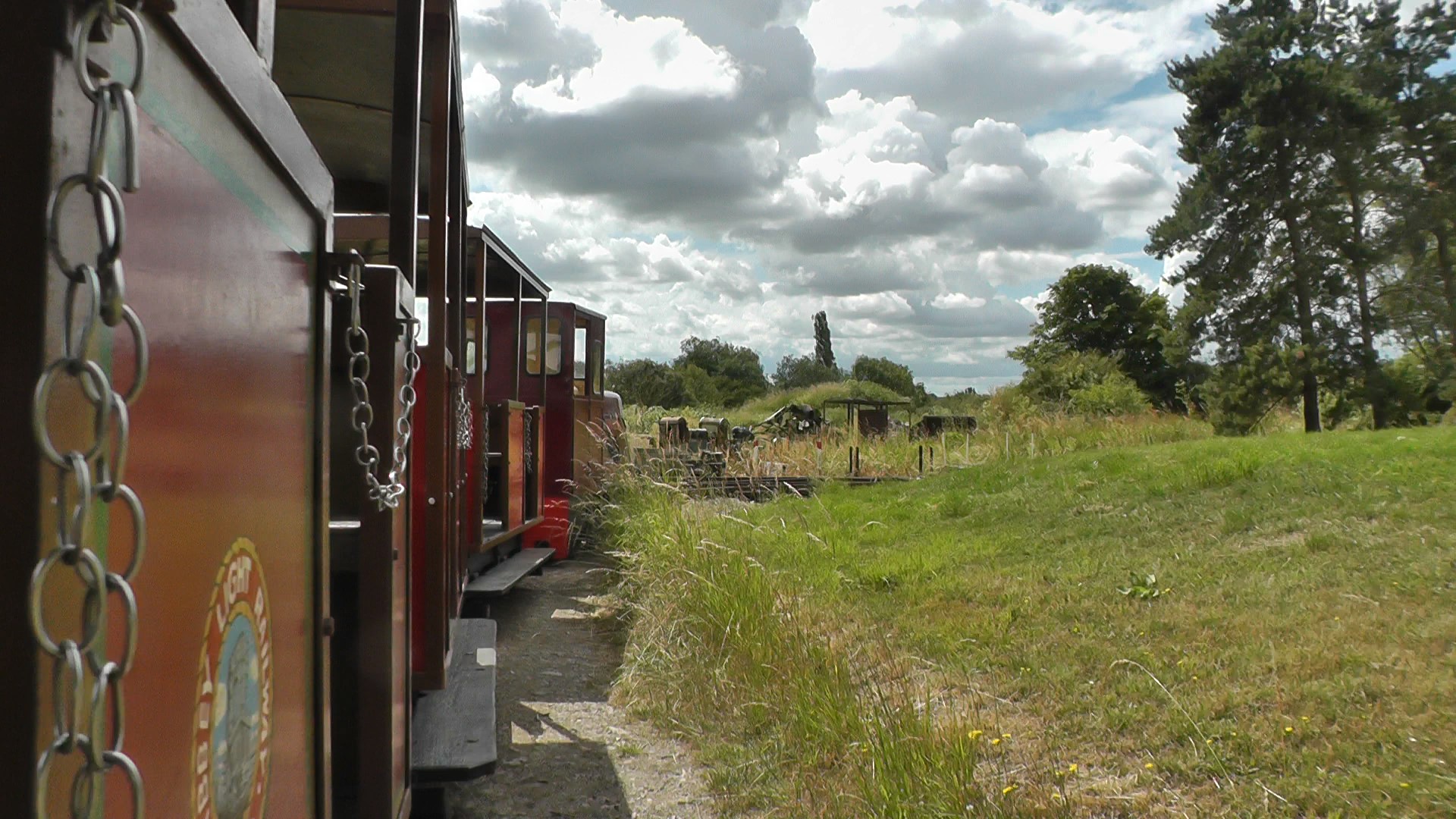
 .... we soon struck out into open countryside.


 The track skirts the airfield ......


  ..... and eventually arrives at the line's second station.
 

This has recently been completely rebuilt and now houses information about the line's history and other memorabilia. Meanwhile, our loco, 1940 vintage Simplex 7481 No. 4 Wilton, formerly at Humberston Brickworks, was running around our train.


After a short while, we began our return journey, this time with a close-upview of the loco and its driver.


Passing Jurassic once more......


 ..... we coasted back into the main terminus.

.... where I alighted and watched the loco running round its train of appreciative passengers.


 After chatting with the staff, I was given the privilege of having a guided tour of the workshops, where I was provided with detailed information about the railway's stock and its present and planned renovations.

The railway's impressive Peckett loco wasn't in steam during my visit, but it is usually in operation at weekends and open days during the summer.  It certainly is a beauty and, one day, I will return to see it in action - though its boiler is scheduled for renewal soon.

I was particularly impressed with the renovated Ashover coach. It has been sensitively restored, retaining as much of the original as possible and mounted on appropriate ex-WD bogies.


Inside the workshop, was the line's Sand Hutton coach, awaiting refurbishment, together with a fine collection of ex-WD wagons which have been painstakingly restored to their former glory


The railway's second Ashover coach is currently receiving attention and looks like it may soon be entering service. I was informed it will have First Class upholstered accommodation. Another reason to return.....

 The various Simplex locos were much in evidence, some with cabs and some without. I must admit to preferring the uncabbed versions, but then, I don't have to drive them!

Outside the shed, a privately owned Simplex was having a test run (or three). I find there is something very atmospheric about hearing the pom-pom sound of their two cylinder motors in action. 

 Overall, I can thoroughly recommend a visit to the LCLR. It's a great little railway with a great deal to interest both railway enthusiasts and those who just like stepping back in time.

The staff and volunteers - though I suspect everyone is a volunteer - were clearly very proud of what they have achieved and were eager to share their experiences with visitors. I can honestly say, without a shadow of doubt, that this is one of the most welcoming and helpful railway visits I have encountered since I have started my quest to visit all the (12"+) narrow gauge railways in the UK and Ireland.

It is definitely on my list for a return visit - maybe when Jurassic is in steam.

Video

Tuesday, 5 July 2022

North Ings Farm Museum

 In a nutshell

Gauge:          2 foot (610cm)

Length:        600 yards (548m)

Opened:       1972 (Private railway) - 1990 (Public railway)


Location:    

Fen Rd, 
Dorrington, 
Ruskington, 
Lincoln 
LN4 3QB


Web:      https://northingsfarmmuseum.co.uk/
Email:    https://northingsfarmmuseum.co.uk/contact-us/
Tel.:        01526 833100


Date of visit:     3rd July 2022


Key Facts

  • The railway was first established in 1972 to provide transportation for the farm's chicken and egg production facilities
  • By 1981, poultry farming on the site had ceased and the railway and collecting agricultural equipment became a hobby
  • In 1990, the local council suggested that the museum's collection of artefacts should be opened to the public
  • The railway has eight industrial diesel locomotives and two further locos on loan from the Talyllyn Railway's Narrow Gauge Railway Museum
  • There is also a freelance vertical boilered steam locomotive which is currently out of action awaiting a new boiler
  • The three passenger coaches were acquired from the Abbey Light Railway after its closure in 2012
  • The signal box, which is prominent on the site, was acquired from Holmes Yard at Lincoln, where it was used as a paraffin store. The lever frame inside the box is from  Skellingthorpe near Lincoln.
  • The farm site is a treasure trove of farming and construction machinery and industrial narrow gauge wagons
  • The museum opens on the first Sunday of each month from April to October.
  • The modest entrance fee allows you to roam freely over the site and have unlimited rides on the railway.
  • Hot and cold drinks and biscuits and confectionary are available


Route


My Impressions

After Google maps navigated me down various narrow winding lanes I had very little idea of where I was. Fortunately, there was a reassuring sign at the end of a farm track informing me that I had arrived and, furthermore, that the museum was open.

There was a pleasing air of informality about the museum with the owners and volunteers clutching mugs of tea, discussing the relative merits of dog clutches and the intricacies of gearboxes, or demonstrating and explaining the exhibits to visitors.

I was invited to wander the sheds and the grounds at my leisure. I started with the sheds, wherein were stored an impressive array of industrial locos .....


...... tractors of various vintages ......

..... and a lightweight Commer truck.


The grounds proved equally intriguing, with a vast array of industrial narrow gauge wagons and locos in various states and stages of renovation.


After a chat with the staff who were keen and well informed to answer any questions I posed, I took a ride on the train.

After curving round beside the signal box, the train made a descent .......

..... to the nether regions of the site.

We wound our way through the lush undergrowth ....

.... passing by the lake and then made a 1:35 climb back up towards the main part of the museum


......  and passed through the station (Pear Tree Junction), .....

before repeating the journey and then arriving back at the start.

I spent a very pleasant morning at the Museum and gained considerable knowledge of industrial locomotives and the history of the museum from the well informed and helpful staff who were in attendance.

I can thoroughly recommend a visit if you happen to be in the area on the first Sunday of a summer month. It's far more interesting than an impersonal, regimented and formalised railway museum. Particularly if you want to get down to the nitty gritty of how these things work.


Video


Wednesday, 28 June 2017

Progress Report 5

Well, as you can see, it's been quite a while since I posted my previous Progress Report - over three years. I have been making visits to railway in that period but they have been less frequent. Partly, this is because the railways which I have yet to visit are now further away, having visited most of the railways which are within a day's travel of my home in Cheshire.

Since my last report in 2014, I have visited:
So, I've not exactly been idle.

Over the past eighteen months, health problems with various members of my immediate family have restricted my ability to travel far from home. We are hoping that these problems are now becoming resolved and so have plans to visit a few railways in the North East over the next few weeks and maybe take in a couple en route.

There are still plenty of railways on the list which need to be visited, scattered widely across the country from the South West (eg Seaton Tramway and Bicton) to the far North (eg the Alford Valley Railway in Aberdeenshire) and, of course, we've not yet touched any in Ireland.

At least two of the railways on the list seem to have closed but I will leave them in place just in case they are resurrected, as has happened with the Teifi Valley Railway, which is now one of the last railways to be visited on my Welsh list.

I was disappointed that I was denied access to the TwinLakes Leisure Park - because I was a lone adult male unaccompanied by children. Even when I explained that I wanted only to travel on the railway and would be happy to be chaperoned, I was told it was company policy. It does seem to be a sad reflection of our times (and especially galling as I was a primary school teacher for many years). I may have to reconsider visiting the miniature railways which are located inside other leisure parks - or maybe await the arrival of a grandchild .......... !!

Apedale Valley
I am in no mad rush (as yet) to complete my quest - I am presently around 1/3 of the way down the list.  I am still enjoying visiting parts of the country which I might otherwise have never visited ..... and we now have a small caravan, which might help ease the cost of more distant visits.

As indicated, the rate of visitations is inevitably slowing as the unvisited railways become more distant and geographically diverse. In the meantime, I have actually re-visited some of the railways and updated their entries accordingly (eg  Apedale Valley, Ffestiniog, Talyllyn).

I will keep you posted!


Thursday, 11 August 2016

Morwellham Quay - Copper Mine Tramway

In a nutshell

Gauge:         2'

Length:       Approx ¾ mile overall

Opened:     Originally mid 19th century
                   Visitor tramway - early 1970s

Location:   


Morwellham Quay
Morwellham
Tavistock
Devon
PL19 8JL
United Kingdom

Web:       admin@morwellhamquay.org 
                https://www.morwellham-quay.co.uk/
Email:     https://www.morwellham-quay.co.uk/index.php?route=information/contact
Tel.:        01822 832766 


Date of visit:     9 June 2015


Key Facts

  • Morwellham Quay was established in at least 1105 and remained important as a harbour well into the 19th century when it became the biggest exporter of copper in the British Empire with vessels of up to 300 tonnes using the quays.
  • The George and Charlotte copper mine through which the railway runs was opened in 1718 when it was known as the Providence Mine.  The George and Charlotte Mine is first mentioned in documentary sources from 1775.
  • The tramway runs 460 metres into the Deep Adit of the mine and passed an underground waterwheel which was used to pump water out of the lower levels of the mine 350 feet below.
  • In addition to copper and arsenic, the mine yielded a number of rare minerals including the largest known crystals of childrenite in the world.
  • Between 1862 and 1867 the mine reached its peak production, but it closed in 1868. It was reopened from 1869 to 1871. 
  • In the early 1970s, a new access to Footway Shaft was created to allow the narrow gauge tramway to be constructed. The railway travels for over 480 metres into the mine.
  • The railway follows the entrance to Deep Adit, just above the River Tamar, and extends past Whim Shaft, an internal shaft, the bottom of Crosscourse Shaft, and past Ley's Shaft towards Downs Shaft.
  • This adit was the main water drain for the mine and also the principal means of access for materials.
  • The adit roof is approximately 2 metres high and 1.8 metres wide. 
  • In 1985/86 the 'New Quay Drive' railway tunnel excavation (through virgin rock) connected the side of Deep Adit (at a point approximately 200 metres from the portal) to a new railway tunnel portal, via Engine Shaft thereby making a balloon loop for the railway.
  • The railway uses battery powered locomotives and specially built 'carriages' for the visitors.

Route


My Impressions

After parking and making my way through the ticket office and shop for the Morwellham Quay site, I made my way down towards the quays and the main exhibits

The site itself looked very interesting but I was anxious to make my way directly to the Mine Tramway as I heard it can become very busy at peak times. After passing through the main village, I headed upwards behind the white buildings on the right to the Mine Tramway station.

A small queue was forming and we had to wait as a party of French schoolchildren were pre-booked on to first train.

Before long another train pulled into the station ......

.... and before boarding there was a brief opportunity to admire the one of the BEVs (Battery Electric Vehicles) which would be our motive power for the journey underground.

We were ushered aboard the passenger coaches and given safety instructions. I managed to secure a place directly behind the loco - an advantage of getting there promptly and waiting .....

....... and before long we were off. The first quarter of a mile or so of track took us alongside the River Tamar which we glimpsed from time to time through the trees and bushes which lined the railway ......

..... and then we reached the entrance to the mine itself - which looked quite unprepossessing and utilitarian.

 The train wound its way through various galleries and tunnels where clearances were quite tight - which explains the cage-like structure surrounding each carriage.

At intervals we stopped and our driver informed us about the history and working practices in the mine.

 The conditions were harsh and much of the work was done by hand. It seems hard to believe that, at one point, this mine and those surrounding it were the most productive in the whole of the British Empire.

After negotiating a few more twists and turns, we came to what was, for me, the highlight of the tour .... the underground waterwheel.

Not easy to photograph through the grille of the carriage roof, the waterwheel, which has been restored to working-order, was used to pump water from the lower chambers of the mine, which extended up to 350 feet below us.

We then set forth one more ........

..... until, ultimately, daylight was seen once more.

We emerged into outside world and made our way to a run round loop, ........

..... which gave us some tantalising glimpses of yet more industrial archaeological sites beside the river.

The loco ran around its train ......

 ..... and we then made our way back up the valley ....

.....  passing en route, the entrance to the mine which we used previously.

We now retraced our tracks .....

...... before arriving at the station once more.

 There was time to watch the loco run round its train .....

..... before it made ready for the next batch of visitors.

There was time for me to visit a few more of the exhibits .....

.... including the house which had been used for the filming of the TV documentary about the Edwardian Farm.

I was very impressed with the mine tramway. It afforded us with the opportunity to venture into the workings of a real copper mine and gain some idea of the sorts of conditions in which this important ore was extracted during the Victorian era.

I thoroughly enjoyed my visit - not only to the railway - but also to the whole site - and the corned beef hash which I enjoyed in the café
was also something to savour.

Video