Search This Blog

Showing posts with label industrial. Show all posts

Tuesday, 5 July 2022

North Ings Farm Museum

 In a nutshell

Gauge:          2 foot (610cm)

Length:        600 yards (548m)

Opened:       1972 (Private railway) - 1990 (Public railway)


Location:    

Fen Rd, 
Dorrington, 
Ruskington, 
Lincoln 
LN4 3QB


Web:      https://northingsfarmmuseum.co.uk/
Email:    https://northingsfarmmuseum.co.uk/contact-us/
Tel.:        01526 833100


Date of visit:     3rd July 2022


Key Facts

  • The railway was first established in 1972 to provide transportation for the farm's chicken and egg production facilities
  • By 1981, poultry farming on the site had ceased and the railway and collecting agricultural equipment became a hobby
  • In 1990, the local council suggested that the museum's collection of artefacts should be opened to the public
  • The railway has eight industrial diesel locomotives and two further locos on loan from the Talyllyn Railway's Narrow Gauge Railway Museum
  • There is also a freelance vertical boilered steam locomotive which is currently out of action awaiting a new boiler
  • The three passenger coaches were acquired from the Abbey Light Railway after its closure in 2012
  • The signal box, which is prominent on the site, was acquired from Holmes Yard at Lincoln, where it was used as a paraffin store. The lever frame inside the box is from  Skellingthorpe near Lincoln.
  • The farm site is a treasure trove of farming and construction machinery and industrial narrow gauge wagons
  • The museum opens on the first Sunday of each month from April to October.
  • The modest entrance fee allows you to roam freely over the site and have unlimited rides on the railway.
  • Hot and cold drinks and biscuits and confectionary are available


Route


My Impressions

After Google maps navigated me down various narrow winding lanes I had very little idea of where I was. Fortunately, there was a reassuring sign at the end of a farm track informing me that I had arrived and, furthermore, that the museum was open.

There was a pleasing air of informality about the museum with the owners and volunteers clutching mugs of tea, discussing the relative merits of dog clutches and the intricacies of gearboxes, or demonstrating and explaining the exhibits to visitors.

I was invited to wander the sheds and the grounds at my leisure. I started with the sheds, wherein were stored an impressive array of industrial locos .....


...... tractors of various vintages ......

..... and a lightweight Commer truck.


The grounds proved equally intriguing, with a vast array of industrial narrow gauge wagons and locos in various states and stages of renovation.


After a chat with the staff who were keen and well informed to answer any questions I posed, I took a ride on the train.

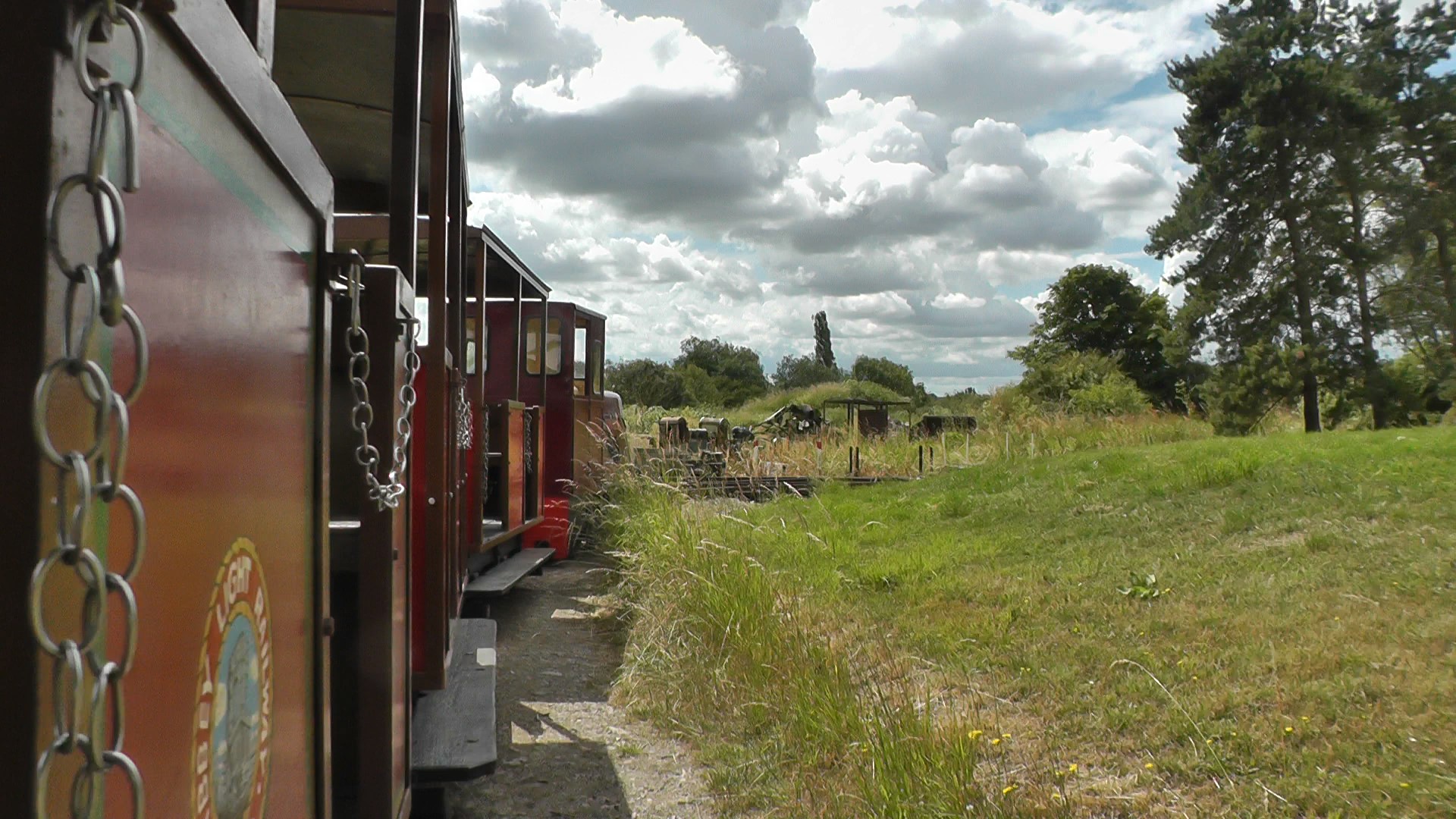
After curving round beside the signal box, the train made a descent .......

..... to the nether regions of the site.

We wound our way through the lush undergrowth ....

.... passing by the lake and then made a 1:35 climb back up towards the main part of the museum


......  and passed through the station (Pear Tree Junction), .....

before repeating the journey and then arriving back at the start.

I spent a very pleasant morning at the Museum and gained considerable knowledge of industrial locomotives and the history of the museum from the well informed and helpful staff who were in attendance.

I can thoroughly recommend a visit if you happen to be in the area on the first Sunday of a summer month. It's far more interesting than an impersonal, regimented and formalised railway museum. Particularly if you want to get down to the nitty gritty of how these things work.


Video


Tuesday, 2 October 2018

Bursledon Brickworks - Hampshire Narrow Gauge Railway Trust

In a nutshell

Gauge:         2'

Length:      1/3 mile (475m)

Opened:     1994

Location:   


Bursledon Brickworks Industrial Museum
Coal Park Lane
Swanwick
Southampton,
SO31 7GW


Date of visit:     23 September 2018


Key Facts

  • The railway at Bursledon originated with the formation of the Hampshire Narrow Gauge Railway Society in 1961. It's main purpose was to purchase and rescue and rebuild a Bagnall saddle tank locomotive from a slate quarry in Blaenau Ffestiniog, and to set up a narrow gauge railway in Hampshire.
  • The society transformed into the Hampshire Narrow Gauge Railway Trust in 2006, based at the Bursledon Brickworks Museum, where it now has a collection of locomotives and equipment rescued from various industrial locations around the country.
  • The Bursledon Light Railway has four operational locomotives; two steam - Wendy (the original Bagnall loco), Cloister (a quarry Hunslet loco from Dinorwic Quarry in North Wales); and two Simplex Motor Rail internal combustion locos - Agwi Pet (from a refinery in Fawley) and Brambridge Hall (used on the construction of Winchester Bypass).
  • The railway also has a miscellaneous collection of goods rolling stock and a couple of passenger carriages.
  • The railway operates during special events through the year coincidental with events organised by the Bursledon Brickworks Museum. See http://www.hngrt.org.uk/events_bbim.php or http://www.bursledonbrickworks.org.uk/events.php
  • There are refreshments available at the adjacent Brickworks Museum cafe and ample parking. The trains are wheelchair accessible.

Route


My Impressions

My visit to the railway coincided with a WW1 re-enactment day at the Brickworks Museum and so there were soldiers in WW1 uniforms wandering around together with a pipe band performing at regular intervals (you will be able to hear some of their music in the background on the video).

After parking and paying our modest entry fee, we spent an hour or so looking around the Brickworks museum, which is fascinating as it is the only steam powered brickworks still operational in the UK. I had no prior conception of the brick-making process and so by the end of my wanderings, I was considerably wiser and much impressed.

The machinery was powered by a horizontal mill engine built in 1885 by Woods & Sons of Wigan and is very much in working order. This is one of four working stationary steam engines at the site - only two of which were operating when I visited.

 This engine powered one of the brick clay rolling and extruding machines - the clay would have been loaded in through a hopper at the top of the machine and fed through the rollers .......

..... to be extruded as a rectangular block which was then sliced with cheese wires into individual bricks. These were taken by barrow to be stacked in the drying rooms and then on to the kilns. And, basically, that was the brick-making process.

Another machine was used to press clay into wooden moulds, for decorative or shaped bricks ....

.... and there were some really impressive educational exhibits, such as this model of the mill engine which allows children (and adults) to figure out the the role of key components needed to make the valves operate the piston, which in this case is powered with compressed air.

There were many other artefacts on display, including demonstrations of brick-making by hand ...

..... and of various tools of the trade.

But of course, what really interested me was the railway - which would, of course, originally have been used (together with an aerial ropeway) to transport raw clay from the quarries to the brickworks. Some of the sheds and workshops for the railway were adjacent to the museum and gave a tantalising glimpse of the equipment owned by the Hampshire Narrow Gauge Railway Trust.

I made my way to the station where the loco and coach were sitting awaiting passengers. Unfortunately, the line's principal Simplex loco was experiencing a few technical problems at that moment, ......

...... and so, the slightly less powerful alternative Simplex loco was pressed into service.

The rain stopped and the passenger trains resumed service as the sun broke through the clouds. We were taken firstly up the line ......

..... and were then propelled back down past the station, before heading up the other arm of the U-shaped track. We then returned to the station where another enthusiastic group of passengers were waiting.

I then spent another hour or so, watching further trains taking delighted passengers back and forth; the original loco having been repaired.

The Trust has made the most of the site, squeezing the maximum amount of track into the available space. A spur, running alongside one of the arms of the passenger track is used mostly by goods traffic to display some of the railway's freight stock.

The right-hand section of the 'main line' meanders through the trees and past some of the workshops behind the car park, so there is plenty to see on the short journey.

I really enjoyed my morning at the Bursledon Brickworks. The museum itself is very well laid out with a good range of exhibits and plenty of well informed and helpful staff on hand to explain the brick making process and the role of various bits of machinery and architecture.

The railway itself is of extreme interest to anyone who is enthusiastic about industrial narrow gauge railways. The combination of a passenger train ride, together with an opportunity to see freight trains in operation, makes for a pleasant and informative experience. The staff were extremely welcoming and helpful, answering every question with enthusiasm and knowledge.

There is also a passenger carrying 7¼" gauge railway for the young and the young at heart.

Video

[In preparation] 


Tuesday, 21 August 2018

Sittingbourne and Kemsley Light Railway

In a nutshell

Gauge:         2 ' 6" (756cm)

Length:        2 miles (3.2km)

Opened:       Originally opened 1904

                  Closed 1969
                  Re-opened 1970
                  Closed 2008
                  Re-opened 2010

Location:   

Sittingbourne and Kemsley Light Railway Ltd.
PO Box 300
SITTINGBOURNE
Kent ME10 2DZ


Web:      http://www.sklr.net
Email:    info@sklr.net
Tel:         01795 424899

Date of visit:     19 August 2018


Key Facts

  • The railway was built originally to transport raw materials and paper to and from the paper mill in Sittingbourne and the wharves at Milton Creek
  • In 1913, the line was extended to the newly constructed Ridham Dock
  • In 1923 a new paper mill was constructed, about half way along the railway at Kemsley.  At the time, it was the largest paper mill in Europe
  • Passenger services were introduced at this time to transport workers to the mill from Sittingbourne
  • The line is unique in that for half a mile it is carried on a half mile long reinforced concrete viaduct
  • In 1965, it was decided that the railway was no longer commercially viable and so, in 1969, it was gifted to the Locomotive Club of Great Britain (LCGB)
  • In 2010, the paper mill in Sittingbourne closed and was demolished. The site is now occupied by a large supermarket. The present Sittingbourne Viaduct Station became the new terminus for the railway.
  • In its heyday, the railway boasted 14 steam locomotives (including two articulated locos), two fireless steam locos, a battery electric loco and a petrol loco
  • The railway now has seven operational steam locos, plus several narrow gauge and standard gauge display locos in various states of repair. It also has three diesel locos.
  • Seven of the railway's original passenger coaches (converted from freight wagons) are still in service, together with four coaches from the now closed Chattenden & Upnor munitions factory railway
  • The railway has 42 freight wagons, mostly preserved from the original railway but a few from other sources
  • The railway generally runs on Sundays and Wednesday afternoons during the school holidays 

Route


My Impressions

According to the SKLR website, their station is opposite the main railway station. It was close, but not that obvious initially. The entrance to the SKLR's Sittingbourne Viaduct station turned out to be just behind a Pizza Hut restaurant, between a drive-thru KFC and drive-thru MacDonalds. Handy if we were feeling peckish, but less so if we were late for the 12.00 train - which we were.

However, once we tracked down the station and bought our modestly priced tickets, we had time to look around the station and chat with the volunteer staff, who gave us some interesting background information about the railway and its history.

It turned out that the viaduct on which the station is presently located used to extend further, over the road to the paper mill which used to be situated beside the town's main railway station where the Morrison's Superstore and car park are presently located. The facilities at the SKLR station are somewhat basic as they have experienced a number of thefts of equipment and repeated bouts of vandalism which make them reluctant to develop the site beyond the bare minimum.

What a sad indictment of the reality of the world in which we now find ourselves. Full credit to the dedicated band of volunteers who give up their time and energy to manage such important historical sites despite such adversities.

Before long, there was a short toot announcing the arrival of the train of five miscellaneous coaches hauled by the line's very smartly attired 0-4-2 Kerr Stuart Brazil Loco Leader.

After running around its train, the loco awaited the all clear before setting off, with a slightly irregular engine beat. It transpired that this was caused through the fitment of a non standard replacement eccentric driving the valve gear when there was no appropriate spare available.

We slowly ventured out over the tight reverse curves of the first part of the concrete viaduct on which this end of the railway was built,

...... before picking up speed when we encountered the straight.

Alongside the railway are the enormous pipes which once carried steam from the paper mill at Kemsley to the mill in Sittingbourne. At level crossings, the pipes arched their way over the roads.

After passing underneath the Swale Way, the line passed through the marshes as it headed towards the paper mill at Kemsley.

The train then slowed as it approached and entered Kemsley Down station.

There was a 20 minute stop at the station while the loco ran around its train.

There was plenty for a railway enthusiast to see at Kemsley Down station. In addition to various items of rolling stock from the days the railway served the paper mills ....

...... quite a number of the line's locomotives are on show in various states of repair.

These include both the narrow gauge and standard gauge fireless steam locomotives, which were topped up from the paper mill's high pressure boilers.

There is also a small museum (the green shed in the above photo), which includes some interesting facts and photos showing the history of the railway.

There is also a tea room .......

...... and a small shop, where booklets and souvenirs can be purchased.

Twenty minutes is insufficient time to do all the exhibits justice and so I would suggest waiting an hour for the next train back to Sittingbourne. The staff and volunteers are more than willing to explain and demonstrate to curious fellow enthusiasts.

There was an announcement warning us that the train was about to depart ......

....... and before long we embarked on our fifteen minute return journey.

With squealing wheel flanges we re-negotiated the reverse curves at the end of the viaduct .....

..... and slowly entered the station.

We really enjoyed our visit to this historic and slightly quirky railway which holds great significance for narrow gauge railway enthusiasts. The staff are among the friendliest and most helpful on any of the preserved narrow gauge and miniature railways I have visited - this is number 76 in my quest to visit them all!

I can thoroughly recommend a visit to the Sittingbourne and Kemsley Light Railway. It is only an hour from London by rail and so well within reach should you be planning a visit to the capital for a long weekend (which is what we did).

Video