In a nutshell
Gauge: 61cm
Length: ¾ mile
Opened: 1960 / 2009 (on present site)
Location:
Skegness Water Leisure Park
Walls Lane
Ingoldmells
Lincolnshire
PE25 1JF
Date of visit: 16 July 2025
Key Facts
- The railway was originally located at Humberston near Cleethorpes, where it opened in 1960
- It closed there in 1985 and reopened on its present site on 3 May 2009
- It originally used equipment from the Nocton Potato Estate railway and operated there until 1985.
- It was the first heritage railway in the world to be built on a greenfield site.
- The first services used a Motor Rail "Simplex" locomotive and a bogie carriage converted from a wagon
- The line now has seven Simplex locos of various vintages and a Peckett 0-6-0T steam loco, Jurassic.
- In addition to its original bogie coach, it has two former Ashover Railway coaches (one in the process of renovation) and a coach from the Sand Hutton Railway (also undergoing renovation)
- It also has several former WD wagons which have been beautifully restored under the auspices of the LCLR Heritage Vehicles Trust
Route
My Impressions
After making my way through the barrier to the Caravan Park (there is no entrance fee BTW), I parked up outside the station building and bought my modestly priced (£2.00 GBP) ticket.

The train was already awaiting its passengers, and so I boarded.

I opted for the open carriage which is basically an ex-WD bogie open wagon equipped with seats.

Before long, we set off, passing the railway's workshops where the line's Peckett steam loco, Jurassic was parked with one of the railway's ex-Ashover Railway coaches.

Passing behind the hangars for the airfield ......

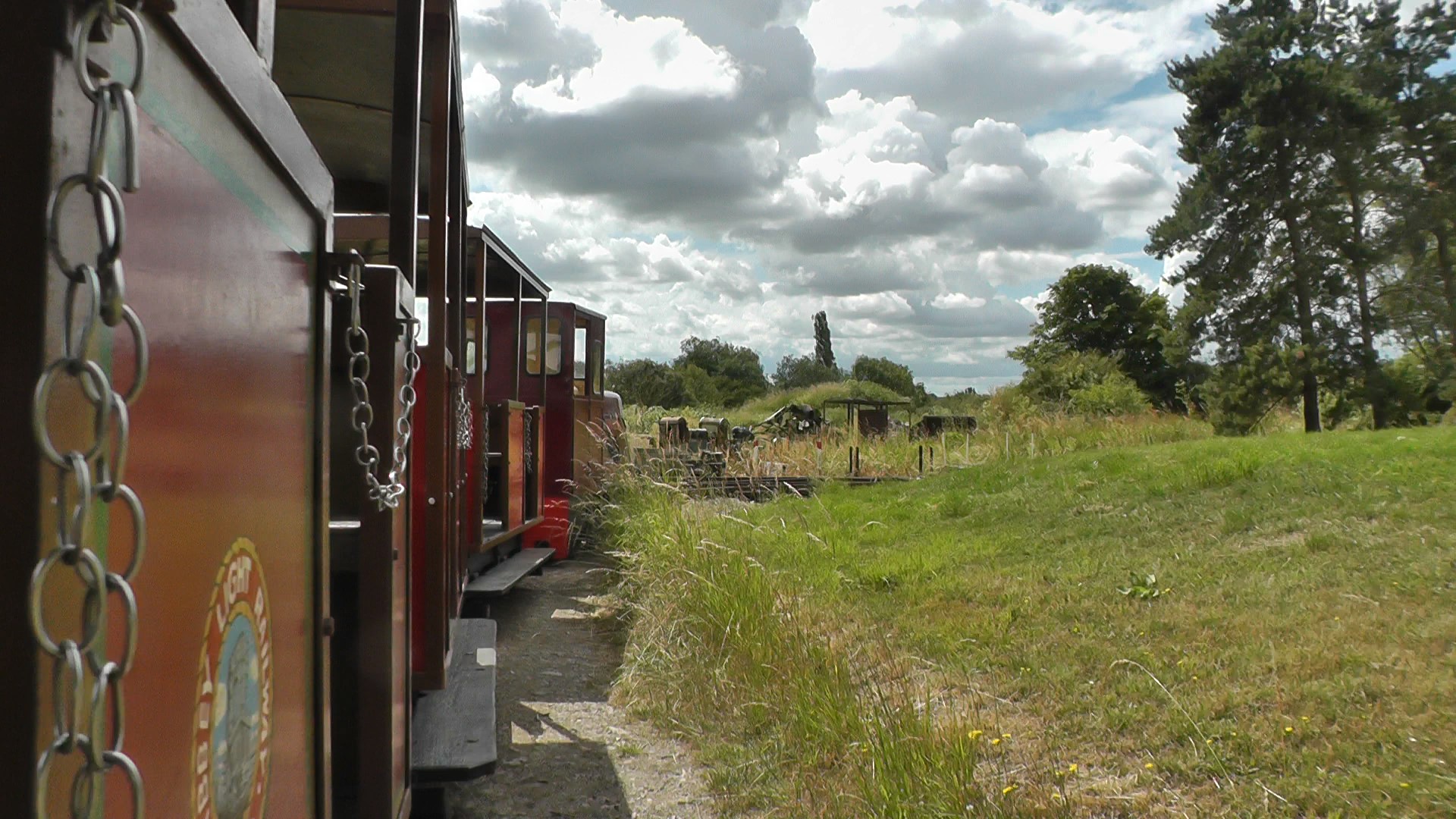
.... we soon struck out into open countryside.

The track skirts the airfield ......

..... and eventually arrives at the line's second station.

This has recently been completely rebuilt and now houses information about the line's history and other memorabilia. Meanwhile, our loco, 1940 vintage Simplex 7481 No. 4 Wilton, formerly at Humberston Brickworks, was running around our train.

After a short while, we began our return journey, this time with a close-upview of the loco and its driver.


Passing Jurassic once more......

..... we coasted back into the main terminus.

.... where I alighted and watched the loco running round its train of appreciative passengers.

After chatting with the staff, I was given the privilege of having a guided tour of the workshops, where I was provided with detailed information about the railway's stock and its present and planned renovations.
The railway's impressive Peckett loco wasn't in steam during my visit, but it is usually in operation at weekends and open days during the summer. It certainly is a beauty and, one day, I will return to see it in action - though its boiler is scheduled for renewal soon.

I was particularly impressed with the renovated Ashover coach. It has been sensitively restored, retaining as much of the original as possible and mounted on appropriate ex-WD bogies.


The railway's second Ashover coach is currently receiving attention and looks like it may soon be entering service. I was informed it will have First Class upholstered accommodation. Another reason to return.....


The various Simplex locos were much in evidence, some with cabs and some without. I must admit to preferring the uncabbed versions, but then, I don't have to drive them!

Outside the shed, a privately owned Simplex was having a test run (or three). I find there is something very atmospheric about hearing the pom-pom sound of their two cylinder motors in action.

Overall, I can thoroughly recommend a visit to the LCLR. It's a great little railway with a great deal to interest both railway enthusiasts and those who just like stepping back in time.
The staff and volunteers - though I suspect everyone is a volunteer - were clearly very proud of what they have achieved and were eager to share their experiences with visitors. I can honestly say, without a shadow of doubt, that this is one of the most welcoming and helpful railway visits I have encountered since I have started my quest to visit all the (12"+) narrow gauge railways in the UK and Ireland.
It is definitely on my list for a return visit - maybe when Jurassic is in steam.
Video



.jpg)
.jpg)

.jpg)
