Search This Blog

Showing posts with label Llanberis. Show all posts

Wednesday, 18 December 2019

Snowdon Mountain Railway

In a nutshell

Gauge:          2'  7½"(800cm)

Length:        4 2/3 miles (7.5km)

Opened:      1896

Location:   

Email:     info@snowdonrailway.co.uk 
Tel.:         +44 (0) 1286 870 223

Snowdon Mountain Railway
Llanberis
Gwynedd
LL55 4TT 


Date of visit:     20 September 2019

Key Facts

  • The Snowdon Mountain Railway is the only rack assisted railway in the UK
  • There has only been one accident on the line, on the day it first opened when one passenger died after the first downward train became derailed probably because it was overloaded
  • The line was constructed between December 1894 and February 1896
  • The rack system used by the railway was devised by Roman Abt, a Swiss locomotive engineer. Two racks are positioned between the rails, staggered by half a tooth to ensure there is always a complete tooth on the pinions engaged with the rack
  • The locomotive is not coupled to the carriage, so that the carriage would not be dragged down the mountainside if the locomotive became derailed
  • Gripper rails are fitted to either side of the rack to prevent the pinion from disengaging with the rack
  • Each locomotive and carriage has a manual brake which operates on the pinion
  • The locomotives also have a compression brake which uses air in the cylinders to slow the descent
  • The locomotives and carriages also have automatic brakes which engage if they exceed a certain speed
  • The railway has eight steam locomotives, five of which were built for the line's opening.
  • There are also four diesel hydraulic locomotives, powered by Rolls Royce engines
  • The line has ordered a diesel/battery hybrid locomotive which is intended to enter service in 2020. The batteries will be recharged on the descent.
  • There is a cafe and visitor centre at the summit (3560ft (1085m) above sea level) which was opened in 2009
  • There is also a cafe and toilet facilities at Llanberis station
  • During the winter or bad weather, trains will only run to Halfway station
  • It is advisable to book in advance as the number of tickets are limited each day

Route

Source: By MickMacNee at en.wikipedia - I created this work entirely by myself., Public Domain, https://commons.wikimedia.org/w/index.php?curid=13430621

My Impressions

The last time I travelled on the Snowdon Mountain Railway was over fifty years ago, so I was anxious to see how things had changed.

We arrived at Llanberis in good time to pick up our pre-booked tickets. While waiting we indulged in a cup of coffee and a snack, sitting outside in the early September sunshine.

There was a good selection of food available at the cafe and so we were spoiled for choice.

There was time to watch the departure of one of the diesel hauled trains ......


 ..... and our train being marshalled from the sheds. We were booked on one of the vintage steam services. We figured that as this was likely to be a one-off, we would travel in style.

Before long, we boarded. Although not first in the queue, we were able to get a good seat at the rear of the carriage close to the loco.

After crossing the Waterfall viaduct, we soon left the treeline......

......  and reached the first station / passing place at Hebron.

After passing a downward diesel train, we progressed further, the mountain scenery becoming more rugged, until we reached Halfway Station, where we paused to wait for another downward train.

Our guard/train manager took the opportunity to point out some of the scenic features observable from our vantage point ......

..... until the downward train passed us on the loop.

We continued upwards, allowing a fine view of the downward train and the emerging landscape towards Anglesey.

As we laboured further up the mountain, the views began to open out, here looking towards the Rivals on the Lleyn Peninsula.

As we approached Clogwyn Station, the train traversed a stretch of line on a ridge, which permitted views down to the left of the Llanberis Pass in the valley below. Apart from the summit, this is probably the most spectacular view on the trip.

We paused again at Clogwyn Station to await another downward train which we could see approaching from further up the line. There seemed to be a considerable number of people walking the path from Llanberis to the summit, hardly surprising as the weather was unseasonably warm and the sky very clear.

Eventually, the train came nearer, passing over the curve on which the first passenger carrying train derailed on the line's opening day.

Then it was our turn to tackle the last section of the railway to the summit. The views opened out even more, giving a fine view out of the whole island of Anglesey .......

..... and along the north coast of the Lleyn Peninsula ......

....... before our train gently eased itself into the station at the summit.........

............  where the loco was given a well deserved rest

 We were given 30 minutes at the summit which allowed plenty of time to browse through the souvenirs and walking equipment in the shop, ...

.... grab a cuppa and a pie in the cafe .......

 ...... and join the crowd at the summit.

The views from the summit were spectacular in all directions.

Looking North West ........

...... looking East

...... South West .....

..... South East.

.... and West.

It was very blustery at the top and so it was somewhat of a relief to re-board our train and start the descent. With our destination visible in the distance .....

..... we passed many walkers toiling their way towards or away from the summit.

At Hebron, we met another steam heritage train making its way up towards the summit.

Eventually, we arrived at Llanberis ......

...... where our train was shunted back into its siding.......

..... and we could watch the departure of another train towards the summit.

Passing through the railway's shop on the way towards the exit, I bought a handy little guide on the railway's history but avoided the temptation of buying a snow globe or fridge magnet.

I was impressed by how efficiently the railway is operated and also by the enthusiasm and willingness of the staff to help and/or discuss the railway.

The stock was scrupulously clean and well maintained, particularly considering the age of the steam locomotives and the heritage carriages. The fare is not cheap, but then it is a unique experience in the UK and presumably the cost of maintaining the track and railway infrastructure.

It is possible to take a one way journey, but I would advise you to check the long term weather forecast. We were extremely fortunate in having booked the perfect day for viewing the landscape. This was partly luck and partly due to careful scrutiny of the weather forecasts by my partner - who, incidentally, funded the trip as part of an unexpected Christmas present two years ago. It took us that long to find the ideal conditions in relation to weather and our availability. A previous booking we had made a year earlier had to be cancelled because steam hauled trains had been withdrawn owing to fire risk during the drought at the start of the 2018 summer season.

It pays to be patient!

Video


Saturday, 9 March 2013

Progress Report 3


I had quite a busy summer visiting as many railways as I could. I tended to focus initially on those in North Wales as many could be visited in a day from my home in Cheshire and also I wanted to make the most of my Great Little Trains of Wales discount card.


The railways in Wales visited since my last progress report include:

In addition, I have ventured into Staffordshire to visit


A brief trip to East Anglia (where I spent my formative years) provided an opportunity to visit


A visit to the West country for a family event enabled a visit to
Whilst a trip to Bridgnorth gave an opportunity to ride on the


A couple of  forays into Lancashire and Yorkshire led to visits to


and a flying visit to the Wye Valley resulted in visits to


I have been surprised at the number of railways which lie within the reach of a day visit, though the number of these is inevitably beginning to diminish. I have realised that the most productive visits are those which coincide with gala days as these provide more opportunities for photos and videos. However, this is dependent on my availability on those particular days.

Having now visited several 15" gauge railways, I have come to appreciate the historical significance of this gauge to the history of the narrow gauge in this country. The more I found out, the more I wanted to know and as a consequence I've blogged the results of my researches so far -  see The 15" Minimum Gauge Railways - a Chronology.


One of the things which has struck me during my travels is the enduring appeal of steam railways for most people. My trip on the Ffestiniog was taken during the February half term holiday and the train was packed - mostly with parents and young children. However, there was also a fair smattering of older couples. Similarly, even on a cold Saturday morning in February, the train at Windmill Farm was full.


My tour of the route of the Lynton & Barnstaple happened by chance. We were spending a weekend helping a friend celebrate a particularly special birthday in holiday let not far from Barnstaple and a half day became available for me to set off on my own to trace the route of the railway. It was extremely fortunate that the weather was very kind considering it was January. Having never visited the railway before, I now know the lie of the land and when I revisit the area to travel on the railway at Woody Bay, I will be able to fill in some of the gaps along the line caused by pressure of time (eg Snapper Halt, Parracombe and Wistlandpound). I was very impressed with the location for the railway and also by the enthusiasm and dedication of the enthusiasts I came across who were working on restoring the line. Mind you, this has been so with all those I've encountered on the railways visited so far - including some teenage volunteers on the Kirklees Light Railway who did much to restore my faith in the youth of today.

My intentions for this coming season are to complete my visits to the Welsh Narrow Gauge Railways and also to visit some of the railways which are open for limited days in the year (eg the Statfold Barn Railway, the Eaton Railway). I'd also like to spend a few days in Cumbria and maybe also visit the North East to take in some of their railways - but all this is speculative at this stage. I'd really like to visit the Isle of Man and Ireland - but maybe that will have to wait until another year as it looks like our holiday plans have already been finalised for this year.


Monday, 13 August 2012

Llanberis Lake Railway

In a nutshell

Gauge:         1' 11 ½"

Length:  2.5 miles (4 km)

Opened: 1824 (horsedrawn) - 1842 (steam hauled) - 1971 (Heritage Railway)

Location:

Rheilffordd Llyn Padarn
Gilfach Ddu,
Llanberis,
Caernarfon,
Gwynedd.
LL55 4TY 

Tel: 01286 870549 


View Larger Map


Date of visit: 11 August 2012


Key Facts

  • The route for the present day railway partly follows that of the 4' gauge Padarn railway which connected the Dinorwic Slate Quarries at Llanberis with Port Dinorwic on the Menai Straits.
  • The 2'(ish) narrow gauge wagons were loaded side by side on Padarn Railway transporter wagons
  •  One of the original 4' gauge locomotives, Fire Queen, is preserved in the museum at Penrhyn Castle
  • The slate quarries at Llanberis used a large number of 1' 10¾" gauge steam locomotives to haul slate wagons at different levels in the quarry. Two of the former Hunslet quarry locomotives now haul the trains on the Llanberis Lake Railway and one of the Hunlset locomotives on the line was used at Port Dinorwic
  • The actual gauge of 1' 10¾" was determined after measuring 2' between the centres of each rail rather than the edges
  • Other former Dinorwic quarry locomotives have been preserved and now run on the Bala Lake Railway and the Statfold Barn Railway
  • The former workings for the slate quarries at Gilfach Ddu, Llanberis are now the Welsh National Slate Museum which houses the largest working water wheel in mainland Britain


Route

Map: © OpenStreetMap contributors/http://openstreetmap.org / CC-BY-SA-3.0

My Impressions

 Although we could have boarded the train at Llanberis Station we decided to explore the area around Gilfach Ddu where there is much to see, including the National Slate Museum (free admission).......

the quarries with their several walks and trails........
 ....... and the former hospital for the quarries which give some indication of the dangerous working conditions for the quarrymen.

We bought our tickets in the station building, which houses a small souvenir shop and a café ......

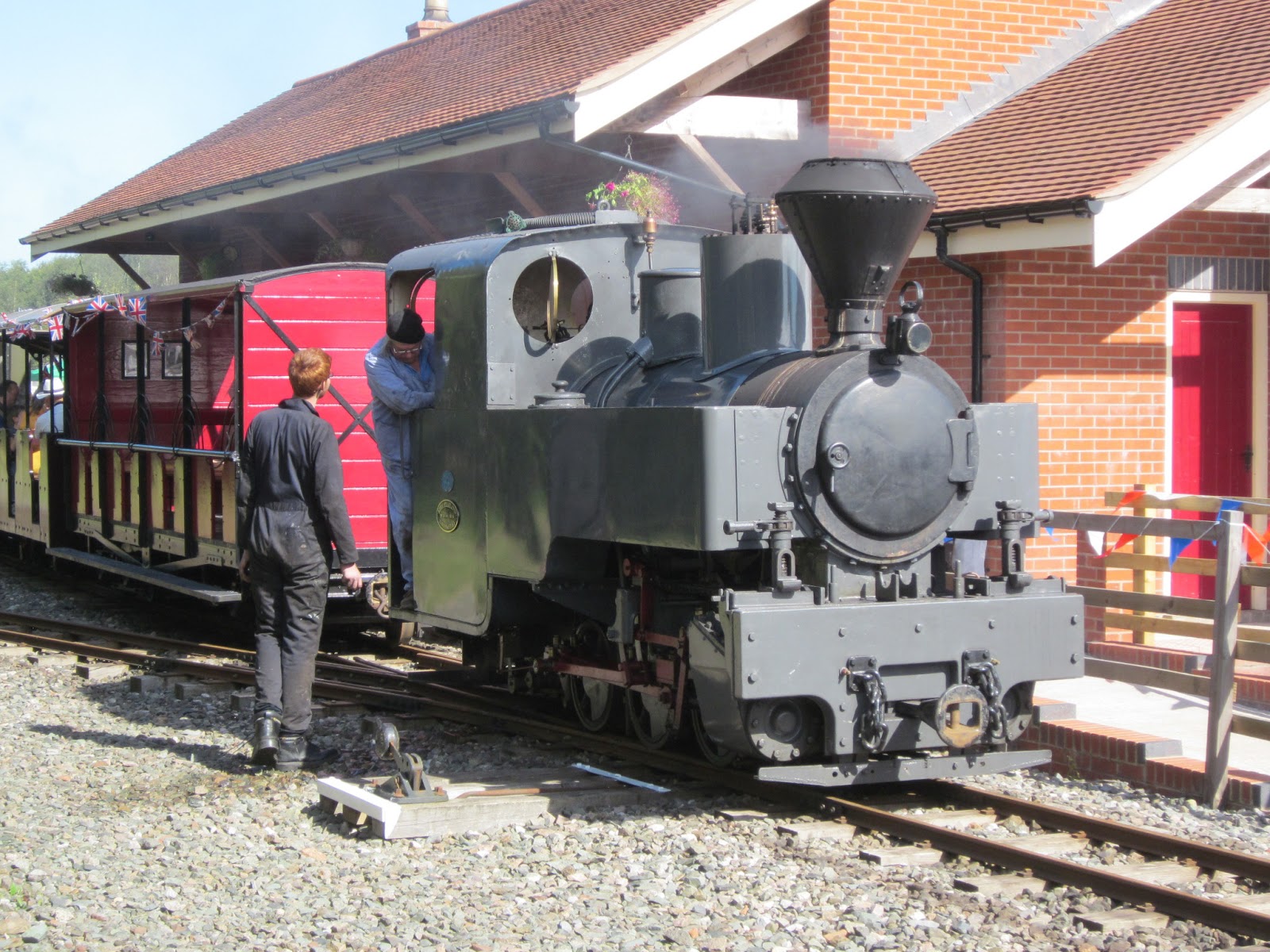
..... and awaited the arrival of our train, which on this occasion was hauled by former quarry Hunslet, Thomas Bach.


After taking on water and refuelling, we departed for Llanberis Station, where Thomas Bach ran around the train.........

 ....... before departing back down the line, this time passing through Gilfach Ddu without stopping. As we clicked and clacked our way beside the lake we had some fine views of the Snowdon Range, the summit of which was shrouded in cloud

...... before reaching the end of the line at Penllyn,  where the loco once more ran round its train.

At about the midway point on our return journey we paused for ten minutes at Cei Lledan station........

........ where we were passed by one of the line's other former quarry Hunslet locomotives, Dolbadarn. which formerly worked on the quayside at Port Dinowrwic.

On reaching Gilfach Ddu we alighted, though we could have stayed aboard to reach the terminus at Llanberis.

Certainly, for a day out, Llanberis has much to offer for all members of the family. On the train journey we shared our carriage with a young family and in a strong Liverpudlian accent one othe children said, "Llanberis is the best place in the whole world!" and somehow, I couldn't disagree with him.

Video