Search This Blog

Showing posts with label slate. Show all posts

Tuesday, 21 May 2013

Corris Railway

In a nutshell

Gauge:         2' 3"


Length:       Originally = 6½ miles
                     Preserved railway = ¾ mile


History:      1858 - horsedrawn tramway from Aberllefenni to Derwenlas Quay opened
                    1864 - line from Machynlleth to the quay at Derwenlas closed
                    1878 - steam locomotives and passenger services introduced                   
                    1929 - line acquired by GWR
                    1931 - passenger services removed
                    1948 - railway closed and stock scrapped or sold off
                    1966 - Preservation Society established
                    1970 - Museum opened
                    1985 - First preserved train ran

Location:


View Narrow Gauge Railways in a larger map


Date of visit:  6 May 2013


Key Facts

  • The railway ran for most of its length beside the road up the valley from Machynlleth to Corris with a steady gradient of around 1:40
  • The railway was originally constructed to transport slate from the quarries around Corris and Aberllefenni to a wharf on the River Dovey to the west of Machynlleth
  • When the Cambrian mainline reached Machynlleth, the line from Machynlleth to the wharf was closed and the slate traffic was instead transferred to standard gauge wagons
  • In 1878 the railway acquired three steam locomotives and ten four wheeled passenger carriages, though passenger services were suspended until 1883 owing to a dispute with local quarry owners
  • The Great Western Railway acquired the line in 1927 and shortly afterwards suspended passenger services
  • When the railway bridge over the River Dovey near to Machynlleth was weakened by floods in 1947, it was decided that it was uneconomic to continue running the line
  • The railway was one of the first to be closed by the newly nationalised British Railways
  • In 1966 a small group of Talyllyn Railway members formed the Corris Railway Preservation Society and acquired the station buildings and yard in Corris
  • The museum and a short length of track was opened in 1970-71
  • In 1981, the railway acquired the engine shed at Maespoeth and shortly afterwards the line was relaid from Maespoeth to Corris although for various bureaucratic reasons it was not possible to re-establish passenger services until 2002
  • There are plans to extend the railway from Maespoeth for 2½ miles down the valley to Tan-y-Coed and eventually to Machynlleth

Route

Original route - source: wikimedia
The railway today - source: http://www.corris.co.uk


My Impressions

When I arrived at the station yard in Corris, a train was in the station and about to depart for Maesporth. On this occasion only one coach was in use as the line's other carriage was in the sheds awaiting repair.

The coaches are replicas of the railway's original coaches which were in fact made from the bodies of two four wheel coaches mounted on a chassis with bogies.

I boarded the train with the twelve other passengers and the line's steam locomotive, a faithful replica of one of the railway's original Tattoo class locomotives, began its sedate journey down the ¾ mile to the line's workshops and sheds at Maespoeth.

 This was the site of the junction where the line divided to serve the quarries at Corris Uschaf and Aberllefenni.

We were given a guided tour of the workshops. In the carriage shed, the lines other coach was under repair, another was under construction and some goods stock was in the process of being renovated.

 After an enlightening talk about the history of the railway and its subsequent preservation, we made our way up to the station yard, where a new platform is under construction and one of the line's diesel locos was pottering around shunting wagons loaded with building materials and sleepers.

The signal cabin which controls the station area is not a replica of the original but has been constructed on-site by the Society.

 Once the line has been extended further down the valley, the signal box will perform an essential function monitoring and controlling the movement of trains through the station.
Maespoeth Junction signal diagram - Source: http://www.256.eclipse.co.uk/tube/MaespoethDiag.jpg
We then had an opportunity to view the engine shed which is one of the railway's original structures. It has recently been re-roofed and still retains many of its original features, including a large slate water tank.

After wandering around and viewing more of the station area, we wandered back to the platform, taking in a glimpse of the track winding back up the valley to Corris.

There was a quick opportunity to take a few more pictures of the our train.......

....before re-boarding for the return journey. As there are presently no operational run-round facilities at either station, the train operates as a shuttle. We were sedately propelled up the line to Corris where there was an opportunity to view the line's museum and shop.

In addition to railway artefacts, there are some fine models of various parts of the original railway on display.
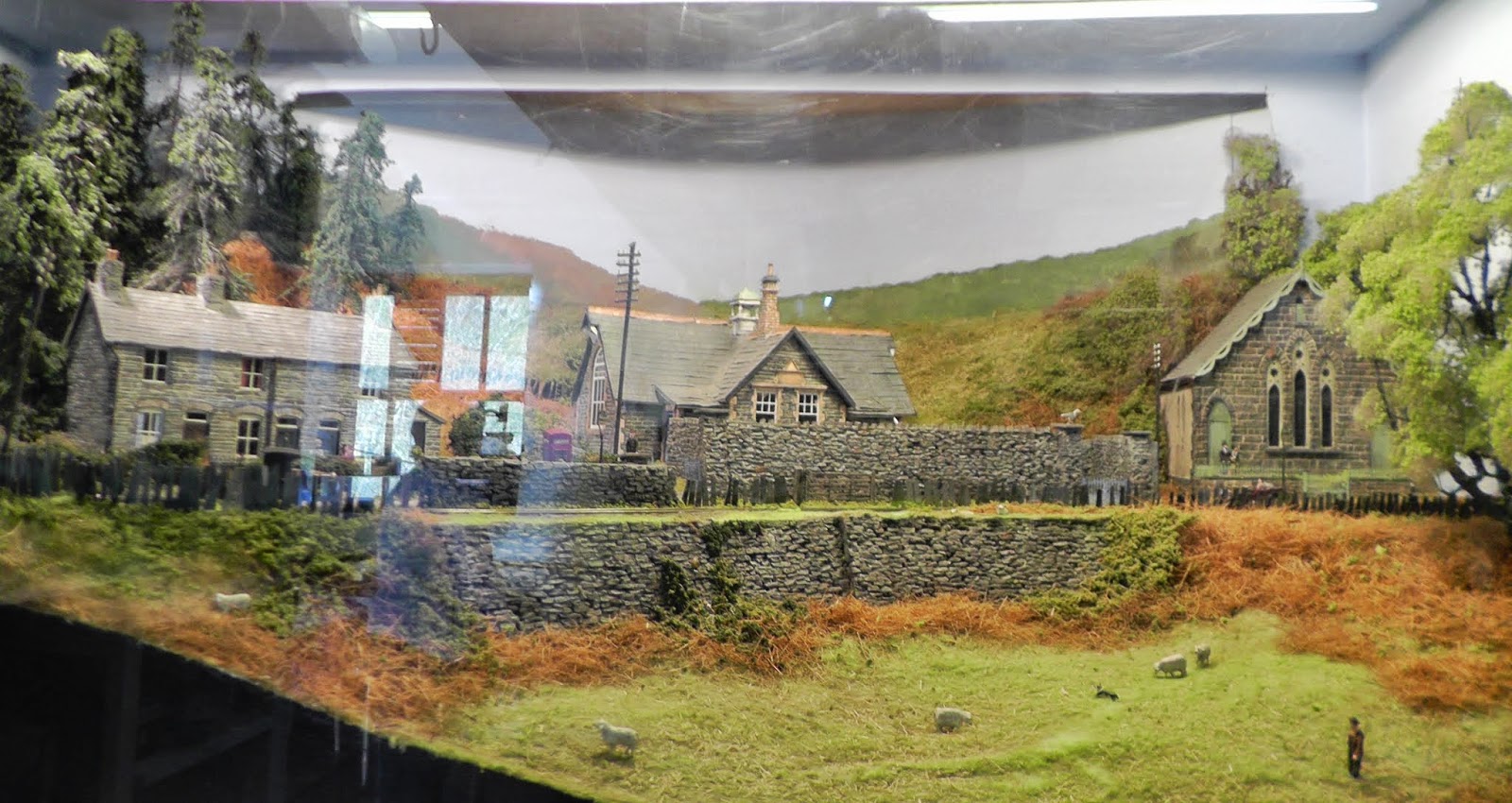
 After partaking of a freshly made cup of tea, I explored the immediate locality, finding the street modelled in the above photo.......

.... and discovering that as the railway continued its way through the village and onwards towards Aberllefenni, it passed very close behind the houses, which have now adopted the route of the railway to provide some much needed backyard psace and/or extensions.


One day I will return to walk the route of the line, documenting what remains of the trackbed, but on this occasion, I took a lingering look up route of the railway towards Aberllefenni ......

....... before walking back through the village towards the station, passing on the way the bridge over the stream which has now become a patio area for the neighbouring house.

I then followed the route of the existing railway ..........

.... taking the opportunity to get some lineside shots as the train made its way down to Maespoeth .......
 

..... and then back up the line to Corris. 

As this was the last train of the day, I returned to my car in the station's car park and then made my way back home.

I found the Corris Railway to be a very friendly place. The staff were clearly (and rightly) proud of their achievements and more than willing to answer even the most naive of my questions and also to provide plenty of additional information. It seems they have plans to remodel Corris Station, including a rebuild of the train-shed which was a feature of the stations at both Corris and Machynlleth. The planned extension will be the next phase in their ambition to restore the line to Machynlleth, which is readily achievable as much of the trackbed is still in existence, though road widening has, in some places, encroached on the route of the railway.

Although the museum and shop are quite small, the welcome is large and there are plenty of secondhand books and DVDs to satisfy the enthusiast whose sales will help to swell the society's funds. There are light refreshments and hot drinks available and an opportunity to discuss the railway's past, present and future with the staff as you sit and sup.

One advantage of a compact railway such as this is that can be visited in around an hour (or longer if you want to explore further aspects). And so, it caters well for those who want to drop in on their way through the valley. I would strongly urge you to do so whenever you are in the area. Such an interesting and unique narrow gauge railway is well worth the visit.

Virtual Visit Video


Friday, 22 February 2013

Llechwedd Slate Caverns

In a nutshell

Gauge:         1' 11½"

Length:       800m (Tramway) 500' descent plus half mile walk (Deep Mine)

Opened:      1846 (Original quarry) 1972 (Miners' Tramway) 1979 (Deep Mine)

Location: 

Llechwedd Slate Caverns
Blaenau Ffestiniog
Gwynedd LL41 3NB

View Larger Map

 Tel.:   01766 830306
Web:   http://www.llechwedd-slate-caverns.co.uk/index.php


Date of visit: 20 February 2013


Key Facts

  • The Llechwedd slate quarry was opened in 1846 by John Greaves. He later became the treasurer and eventually chairman of the Festiniog Railway.
  • At its peak, the quarry had 513 employees and produced 23,788 tons of finished slate per year (1884)
  • In 1890 the quarry machinery was converted to electrical power with the quarry's own hydro-electric generating station.
  • In its heyday, slate was mined by hollowing out large galleries. A team of four men was responsible for extracting and finishing the slate from each gallery. Some galleries were up to 250' from floor to ceiling.
  • Blocks of slate were transported from the galleries to the finishing sheds along horse-drawn tramways.
  • Slate is still being extracted on the site by open-cast quarrying from the surface.
  • The caverns now include two separate visitor attractions - the Miners' Tramway which uses a battery powered locomotive to haul visitors through a tunnel with two stops in galleries for illustrated talks - and the Deep Mine which involves descent via an incline with a guided walk through a series of galleries, some of which are now flooded.
 

My Impressions

I coincided this visit with a trip on the Ffestiniog Railway and only had time on this occasion to travel on the Miners' Tramway. I will return at some time in the future to complete the visit by touring the Deep Mine.

As this was only a flying visit, I did not have time to sample the delights of the cafe though I did spend a while exploring the shop, which provides a selection of slate-related memorabilia and some literature relating to slate quarrying and the local community. At this time of the year, tours depart at half hourly intervals and so, after a short wait, our train reversed into the station and we boarded the coach for our trip into the mine.

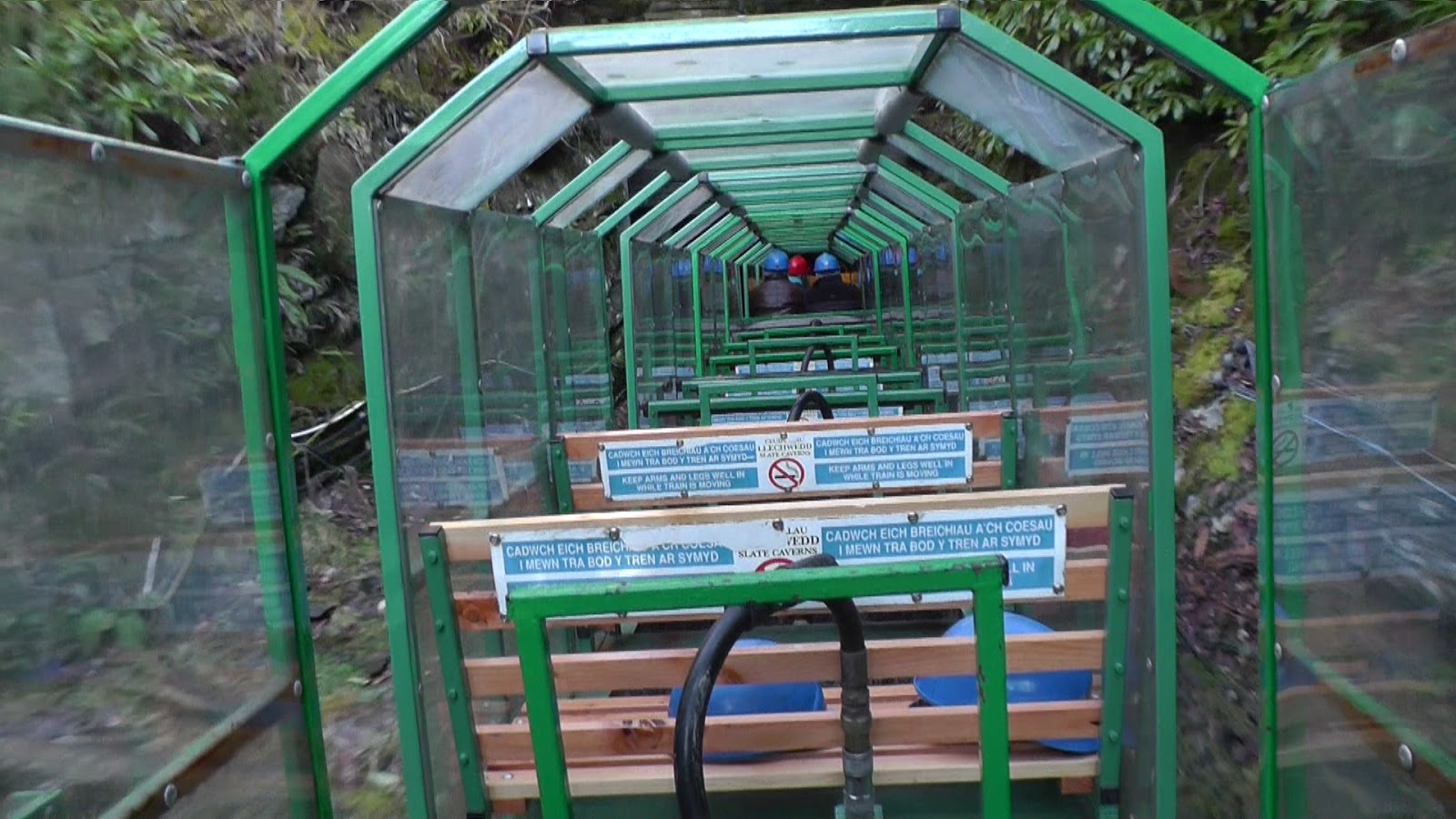
I took my seat in the last carriage which gave me a view through the other coaches as the train wound its way through the twisting tunnels.

After passing a few floodlit galleries and side tunnels we stopped at the entrance to a gallery where we alighted and our guide explained the Victorian working practices for extracting slate.

We hopped aboard the train once more and wound our way through to another two galleries where we were entertained with an audio visual presentation of working practices and a further live talk, explaining some of the health and safety issues associated with life in the mines.

Meanwhile, our train had turned round via a reversing triangle and we resumed our seats for the return ride. We were then given a demonstration of slate-splitting in the finishing shed.................

............ before my fellow-passengers made their way to the Deep Mine. I will have to save this part of the tour for my next visit as we needed to travel back to Cheshire for an appointment.

The slate caverns are certainly impressive and if you have not already seen them, they are well worth a visit. The opportunity to see first-hand this reconstruction of an important part of North Wales' industrial heritage is both enlightening and salutary. The last time I visited the Caverns was 26 years ago when I accompanied a school party on a visit. It was reassuring to see that this tour was very much as it was then. It would seem that the winning formula from the early days of this visitor attraction has been retained. I am looking forward to my next visit when I will be able to relive my experiences in the Deep Mine.

Video

[In preparation]


Monday, 13 August 2012

Llanberis Lake Railway

In a nutshell

Gauge:         1' 11 ½"

Length:  2.5 miles (4 km)

Opened: 1824 (horsedrawn) - 1842 (steam hauled) - 1971 (Heritage Railway)

Location:

Rheilffordd Llyn Padarn
Gilfach Ddu,
Llanberis,
Caernarfon,
Gwynedd.
LL55 4TY 

Tel: 01286 870549 


View Larger Map


Date of visit: 11 August 2012


Key Facts

  • The route for the present day railway partly follows that of the 4' gauge Padarn railway which connected the Dinorwic Slate Quarries at Llanberis with Port Dinorwic on the Menai Straits.
  • The 2'(ish) narrow gauge wagons were loaded side by side on Padarn Railway transporter wagons
  •  One of the original 4' gauge locomotives, Fire Queen, is preserved in the museum at Penrhyn Castle
  • The slate quarries at Llanberis used a large number of 1' 10¾" gauge steam locomotives to haul slate wagons at different levels in the quarry. Two of the former Hunslet quarry locomotives now haul the trains on the Llanberis Lake Railway and one of the Hunlset locomotives on the line was used at Port Dinorwic
  • The actual gauge of 1' 10¾" was determined after measuring 2' between the centres of each rail rather than the edges
  • Other former Dinorwic quarry locomotives have been preserved and now run on the Bala Lake Railway and the Statfold Barn Railway
  • The former workings for the slate quarries at Gilfach Ddu, Llanberis are now the Welsh National Slate Museum which houses the largest working water wheel in mainland Britain


Route

Map: © OpenStreetMap contributors/http://openstreetmap.org / CC-BY-SA-3.0

My Impressions

 Although we could have boarded the train at Llanberis Station we decided to explore the area around Gilfach Ddu where there is much to see, including the National Slate Museum (free admission).......

the quarries with their several walks and trails........
 ....... and the former hospital for the quarries which give some indication of the dangerous working conditions for the quarrymen.

We bought our tickets in the station building, which houses a small souvenir shop and a café ......

..... and awaited the arrival of our train, which on this occasion was hauled by former quarry Hunslet, Thomas Bach.


After taking on water and refuelling, we departed for Llanberis Station, where Thomas Bach ran around the train.........

 ....... before departing back down the line, this time passing through Gilfach Ddu without stopping. As we clicked and clacked our way beside the lake we had some fine views of the Snowdon Range, the summit of which was shrouded in cloud

...... before reaching the end of the line at Penllyn,  where the loco once more ran round its train.

At about the midway point on our return journey we paused for ten minutes at Cei Lledan station........

........ where we were passed by one of the line's other former quarry Hunslet locomotives, Dolbadarn. which formerly worked on the quayside at Port Dinowrwic.

On reaching Gilfach Ddu we alighted, though we could have stayed aboard to reach the terminus at Llanberis.

Certainly, for a day out, Llanberis has much to offer for all members of the family. On the train journey we shared our carriage with a young family and in a strong Liverpudlian accent one othe children said, "Llanberis is the best place in the whole world!" and somehow, I couldn't disagree with him.

Video


Saturday, 11 August 2012

Penrhyn Quarry Railway

In a nutshell

Gauge:    1' 10¾"

Length:  Less than a mile (at present), potentially 6 miles

Opened: 1801 (horsedrawn) - 1876 (steam introduced)

Location: 

Penrhyn Quarry Railway
Felin Fawr Cyf,
Felin Fawr Works,
Bethesda, Bangor,
Gwynedd.
LL57 4YY

View Penrhyn Quarry Railway in a larger map


Date of visit: 8 August 2012 (preliminary visit)


Key Facts

  • The railway was constructed to carry slate from the quarries at Bethesda to Port Penrhyn on the shore of the Menai Straits six miles away
  • Initially, the railway was horsedrawn, with three gravity inclines, but the route was amended and steam locomotives introduced in 1876
  • The railway closed in 1962.
  • Two former Penrhyn locomotives - Blanche and Linda - are presently owned by the Ffestiniog Railway. Other Penrhyn locos are preserved at other sites around the UK including Bressingham Steam & Gardens in Norfolk
  • There are more exhibits and information about the railway at Penrhyn Castle in Bangor, the former residence of Lord Penrhyn who was responsible for the quarry and the railway


Route

The line extends from the yard at Felin Fawr Works (the former workshops for the railway) to St Anne's, approximately half a mile down the original route of the railway.


My Impressions

 There was no one in evidence when we visited the railway - but we did arrive unannounced. The workshops for the railway are situated in the Felin Fawr Works, in the shadow of the quarry tips. These were the workshops for the quarry railway when the line was in its heyday.

It is clear that the workshops are preparing for more extensive operation in the not too distant future.....

 ...... while at the rear of the workshop track has been laid on the former trackbed of the railway.

Image: Penryhn Quarry Railway - http://amutek.co.uk/penrhynrailway/
 The Official Opening of the railway was held on 24th July 2012, exactly 50 years since the line closed. The former Penrhyn Quarry locomotive, George Sholto, made a special return visit from its present home in Bressingham Steam & Gardens to mark the occasion.


This first visit was a preliminary reconnoitre to find the exact location of the railway and check developments. A further visit will be made when the railway has its next Open Day.