In a nutshell
Gauge: 3'
Length: Approx. 1¾ miles
Opened: Saturday 13 July 1895
Closed: 1939 (Outbreak of WWII)
Location:
View Narrow gauge railways Britain & Ireland (closed) in a larger map
Dates of visit: 4 April and 6 April 2013
Key Facts
- The railway was engineered by Holman F Stephens (Lt. Colonel Stephens) who later became well known for being responsible for several Light Railways across the country - Including the Kent & East Sussex Railway which has a museum charting his exploits.
- It was called a 'tramway' because it was built entirely on private land and so at the time did not need an Act of Parliament. The Light Railways Act came into force the year after it was opened and so, had it been built then it would have been called a Light Railway.
- The railway was originally set up to transport golfers to the newly opened Camber golf club.
- At first the railway terminated at what later became Golf Links Station. The line was extended in 1908 to Camber Sands to accommodate the increase in day tripper traffic - although the station was still about ½mile from Camber itself
- The railway had two 2-4-0 steam locomotives - Camber and Victoria, both constructed by Bagnalls of Stafford.
- The railway had two bogie passenger coaches and two open wagons which could be converted to carry passengers as needed
- In 1925, the railway acquired an 0-4-0 Simplex petrol powered locomotive. Victoria was sold and Camber was used only on very rare occasions
- In 1939 Camber Sands station was moved to a new location to permit improvements to the golf course. However, the railway closed to passenger transport shortly afterwards and, although the Admiralty made some use of the railway, including concreting over part of the trackbed near the Golf Links Station, but after the war the railway was in such poor condition it was closed completely.
- Although much of the trackbed is still visible, the extraction of shingle between Broadwater Bridge and Halfway House has resulted in a large lagoon where this part of the railway once ran.
Route
 |
| The Route of the Rye & Camber Tramway - Source: http://www.hfstephens-museum.org.uk/images/stories/railways/ryecam/02_ryecam.jpg |
My Impressions
My first encounter with the railway was on a bitterly cold day in April when I parked the car beside the bridge over the River Rother in Rye and walked the footpath to the lagoon.
The site of the station beside the Monkbretton bridge is indistinct but the line of the railway across the meadow from the station towards Camber is clearly visible.
 |
| Rye Station with the abutments of Monkbretton Bridge in the background - Source http://www.hfstephens-museum.org.uk/images/stories/topics/camber_tramway/tram_b.jpg |
 |
| The site of Rye Station |
 |
| The Rye & Camber Tramway track across the meadow |
|
|
|
A brisk walk across the meadow along the footpath/cycle track and we reached the Broadwater Stream which was crossed by the railway on a simple girder bridge.
 |
| Broadwater Bridge with a train bound for Rye - Source: http://www.hfstephens-museum.org.uk/images/stories/topics/camber_tramway/tram_j.jpg |
 |
| Broadwater Bridge today |
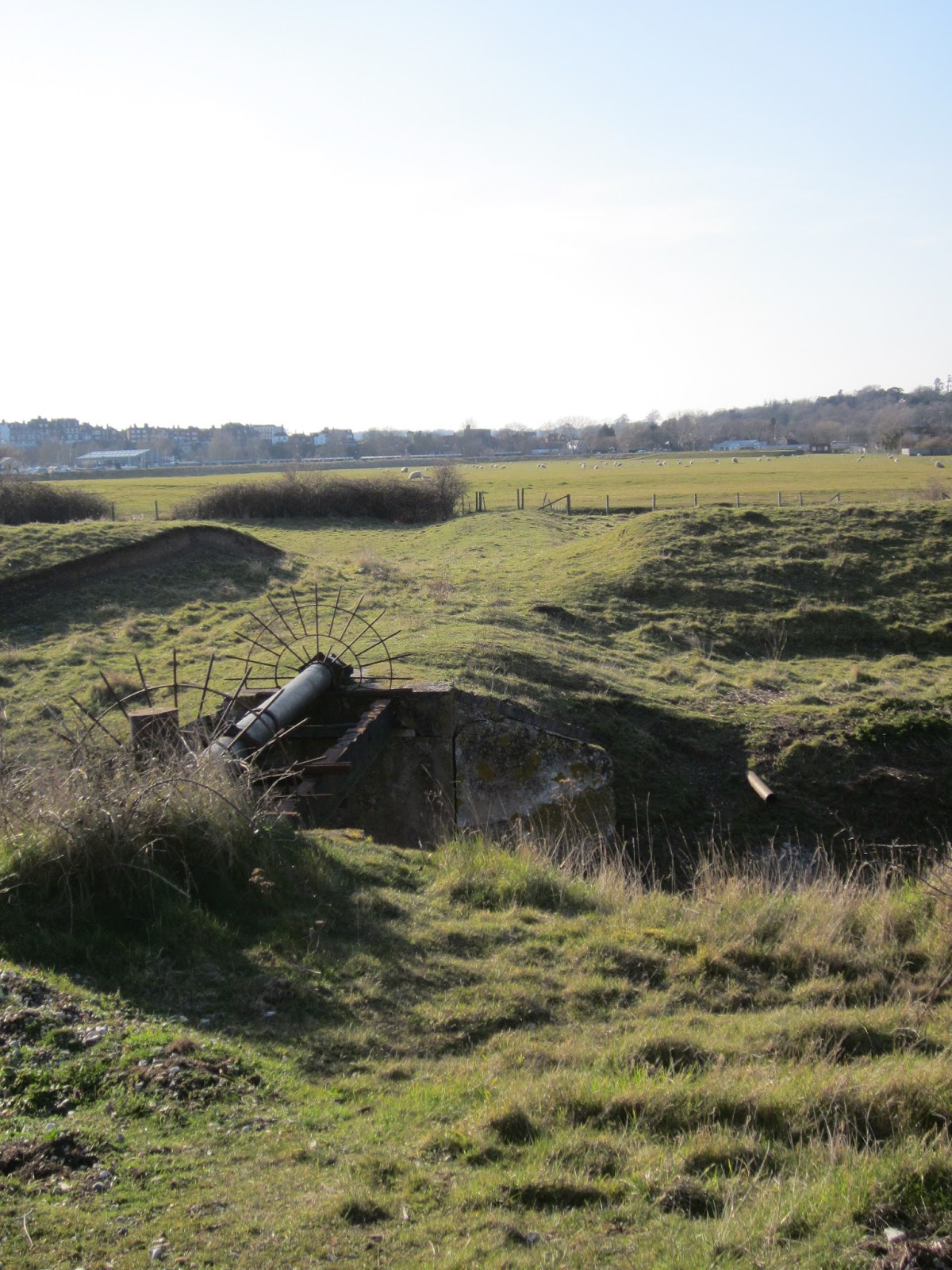
Looking back towards Rye, it is possible to make out the embankment leading up to the bridge and the route of the railway across the field.
 |
| Broadwater Bridge looking back towards Rye |
At this point the route of the railway is interrupted by a lagoon formed by flooding the shingle workings at Northpoint Beach - it is now used for windsurfing.
 |
| The flooded shingle workings covering the old trackbed of the railway. |
Although it would be possible to walk beside the lagoon towards Camber, we re-traced our steps hopped in the car to Camber, where we attempted to trace the route of the railway from the opposite direction.
 |
| The trackbed as it emerges from beside Gorse Cottage. |
With the lagoon and Rye in the background the railway emerges once more by Gorse Cottage. It is now embedded in concrete which was laid by the Admiralty during the Second World War. On the right of this picture would have been
Golf View which was demolished in 1983.
 |
| Golf View (aka Beachlands and Squatters' Right) with a Rye Bound train - Source: http://www.hfstephens-museum.org.uk/images/stories/topics/camber_tramway/tram_d.jpg |
Turning around to look towards Camber, the trackbed now forms the roadway to Rye Harbour - but in places the rails are still visible.
 |
| The trackbed looking towards the site of Golf View - Golf Links station in the distance |
 |
| The trackbed beside the site of Golf View - looking towards Golf Links Station |
At the end of the road lies the slightly extended and modified station building and platform for
Golf Links station which is presently in use by the golf club as a store room.
 |
| Golf Links Station building and platform with the concreted trackbed. |
 |
| Golf Links Station in its days as the Camber terminus - Source: http://www.urban75.org/railway/images/camber02.jpg |
The track is very much in evidence preserved in the Admiralty's concrete. Looking back towards Rye it's possible to imagine the train snaking its way beside the golf course to the station.
 |
| The trackbed looking back towards Rye from just outside Golf Links Station |
 |
| The Simplex Railmotor hauls a packed train between Rye and Golf Links in 1931 - Source: http://www.hfstephens-museum.org.uk/images/stories/topics/camber_tramway/tram_n.jpg |
 |
| Golf Links Station building from the jetty. The Golf Club buildings in the background |
Although the course of the river has changed slightly and the golf course has been extended beyond the railway into what was once salt marshes, the station building is still quite close the the harbour and the newly built harbour master's house.
 |
| Golf Links Station during WWII when the Admiralty built a siding to a jetty - Source: http://www.colonelstephenssociety.co.uk/R&C%20E.jpg-for-web-large.jpg |
On the day we were there, builders had taken over part of the former station yard and so not all was accessible - however, this looked to be a temporary intrusion.
The golf course has commandeered the trackbed immediately after the station but within a short distance there is a gateway to a permissive footpath across the golf course on the trackbed of the railway. This photo was taken looking back towards the Golf Links station, the harbour master's house is quite an impressive structure in the middle distance, dwarfing the old station building to its right.
 |
| Looking back towards Golf Links Station. The Harbour Master's house dwarfing the station building to its right |
Looking the opposite way, towards Camber Sands Station, after curving to the left the track strikes out in a straight line on a low embankment. On the right would have been saltmarshes in the days of the railway, the embankment being washed by high tides. To the right in the middle distance the original trackbed branches off towards the pre 1939 terminus.
 |
| Looking towards the second Camber Sands Station - the original trackbed veered off to the left in the middle distance. |
 |
| An early train with all coaching stock pressed into service among the marram grass near Camber Sands Station - Source: http://www.colonelstephenssociety.co.uk/COL-RCT1.jpg-for-web-large.jpg |
The footpath follows the 1939 deviation to the second, short-lived
Camber Sands Station. There is very little to show nowadays, apart from a widening of the trackbed to accommodate the wooden platform and shelter.
 |
| The site of the second Camber Sands Station |
 |
| The original Camber Sands Station with the tea rooms in the background - Source: http://www.colonelstephenssociety.co.uk/Camber%20sands%201924.jpg-for-web-large.jpg |
 |
| Camber Sands Station looking towards Golf View and Rye - Source: http://www.hfstephens-museum.org.uk/images/stories/topics/camber_tramway/tram_l.jpg |
 |
| Camber Sands - Source: https://encrypted-tbn3.gstatic.com/images?q=tbn:ANd9GcRkfDfyebsN38vl2CTuVkI5YINPCWkEnRIL-LffM3WflgRAyG2p |
There is very little in evidence now of the original structure but searching among the 'rough' beside the trackbed unearthed the remains of a wooden post - which might well have been one of the supports for the wooden platform.
 |
| Camber Sands Station (1939 site) looking back towards Golf View and Rye. The remains of a wooden post just visible in the foreground. |
Access
Most of the railway trackbed is still accessible. There is a small parking area beside the Monkbretton Bridge on the way out of Rye towards Camber. The footpath starts here beside the site of the station.
 |
| Site of Rye Station beside the bridge |
 |
| View from the bridge - the trackbed is just discernible stretching out across the field from beside the Pumping Station. |
|
|
|
|
It is possible to walk or cycle from here to Camber following the trackbed for much of the way.
Another access point is on the Camber Road, just where it takes a sharp left turn to run beside the lagoon. There is a parking area on the bend where the cycle track crosses the road. A short walk down the cycle track will take you to the remains of the Broadwater Bridge.
 |
| The remains of the Broadwater Bridge snapped from the footpath. |
The best approach to the railway from Camber is to park in the Camber West car park and take the footpath to beach from the Westernmost end of the car park (near to a row of cottages). The permissive footpath across the golf course on the trackbed can be accessed about half way along this path on the right hand side. The car park fee is quite pricey but you can walk the remaining section of the railway to the lagoon and back again in two hours.
Alternatively, you can park on the main beach car park and walk along the sands. Take the path into the dunes beside the 'Red Zone B' signboard and you will come to the start of the permissive path across the golf course (this time on the left hand side about half way along).