Search This Blog

Showing posts with label alan keef ltd. Show all posts

Monday, 15 September 2014

Ironbridge - Blists Hill Mine Railway

In a nutshell

Gauge:         2'

Length:       212m

Opened:     2010

Location:    


Blists Hill Victorian Town
Legges Way
Madeley
Telford,
Shropshire
TF7 5DU

Web:            http://www.ironbridge.org.uk/our-attractions/blists-hill-victorian-town/
Telephone:  01952 433424
Email:         http://www.ironbridge.org.uk/about-us/contact-us/ 


Date of visit:     12 September 2014


Key Facts

  • The locomotive appears to be a 4w W417 Wingrove & Rogers battery electric, which was refurnished by Alan Keef in 2008
  • The train comprised eight four wheel coaches and the locomotive with the name of  "Sir Peter Gadsden" who was chairman of the museum trust until 2006. 
  • The last carriage includes a driver's compartment which is used to control the train on the outward leg.
  • The track winds serpent-like around along the hillside and then enters an artificial tunnel before stopping in a darkened area where there is a projected AV show depicting a conversation in silhouette between a young boy, who has just started working in the mine, and his father.
  • Trains leave approximately every half an hour and the trip lasts for about 15 minutes
  • There is an additional charge of £2.00 per head to travel on the Mine Tramway

Route

My Impressions

Whilst awaiting the arrival of the next train, there was an opportunity to read the information boards about the history of clay mining in the valley, and also an opportunity to watch the train arrive on to the platform.

We were given a short talk about the mining process before we then boarded the train which wound its way along the circuitous track carved into the hillside.

 The train then negotiated the entrance to an artificial tunnel ....

 ...... which became progressively darker until the train stopped in almost complete darkness. We were then entertained by a short AV presentation which depicted an imagined conversation between an experienced clay miner and his son. The presentation focused on the dangers associated with clay mining - principally suffocation through a build-up of carbon dioxide and roof falls associated with the careless use of explosives.

The train then reversed (or strictly speaking went forward) out of the mine and back along the track .....

... to the station .......

...... where we disembarked.

 On the platform is a restored example of one of the tub wagons which were used to transport clay from the mines along the valley. These were propelled by hand and by horses.

Personally, I would have been interested in being given more detail about the mining and processing aspects of the venture, but this level of detail would probably not have appealed to the majority of the passengers on the train - several of whom were very complimentary to the staff about the quality of the trip.

The Mine Railway forms part of the Blists Hill Victorian Town exhibit in Ironbridge and so there is plenty to see and do. Many of the shops in the replica streets are manned by staff in period costume who are happy to explain the technicalities and history of the trades they represent.

It is possible to exchange today's currency into Victorian pennies which can then be used to purchase items in the shops - including fresh bread, rolls and shortcake baked in the town's bakery.

There are working steam engines, including this working replica of Trevithick's 1804 Pen-y-Darren locomotive which was not in steam during our visit.

Around the town are various stationary engines, such as this one in the yard of the stone mason.

 The entrance fee is quite substantial, but it is possible to buy a year-long passport to most of the exhibits in the gorge which makes a considerable saving in entrance fees overall and provides an opportunity for return visits - it would be difficult to see all the exhibits in the gorge in one day.

There are food outlets in the Victorian Town which offer both snacks and cooked food at reasonable prices and there are plenty of places to have picnics if you prefer.

Overall, this trip would make an interesting day out for the whole family - there is plenty to see and do and all the staff we met were very helpful and well informed - only too happy to demonstrate and discuss the exhibits they were manning.


Video

[In preparation] 


Wednesday, 30 April 2014

Margam Park Railway

In a nutshell

Gauge:         2'

Length:       Approx 1¼ miles

Opened:     2011 (?)

Location:  


View Narrow Gauge Railways in a larger map

Email:   margampark@npt.gov.uk
Tel:        01639 881 635


Date of visit:     12 April 2014


Key Facts

  • The railway has one steam outline 0-4-0DH  'Margam Castle' and three carriages (two open one closed) built by Alan Keef Ltd.
  • The railway runs daily in the summer months (usually from 1 April to the end of October).
  • The railway runs from the car park near the entrance to the Park through the grounds, across the dam of the lake (New Pond) to the castle.
  • The line originally ran from the castle around the lake to the adventure playground.
  • There is a modest additional charge to take the train which run every half hour.
  • There is a cafe in the castle courtyard and play areas for children.

Route


My Impressions

 Entrance to the park is free, though there is a charge (£3.50) for car-parking - which I consider to be very reasonable when one considers the cost of visiting other visitor attractions.

As we arrived before the first train of the day, we walked from the car park to the Castle, where we partook of a cup of coffee in the cafe. There was an opportunity to study the history of the park and the 19th Century Tudor Gothic Mansion, which was designed by the architect Thomas Hopper for Christopher Rice Talbot between1830 and 1840. I was intrigued to discover that a frequent visitor to Margam was Henry Fox Talbot, probably the country's most famous early photographer.

Just outside the courtyard of the Castle, the train was being prepared for her first trip of the day

The Alan Keef 0-4-0 DH loco is very similar in design to that used on the Blenheim Park Railway and the one closed and two open carriages provide utilitarian comfort for admiring the views of the parkland.

After watching the train depart to pick up its first load of visitors, I waited for its return.

It skirted the artificial lake (New Pond) before returning via the balloon loop to the Castle Station .....

...... where I boarded, the only Down passenger on this particular service.

After paying the fare, we set off around the remainder of the balloon loop........

...... and off to the banks of the lake .........

 ...... eventually crossing the dam which helped form the ornamental lake. At the end of the lake, in front of the adventure playground, is the old loop which originally formed the other end of the railway.

We branched off to the left to begin our descent through the parkland towards the car park.

Visitors arriving at the car park and taking the train up the line to the castle will get a good feel for the park and its attractions as the train passes through some of the parkland and woodland .......

......as the track meanders through the park. As the train approaches the lower end of the line it crosses a stream and heads on to the balloon loop beside the cricket pitch .......

 ...... before pulling into the lower station adjacent to the entrance and the car park.

The approach to the station is a short walk from the main entrance but there is easy wheelchair access and facilities on the train to take disabled passengers.


The railway is in a wonderful setting and it's good to see that it is performing a useful function. I should imagine that young families who have expended their energies in the play areas and following the walks in the park will appreciate a return trip on the train. It's still very pleasing to see how excited young children get when they are having a train ride - and the length of the trip is just about right. Far enough to retain their interest but not too far that it becomes boring.

Video


Monday, 2 September 2013

Buxton Pavilion Gardens Railway

In a nutshell

Gauge:         12¼"

Length:        320 yards

Opened:       1972 - 10¼"
                      1998 - 12¼"

Location:    


View Narrow Gauge Railways in a larger map  


Date of visit:     6 August 2013

Key Facts

  • When the railway first opened in 1972 it was 10¼" gauge.  
  • The first loco was made by Shepperton Metal Products and called Borough of Buxton
  • During the winter of 1998, the line was regauged to 12¼" and supplied with Alan Keef rolling stock.    
  • The railway is circular, with a tunnel which also acts as a stock shed. It runs beside a stream which it bridges in two places
  • The railway runs at weekends and during school holidays but not when the weather is inclement (advisable to phone the gardens beforehand to check)
  • Two circuits of the line costs £1.00 (2013 prices)

Route


My Impressions

The Pavilion Gardens at Buxton are what I consider to be a traditional town park - with a boating lake, a river, formal gardens, children's playground plenty of grass and, of course, a miniature railway.

One of our first priorities was to find something to eat. There is a coffee bar but we felt the need for something more substantial and opted for lunch in the restaurant which is housed in the Pavilion.  The food was very tasty and reasonably priced, and given its popularity, we assumed our experience was not uncommon.

I then went to explore the park. The railway is centrally located and, as it was during the school holidays, seemed to be regularly patronised.

 The station platform is readily accessible and the Alan Keef coaches are simple but comfortable.

 The steam outline diesel hydraulic 0-6-0 loco looks the part and happily pulls its train with little effort. It is named after the designer of the park, Edward Milner, who landscaped the gardens in 1871.

After leaving the station, the rain crosses a stream and skirts a small ornamental lake.

The train then enters the tunnel, which doubles as a shelter for the rolling stock.

On emerging from the tunnel ..........

 ..... the train crosses a bridge across the end of the lake and a stream .......

 ......... to then cross a patch of grass and return to the station.

 It was certainly a pleasure to relax in such a well maintained park which is situated in the heart of the town. It's clearly a popular attraction for locals and for visitors - the added bonus being a fountain which acts as a source for the spa water. I saw one elderly but sprightly gentleman refilling several plastic bottles with spa water - presumably to save the expense of buying it in the supermarket.

I assume that the railway is more or less self-financing. The track was well maintained and the rolling stock in excellent condition. It is to be hoped that this sort of visitor attraction remains viable. Certainly the children and their parents or grandparents were very appreciative of it.

Video

[In preparation] 


Tuesday, 9 April 2013

Blenheim Park Railway

In a nutshell

Gauge:         15"

Length:       1000 yd

Opened:      1975

Location:


View Narrow Gauge Railways in a larger map  


Date of visit: 7 April 2013


Key Facts

    • When opened in 1975 the line was a simple push/pull service with Pleasurerail, locomotives
    • The railway is now longer - in the shape of question mark, running from just outside the Palace to the Pleasure Gardens.
    • The railway continues the tradition of 15" gauge park railways developed originally by Sir Arthur Heywood
    • Trains are mainly now hauled by Sir Winston Churchill, an 0-6-2 steam outline diesel hydraulic loco built by Alan Keef in 1992.
    • Carriage stock comprises four bogie open toast-rack style coaches, also by Alan Keef.

    Route


    View Blenheim Park Railway in a larger map


    My Impressions

    The railway was directly opposite the car park when we arrived and so we were able to view the train as it passed us on several occasions while we ate our packed lunch.

     There are two cafés at Blenheim, one at the Pleasure Gardens which specialises in food for children and their parents, and one in the Palace itself which is more focused on grown-ups. They both serve decent coffee and have a selection of hot and cold dishes available.

    While the rest of the family went to sample the delights of the Palace, I amused myself by exploring the railway. The line runs from just outside the Palace, where there is a platform and run-round loop ......
     .... for the line's principal locomotive, an 0-6-2 steam outline diesel hydraulic which was built by Alan Keef.


    Winding in an elongated S-shape,

    ....... the railway descends on a slight gradient towards the Pleasure Gardens .........

    ..... passing en route, the carriage and engine sheds.

    At the Pleasure Gardens, there is another small station with a run-round loop.......


    ...... which allows the loco to pull the train back up towards the Palace Station - something which it does at half hourly intervals.

    Considering the railway has been built to serve one purpose, the attention to detail is quite impressive, the track is in immaculate condition and the whole enterprise runs with a calm air of efficiency. It would be interesting to see some steam power on the line - but the Keef loco makes a fair representation of a steam engine and, of course, will require far less maintenance.

    Video


    Tuesday, 16 October 2012

    Haigh Hall Miniature Railway

    In a nutshell

    Gauge:      15"

    Length:     approx 1 mile

    Opened:    1986

    Location:


    View Larger Map

    Email.   leisureenquiries@wlct.org
    Tel.        01942 828508 


    Date of visit: 14 October 2012


    Key Facts

    • The line is situated in Haigh Hall Country Park.  Haigh Hall originally belonged for many ages to the Bradshaigh family - the local MP for Wigan before passing to the Earl of Crawford. The Hall and its park are now owned by the Wigan Leisure & Culture Trust.
    • The track is in the form of a circuit which is pinched where the tracks pass close to each other
    • The track passes mostly through Woodland skirting ornamental lakes and pools. 
    • There are two stations ‘Haigh Hall South’ which is the main station which also has a three road engine shed and ‘Haigh Hall North’ which is adjacent to the estate's walled garden
    • The line has two locomotives - Rachel, a former Fairbourne Railway diesel and Helen, as steam outline 0-6-0 diesel locomotive built by Alan Keef Ltd.

      Route

      Source: http://www.wigan.gov.uk/NR/rdonlyres/758EB75A-2814-4FF5-AFAE-7B187314E158/0/HaighHealthWalk1180kb.pdf

      My Impressions

      According to the Manchester Countryside website, the railway is supposed to run on Sunday afternoons during the winter months. And so, we set out one October Sunday to explore this railway. The car parks are quite extensive with free parking for disabled badge holders. 

       We parked adjacent to the Stables Tearooms where we indulged in a coffee and an Eccles Cake before seeking out the railway. I realised something was amiss when I found that whereas the children's playgrounds, the Hall, the Tearooms and the walled garden were well signposted, there were no signs indicating the whereabouts or even the existence of the railway. Undaunted, I pressed on and a friendly local inhabitant pointed me in the right direction where I found High Hall North Station, beside the southern edge of the walled garden. The rails were rust-encrusted suggesting they had not been used for some time.

      Further inspection confirmed that the trackbed was in need of more than a little TLC.

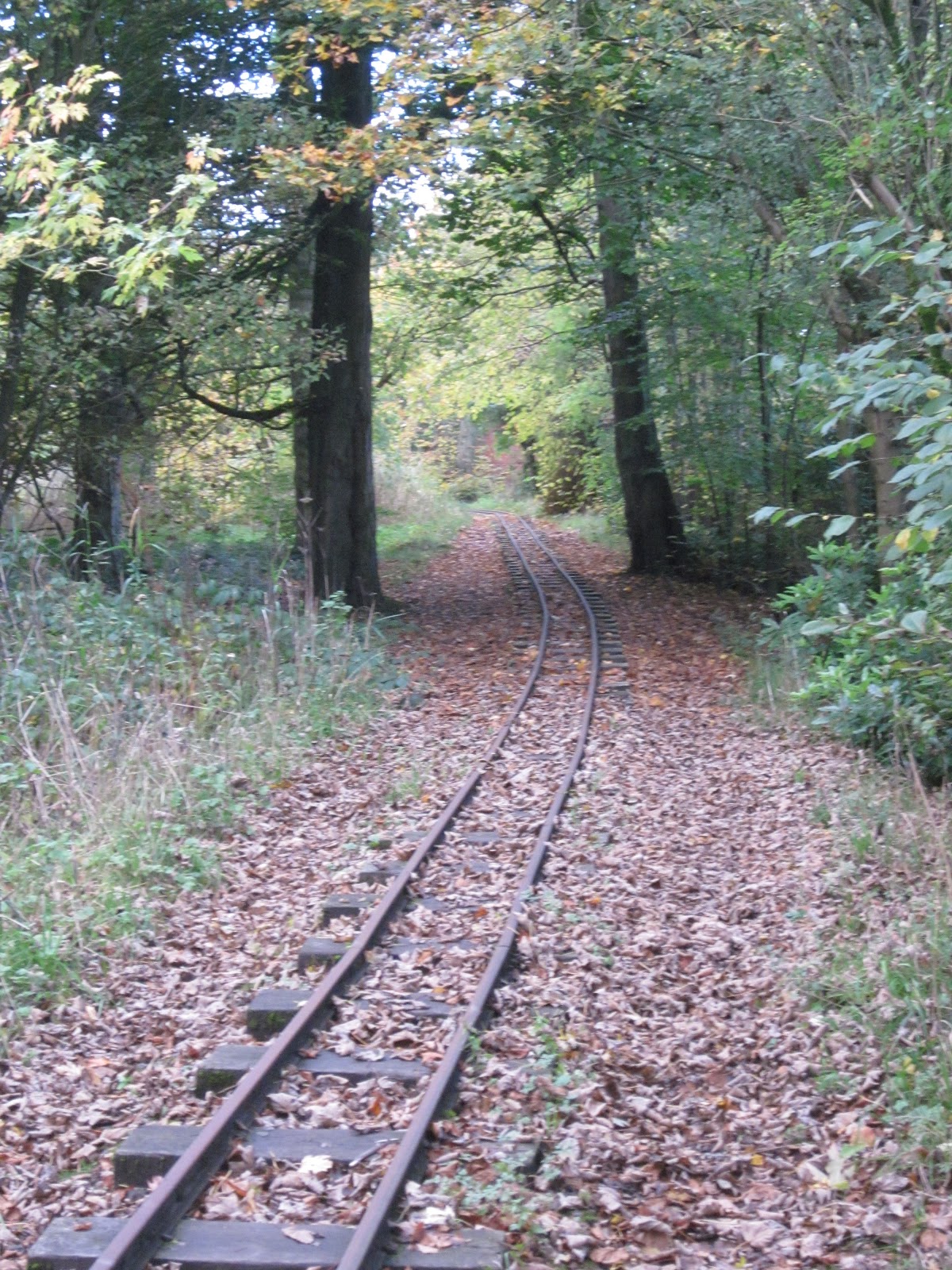
      The trackbed looked well-trodden and so I ventured South, attempting to match my stride to the spacings of the sleepers which in places were the only firm ground amid the mud.After a short, shallow cutting.......

      ..... the track emerged into a small clearing where it encountered another section of the railway looping off through the trees. Following my original track to the right ..................

      ........... I soon came across the railway's stock shed, securely padlocked against intrusion (and prying eyes).

       The sidings and shed were adjacent to the line's Main Station, Haigh hall South. Where once again neglect of the trackbed was evidence - the grass burying the track in places.

      The condition of the sign beside the platform suggested the line had not been used during the previous summer season (and that the price rise had not been sufficient to keep the railway alive).

      A further notice attached to a waste bin confirmed the closure of the railway but suggested there might be an alternative available.

      I 'continued past the station' on my walk along the trackbed looking in vain for the 'signage board'. The line ran for a short distance on a low embankment beside the main path leading to the hall...
      '

      ...... before crossing another path and plunging back into the woodland.

      The setting for the railway is very picturesque, winding as it does between the trees.

      However, it's clear that in places the trackbed needs some attention such as here where there has been some minor subsidence and misalignment.

       Although it's not clear from this photo, to the left is a series of ornamental pools and a stream which meanders through the trees beside the railway.

      Before long, I once more encountered the other section of track looping out of the trees to my left.

       Following the right had track ..........

      ...... I very soon arrived back at my starting point and explored other features of the park. The hall itself, which has a fine view over the town of Wigan.

      The park seems to be popular with dog walkers and with families ............

       .... particularly as there is plenty of playground equipment on which the children can burn off their excess energy.

      It's disappointing that the railway does not seem to be functioning, particularly given the setting through which it travels. An email from the estate indicates that it will be re-opening during 2013 following some repairs (see comments below)

      UPDATE

      The railway did indeed re-open in 2013 and is now running at weekends and Bank Holidays between 11.00am and 4.00pm. - see http://www.wigantoday.net/what-s-on/haigh-hall-train-back-in-action-1-5994583