Search This Blog

Showing posts with label battery powered locomotive. Show all posts

Monday, 10 August 2015

Moseley Industrial Museum

In a nutshell

Gauge:          2'

Length:      700yd

Opened:     1990s

Location:    

Tumblydown Farm,
Tolgus Mount,
Redruth, 
West Cornwall.
TR15 3TA


Phone:01209 211191
Mobile: 0751 1256677

Web
:      http://www.tumblydownfarm.co.uk/museum.html

Email
:    colinsaxton494@btinternet.com


Date of visit:     8 June 2015


Key Facts

  • The museum was originally started by Colin Saxton as a craft project for pupils at Moseley Boys Grammar School in Cheadle, Cheshire in 1969. 
  • Over twenty-five years, the railway collection grew to over forty narrow gauge locos with half a mile of track. It became a museum open to the public.
  • When the school grounds closed in 1990, the collection was dispersed - some forming the basis of the Moseley Railway Trust which is housed at the Apedale Valley Light Railway near Stoke on Trent, and the rest forming the basis for the collection at Tumbly Down Farm in Cornwall
  • The museum now has eight locomotives, many of which are from local sources. Five are battery electric locos and three are diesel.
  • There are also around forty items of rolling stock, renovated and maintained by a team of volunteers
  • In addition to the  railway relics, there is a large collection of vintage toys on display, including clockwork and electric model trains from Hornby, Trix, Lima, ACE and LGB. There is also a large collection of Meccano and Dinky Toys.
  • On the site is a display depicting a mine, with original equipment displayed in a realistic setting.
  • The museum also houses a working replica of William Murdoch's 1784 steam powered road carriage.
  • The museum is not normally open to the public but visits can be arranged by contacting the owner beforehand.
  • There is no admission charge but visitors are encouraged to make a donation to museum funds.

Route


My Impressions

Having phoned beforehand to arrange my visit, it was suggested that a Monday would be a good day, as this was when the volunteers would be on site. I duly arrived shortly after lunch time and made my way into the main museum building which houses an impressive array of vintage model railway equipment. At the centre was a large Hornby Dublo layout with eight independent circuits.

Around the edges and in various nooks and crannies was an assortment of other model railway exhibits, such as LGB, ...

... Triang TT, ...

... Trix Twin and Hornby 0 gauge.

Another room was in the process of being refurbished to hold the museum's collection of Meccano models:

Although this was of great interest to me as a railway modeller of many decades standing, my primary purpose in visiting the museum for the purpose of this blog, was to view the narrow gauge railway artefacts. These were housed in a couple of sheds and workshops:

The museum has accumulated a number of battery electric vehicles which served in local tin and mineral mines. In addition, there was a range of internal combustion locomotives of varying vintages and origins.

Outside, a 700 yard two foot gauge line has been laid around some of the paddocks belonging to the farm and on the day of my visit, a BEV which formerly operated in the Geevor tin mine was coupled-up ready for a trip.

 As I was the museum's only visitor at that particular moment, I was treated to a personalised ride around the line.

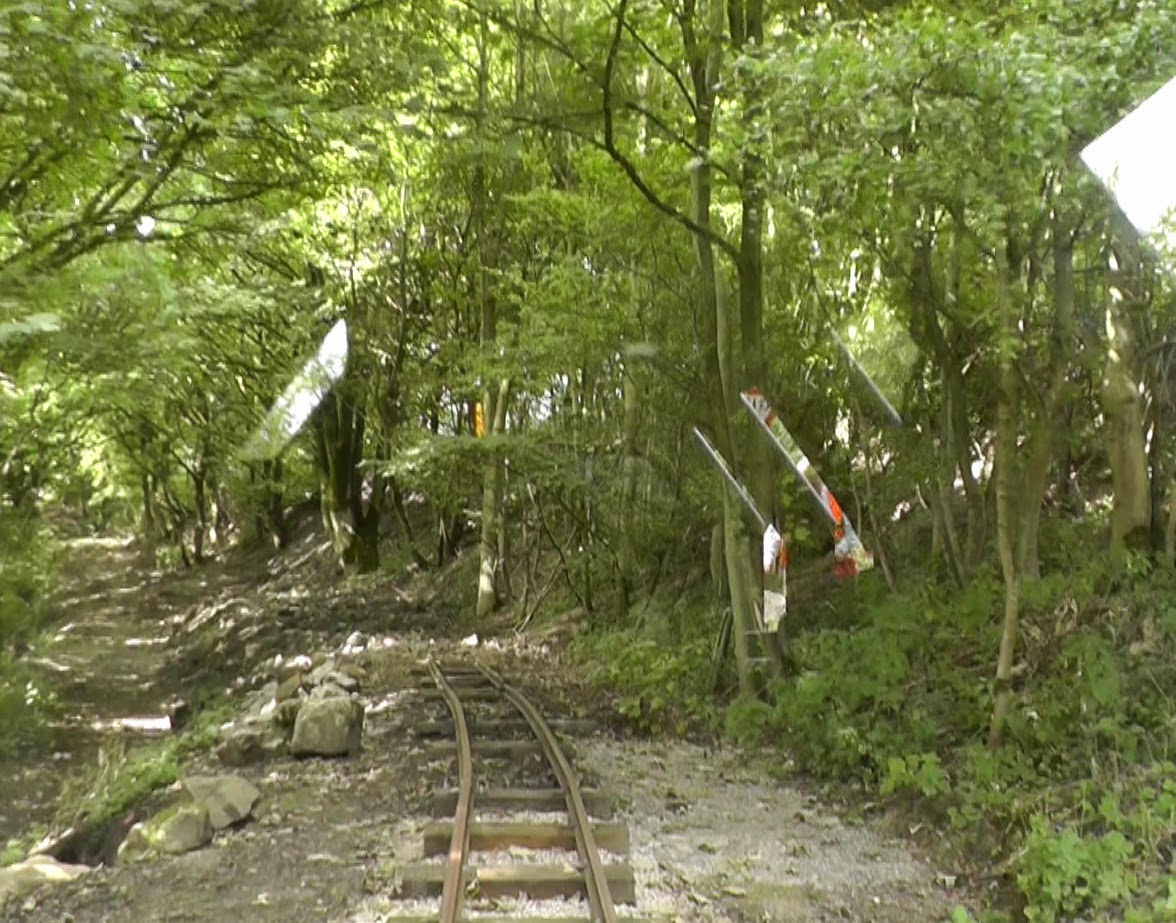
There are a couple of passing places on the railway, which has a balloon loop at its far end

After negotiating the loop ....

... we set off back up the line.

The loco running round its train at the main terminus, where there is an interesting collection of trackwork serving the various sidings and shed roads.

After browsing the museum exhibits in more depth, including seeing the Hornby Dublo layout in operation, and joining the workforce for a very welcome cup of tea, I explored the museum's re-creation of a coal mine in which exhibits are displayed in realistic tableau settings.

 Colin, the museum's owner, talked me through the history, origins and workings of the site's replica of the steam road vehicle which was developed in 1784 by William Murdoch. Apparently, it was being prepared for a run in a local gala that weekend.

As a narrow gauge railway enthusiast and railway modeller (see Railway Modelling and Me), I found the whole experience to be extremely rewarding. Colin was on hand to talk me through many of the exhibits and his long-term and well established devotion shone through. The vast majority of exhibits have been donated by organisations and individuals and a team of volunteers keep things running so they can be shared with fellow enthusiasts and the mildly curious.

There is no admission charge, but a donation to keep this unique collection maintained is, to my mind, well deserved. My only regret is that I was unable to spend more time there and that it is so far away from where I live, otherwise I would become a more frequent visitor. I feel there is so much I was unable to see and experience in the time I had available.

Video


Monday, 15 September 2014

Ironbridge - Blists Hill Mine Railway

In a nutshell

Gauge:         2'

Length:       212m

Opened:     2010

Location:    


Blists Hill Victorian Town
Legges Way
Madeley
Telford,
Shropshire
TF7 5DU

Web:            http://www.ironbridge.org.uk/our-attractions/blists-hill-victorian-town/
Telephone:  01952 433424
Email:         http://www.ironbridge.org.uk/about-us/contact-us/ 


Date of visit:     12 September 2014


Key Facts

  • The locomotive appears to be a 4w W417 Wingrove & Rogers battery electric, which was refurnished by Alan Keef in 2008
  • The train comprised eight four wheel coaches and the locomotive with the name of  "Sir Peter Gadsden" who was chairman of the museum trust until 2006. 
  • The last carriage includes a driver's compartment which is used to control the train on the outward leg.
  • The track winds serpent-like around along the hillside and then enters an artificial tunnel before stopping in a darkened area where there is a projected AV show depicting a conversation in silhouette between a young boy, who has just started working in the mine, and his father.
  • Trains leave approximately every half an hour and the trip lasts for about 15 minutes
  • There is an additional charge of £2.00 per head to travel on the Mine Tramway

Route

My Impressions

Whilst awaiting the arrival of the next train, there was an opportunity to read the information boards about the history of clay mining in the valley, and also an opportunity to watch the train arrive on to the platform.

We were given a short talk about the mining process before we then boarded the train which wound its way along the circuitous track carved into the hillside.

 The train then negotiated the entrance to an artificial tunnel ....

 ...... which became progressively darker until the train stopped in almost complete darkness. We were then entertained by a short AV presentation which depicted an imagined conversation between an experienced clay miner and his son. The presentation focused on the dangers associated with clay mining - principally suffocation through a build-up of carbon dioxide and roof falls associated with the careless use of explosives.

The train then reversed (or strictly speaking went forward) out of the mine and back along the track .....

... to the station .......

...... where we disembarked.

 On the platform is a restored example of one of the tub wagons which were used to transport clay from the mines along the valley. These were propelled by hand and by horses.

Personally, I would have been interested in being given more detail about the mining and processing aspects of the venture, but this level of detail would probably not have appealed to the majority of the passengers on the train - several of whom were very complimentary to the staff about the quality of the trip.

The Mine Railway forms part of the Blists Hill Victorian Town exhibit in Ironbridge and so there is plenty to see and do. Many of the shops in the replica streets are manned by staff in period costume who are happy to explain the technicalities and history of the trades they represent.

It is possible to exchange today's currency into Victorian pennies which can then be used to purchase items in the shops - including fresh bread, rolls and shortcake baked in the town's bakery.

There are working steam engines, including this working replica of Trevithick's 1804 Pen-y-Darren locomotive which was not in steam during our visit.

Around the town are various stationary engines, such as this one in the yard of the stone mason.

 The entrance fee is quite substantial, but it is possible to buy a year-long passport to most of the exhibits in the gorge which makes a considerable saving in entrance fees overall and provides an opportunity for return visits - it would be difficult to see all the exhibits in the gorge in one day.

There are food outlets in the Victorian Town which offer both snacks and cooked food at reasonable prices and there are plenty of places to have picnics if you prefer.

Overall, this trip would make an interesting day out for the whole family - there is plenty to see and do and all the staff we met were very helpful and well informed - only too happy to demonstrate and discuss the exhibits they were manning.


Video
[In preparation] 


Thursday, 28 August 2014

Steeple Grange Light Railway

In a nutshell

Gauge:          18"

Length:         ½ mile

Opened:        1883 (Standard gauge branch opened)
                       1967 (Standard gauge branch closed)
                       1985 (Narrow gauge railway opened)

Location:   


Web:              http://www.steeplegrange.co.uk/  


Date of visit:     24 August 2014


Key Facts

  • The railway is built on the site of a branch line to Middleton Quarry from the junction with the Cromford and High Peak Railway at Steeplehouse. The line was known locally as the 'Killer Branch' after the surname of the brothers who owned the quarry
  • The Cromford and High Peak Railway was constructed in 1831 to to carry minerals and goods between the Cromford Canal wharf and the Peak Forest Canal at Whaley Bridge
  • The first part of the 'Killer' branch, which is now the mainline for the Steeple Grange Light Railway, has a gradient of 1:27
  • There is also has a short branch leading to the limestone quarry adjacent to the station
  • A gauge of 18" was chosen to provider more variety than the more usual gauge of 2' for preserved and heritage narrow gauge industrial railways
  • The railway presently possesses sixteen former industrial locomotives
  • The Greenwood and Batley battery electric locomotive, Greenbat, is the mainstay of motive power on the railway
  • For passenger dutues, the railway also often uses a Ruston Hornsby diesel locomotive named Horwich after the BR locomotive works where she was based. She is the only surviving 18" gauge Ruston Hornsby diesel and is now in lined BR green livery
  • The line also possesses several passenger and goods vehicles in various stages of restoration
  • There are plans for the railway to be extended for another ½ mile to Middleton quarry. There is also a possibility that a branch could be laid to the National Stone Centre and Ecclesbourne Railway
  • The railway is open between midday and 5pm on Sundays and Bank Holidays from Easter Saturday to the end of September and on Saturdays in July and August. The line is also open on some days during the Autumn Half Term holiday.
  • Hot drinks and some light refreshments are available at the main station.

Route

My Impressions

When we arrived at the railway we found the main terminus to be a modest affair but nonetheless a hive of activity. On the mainline, Greenbat was quietly ticking over - which I found intriguing for a battery electric locomotive - and its single manrider coach was awaiting its first passengers of the day.

In one of the sidings, the anatomy of a Simplex diesel was being discussed and analysed,

..... and one of the line's Clayton battery electrics, Peggy, was parked, ready for action later in the day,

.... and another Clayton, Peter, was awaiting its first passengers on the railway's branchline which runs beside and parallel with the Cromford and High Peak Trail.

Another mainstay of the line's passenger motive power, the Ruston Hornsby, Horwich, was also pottering about.

After buying our modestly priced ticket (for both the mainline and the branchline), we stepped aboard the manrider on the mainline and without further ado, set off towards the 1:27 incline.

We passed the railway's lower stock sheds situated immediately behind the main station building, where another Lister was poised and ready for action - presumably when demand rose later in the afternoon.

The sheds are served by an interesting-looking traverser which appears to have been tailor-made onsite.

 Further up the line, we passed beneath one of the railway's overbridges,

..... which is also used for stock storage. Some fascinating items of rolling stock were evident suggesting the railway would be able to run a range of passenger and goods trains on gala days.

Just beyond the bridge was another set of sidings leading to a stock shed. I found the frogless turnout to be fascinating and worthy of being modelled, particularly if my plans for a large scale indoor narrow gauge layout ever come to fruition.

Rounding a shallow curve and Killer's Dale Halt hove into view. As we were the only passengers on the first run of the day there were no requests for stopping and we pressed on up the incline.

Just beyond another overbridge .....

we came to Recreation Ground Halt. Again, we didn't stop.

 A little further down the line (but up the gradient) we came to a passing loop and shortly beyond this .......

....... we reached the road leading to the quarry.

With the guard suitably positioned to warn approaching drivers, we passed over the level crossing and ........

....... soon reached the current end of the line. As can be seen, the existing trackbed is somewhat higher than the original (since the road crossing was installed) and the railway company is presently seeking additional funds (and foundations) to extend the line to the eventual quarry terminus.

After watching our train re-cross the road ........

.... we boarded once more for the descent. Across the passing loop ......

 ..... and back to the main station, where more passengers were waiting.

 We used the other half of our combined ticket to board the branchline train to the limestone quarry.

The short trip took us into the heart of the once thriving quarry ........

.... where our driver gave us a very informative and illustrated talk about the geology, history and technology of the quarry, its stone and its workings.

Not only were the fossils in the limestone highlighted, their origins were explained - including how iron pyrites (Fool's Gold) came to be formed.

We then re-boarded our train for the return journey......

 ..... and spent a while exploring the yard, watching the trains and browsing through the postcards, booklets and memorabilia in the main station building.

The members of the society which operates the railway are clearly accumulating a considerable store of 18" rolling stock to populate the line and also to preserve what remains of this aspect of our industrial heritage. The rolling stock is all in very good condition and as such is a credit to the dedication of the volunteers who must devote much of their spare time to working on the railway and maintaining and restoring its collection. It looks as if the railway has steadily grown in size and scope since it was established around thirty years ago and it also looks to have a secure future, with not just one but two proposals on the books for extensions. The personnel I met on my visit were extremely helpful and very obliging - I felt I'd almost become one of the extended family during my visit. The fare was well worth paying to enjoy the experience and also to gain a well informed insight into the operation of this type of stock and its infrastructure.

Video