Search This Blog

Showing posts with label electric. Show all posts

Friday, 13 September 2013

Volks Electric Railway

In a nutshell

Gauge:          2' 8½"

Length:        1¼ miles

Opened:       1883

Location:    

285 Madeira Drive
Brighton
East Sussex
BN2 1EN


View Narrow Gauge Railways in a larger map


Date of visit:     10 September 2013


Key Facts

  • The first electric railway in Brighton was opened on 4th August 1883 by Magnus Volk. It was 2' gauge and ran for ¼ mile from beside the aquarium to the chain pier (no longer in situ).
  • The council turned down his request to extend the line along the beach towards the town centre and so he extended it in the other direction to the Banjo Groyne (now the midway point of the railway). He changed the gauge to 2' 8½".
  • As the beach was at a lower level in those days, the line needed to supported in places on timber trestles
  • In 1890, Volk opened a new railway which ran from the Banjo Groyne along the coast to Rottingdean. The Brighton and Rottingdean Seashore Electric Railway was unique in that it ran on rails which were submerged during high tides. The single passenger car was supported on long legs and affectionately nicknamed "Daddy Long Legs" by the local inhabitants. This railway unfortunately succumbed the effects of sea defences and was forced to close in 1900. (see http://www.urban75.org/railway/brighton-sea-railway.html - for more information)
  • Volks extended the VER from the Banjo Groyne (then known as Paston Place and now Halfway Station) to Black Rock in 1900 - the line passing through the coach shed as it does to the present day
  • In 1938, the railway was taken under the control of Brighton Corporation
  • The railway was closed in 1940 for the duration of the war to allow work to be carried out on invasion defences.
  • The railway re-opened in 1948, with two cars from the Southend Pier Railway to replace some of the original rolling stock which had not survived.
  • In 1964, two-car operation was introduced. This doubled the carrying capacity of each train and halved the number of drivers needed. It also removed the need for two platform faces at the termini.
  • In 1995, the Volks Electric Railway Association was formed to support the Corporation in maintaining and running the railway
  • At present, the line possesses seven electric cars and one diesel locomotive.
  • The VER is the oldest electric railway in the world which is still operational.

Route

Source: http://www.medwaypier.co.uk/volks/Routemap2.gif
Originally running from a station beside the Palace Pier, the line ran as far as the Chain Pier (shown as a dotted red line). It was then extended to Paston Place in 1884 and further extended to Black Rock in 1901. In 1930, the Western terminus was moved from the pier to the aquarium. Black Rock Station was moved when the Lido was built in 1936 and then moved to its present location when work was carried out on sewerage construction in the 1990s.

My Impressions

Ironically (given the railway's history), I had assumed that the railway would run from the centre of the town and it was a little while before I located it tucked away behind the pier. There was no train in the station when I arrived (they were a driver short for the day) and so there was an opportunity to buy an ice cream and take a few pictures of the terminus station.

The station building was previously a tram shelter and was moved to its present position when the railway was renovated after the second world war. The tracks are raised above the beach level on steel trestles and the supports for the second track can be seen on the other side of the platform.

Before long the two-car train arrived and its passengers disembarked.


 We made our way along the platform and boarded the train.


I was given the privilege of riding beside the driver. She attached the removable control handle to its spigot, released the brakes and we were off.

At about the position of the original chain pier there is a passing loop..........

..... and then we arrived at Halfway Station .......

 ...... where the line's storage sheds and workshops are located. This was the line's terminus until 1901 when it was extended by running one of the lines through a shed and out the other side.


Until the 1930s, the line at this point ran over a steel viaduct as the beach was much lower than it is now.
Source: http://www.medwaypier.co.uk/volks/viaduct1.jpg

 ....... and the rest of the railway to Black Rock was supported on timber trestles. The drivers used to wear oilskins during windy weather to protect them from the spray.
Source: http://www.medwaypier.co.uk/volks/approachingviaduct2.jpg

The track is now very much on firm ground, with a considerable shingle beach between it and the sea.

Another passing loop was traversed about mid-way between Halfway and Black Rock .......

....... before pulling into Black Rock Station. The rather slab-like station building was built in the 1990s and houses some of the pumping equipment for the drainage works which led to a second re-siting of the station.

The passengers disembarked and there was a short while to study the locality which has now become the site for a large marina.

If I had had more time, I would have explored the tideline to look for traces of Volks short-lived but highly imaginative project - the Seafront Electric Railway from Paston Place to Rottingdean, which for fairly obvious reasons was nicknamed 'Daddy Long Legs'

However, time was short and so I re-boarded the train for the return journey.

Taking-up my position beside the driver, I had a prime view of the railway and its architecture as we made our way back towards the Palace Pier.

 I realised on the way back that the route is not as direct as I had first thought. In addition to the detour at Halfway Station, there are another couple of twists and turns, presumably to negotiate underlying environmental or geological features.

At intervals along the line there are various crossings, controlled with automated flashing lights and occasionally guarded with gates.

I was put in mind of a story on the DVD of the railway (which can be purchased from the ticket office) that when the line was first opened the local fishermen resented its presence and the restrictions it placed on access to the beach and would occasionally let their capstan levers slip to whack the trains as they passed.


Just beyond the passing place between the Aquarium Station and Halfway there is a small platform which presumably acts as a request stop. We then pulled up the ramp into Aquarium Station.

 The VERA would like to extend this end of the railway to its original position beside the pier. It would certainly bring it more to the attention of the public - the station building is not a particularly prominent structure and it would be a pity if visitors to Brighton are not made more aware of this significant part of British, if not world, railway history.

Although this was a weekday in September, the railway was carrying a fair number of people on each train - and so it seems to be attracting visitors. It is to be hoped that it continues to thrive.

I wonder how many of today's passengers are fully aware of its history. Apparently, when the railway opened in 1883, a local clergyman urged his congregation to avoid the newfangled electric railway at all costs - as he was convinced it was the work of the devil!


His ministrations did not appear to have affected the success of the railway then or now. Long may it continue to thrive!

Video

[In preparation] 


Thursday, 12 September 2013

Southend Cliff Lift

In a nutshell

Gauge:          4' 6"

Length:        130' (40m)

Opened:       1912 (replacing moving walkway opened in 1901)

Location:    


View Narrow Gauge Railways in a larger map  

Date of visit:     9 September 2013

Key Facts

  • The cliff railway or 'cliff lift' takes passengers vertically 57' (17m) from the Western Esplanade to the Cliffton Terrace rising at gradient of 43.4% (1:2 or 26 degrees)
  • It is a funicular railway, being operated by a cable attached to a counterbalance weight which lowers as the passenger car rises.
  • The passenger car can hold up to 18 passengers
  • It is fairly unique in design as the tracks run on steel girders mounted in parallel with the cliff face
  • The lift has been renovated four times, in 1930, 1959, 1990 and more recently in 2010 (at a cost of £3m)
  • The lift was built originally by Waygood & Co. which is now part of of the Otis Elevator Company
  • The journey costs £1.00 (50p concessions).
  • The lift operates daily from May to September and at weekends between October and April.

Route


My Impressions

The railway is in a commanding position, a short walk from Southend Pier. As it has been recently refurbished (in 2010) through a Lottery Grant, it is in very good condition.

The passenger car was at the summit when I reached the lower station, but after pressing the button (as one would do to summon a lift) it began its descent.


Access to the lift is well considered for wheelchair users. The lift is operated by an attendant, who informed me that I was his first passenger of the day (it was now 3:00pm), which seems a great pity as the fare is not particularly large and the experience of riding in such an interesting piece of technology is well worth it.


Perhaps the lift would get more custom if it was closer to the pier or at the end of the main street in Southend. However, as it has been on the site for over 110 years it's probably too late to move it now.

The ride was very smooth and, despite the weather, there was a good view along the sea front as we reached the summit. 

The architecture retains its Edwardian elegance and the refurbishment has done a great deal to enhance its appearance.

Possibly not as exhilarating as a ride on a roller coaster, but to lend support for the continuation of a piece of our transport heritage, £1.00 does seem a small price to pay.

Video

[In preparation] 


Friday, 22 February 2013

Llechwedd Slate Caverns

In a nutshell

Gauge:         1' 11½"

Length:       800m (Tramway) 500' descent plus half mile walk (Deep Mine)

Opened:      1846 (Original quarry) 1972 (Miners' Tramway) 1979 (Deep Mine)

Location: 

Llechwedd Slate Caverns
Blaenau Ffestiniog
Gwynedd LL41 3NB

View Larger Map

 Tel.:   01766 830306
Web:   http://www.llechwedd-slate-caverns.co.uk/index.php


Date of visit: 20 February 2013


Key Facts

  • The Llechwedd slate quarry was opened in 1846 by John Greaves. He later became the treasurer and eventually chairman of the Festiniog Railway.
  • At its peak, the quarry had 513 employees and produced 23,788 tons of finished slate per year (1884)
  • In 1890 the quarry machinery was converted to electrical power with the quarry's own hydro-electric generating station.
  • In its heyday, slate was mined by hollowing out large galleries. A team of four men was responsible for extracting and finishing the slate from each gallery. Some galleries were up to 250' from floor to ceiling.
  • Blocks of slate were transported from the galleries to the finishing sheds along horse-drawn tramways.
  • Slate is still being extracted on the site by open-cast quarrying from the surface.
  • The caverns now include two separate visitor attractions - the Miners' Tramway which uses a battery powered locomotive to haul visitors through a tunnel with two stops in galleries for illustrated talks - and the Deep Mine which involves descent via an incline with a guided walk through a series of galleries, some of which are now flooded.
 

My Impressions

I coincided this visit with a trip on the Ffestiniog Railway and only had time on this occasion to travel on the Miners' Tramway. I will return at some time in the future to complete the visit by touring the Deep Mine.

As this was only a flying visit, I did not have time to sample the delights of the cafe though I did spend a while exploring the shop, which provides a selection of slate-related memorabilia and some literature relating to slate quarrying and the local community. At this time of the year, tours depart at half hourly intervals and so, after a short wait, our train reversed into the station and we boarded the coach for our trip into the mine.

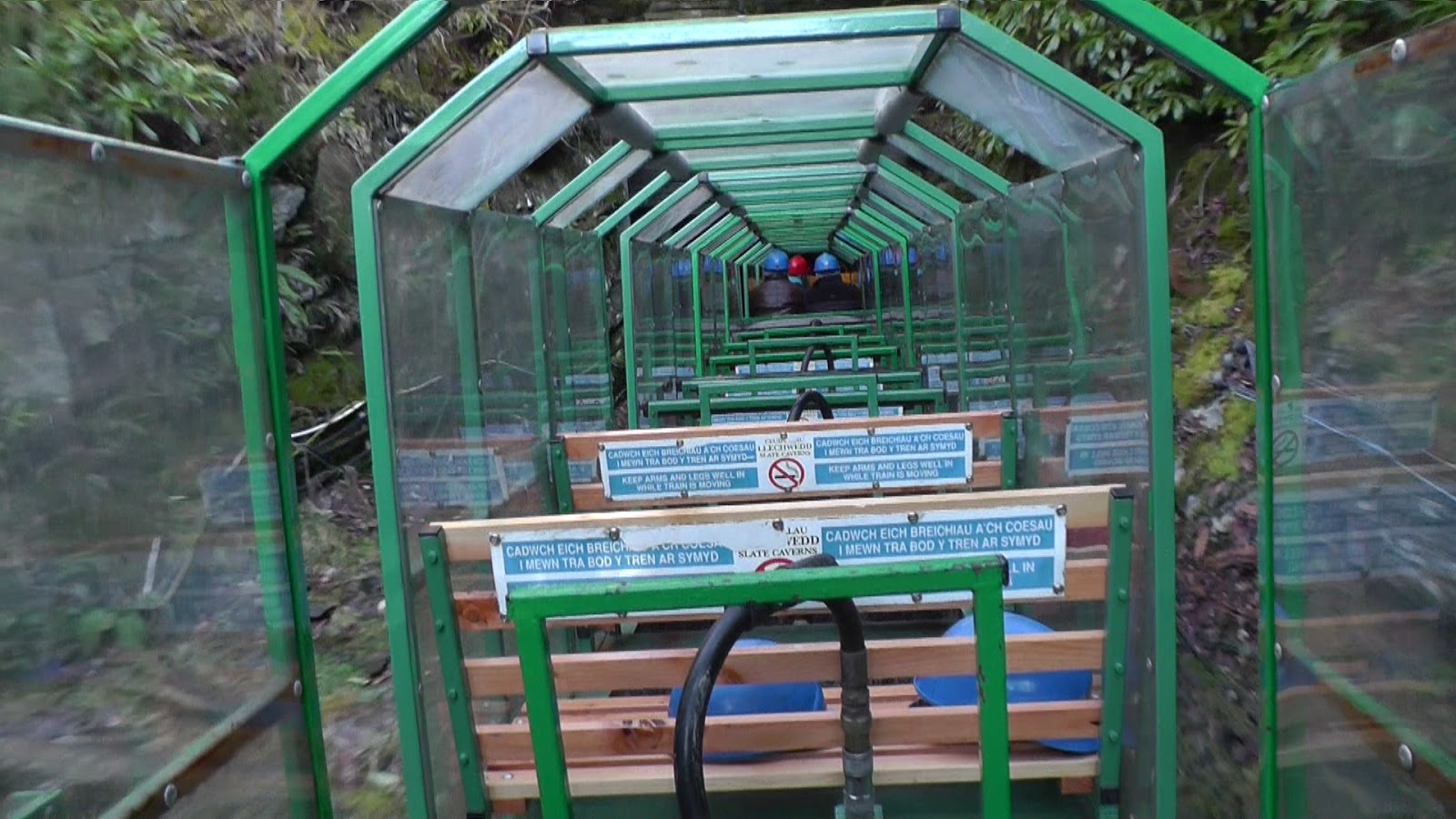
I took my seat in the last carriage which gave me a view through the other coaches as the train wound its way through the twisting tunnels.

After passing a few floodlit galleries and side tunnels we stopped at the entrance to a gallery where we alighted and our guide explained the Victorian working practices for extracting slate.

We hopped aboard the train once more and wound our way through to another two galleries where we were entertained with an audio visual presentation of working practices and a further live talk, explaining some of the health and safety issues associated with life in the mines.

Meanwhile, our train had turned round via a reversing triangle and we resumed our seats for the return ride. We were then given a demonstration of slate-splitting in the finishing shed.................

............ before my fellow-passengers made their way to the Deep Mine. I will have to save this part of the tour for my next visit as we needed to travel back to Cheshire for an appointment.

The slate caverns are certainly impressive and if you have not already seen them, they are well worth a visit. The opportunity to see first-hand this reconstruction of an important part of North Wales' industrial heritage is both enlightening and salutary. The last time I visited the Caverns was 26 years ago when I accompanied a school party on a visit. It was reassuring to see that this tour was very much as it was then. It would seem that the winning formula from the early days of this visitor attraction has been retained. I am looking forward to my next visit when I will be able to relive my experiences in the Deep Mine.

Video

[In preparation]