Search This Blog

Showing posts with label museum. Show all posts

Monday, 10 August 2015

Moseley Industrial Museum

In a nutshell

Gauge:          2'

Length:      700yd

Opened:     1990s

Location:    

Tumblydown Farm,
Tolgus Mount,
Redruth, 
West Cornwall.
TR15 3TA


Phone:01209 211191
Mobile: 0751 1256677

Web
:      http://www.tumblydownfarm.co.uk/museum.html

Email
:    colinsaxton494@btinternet.com


Date of visit:     8 June 2015


Key Facts

  • The museum was originally started by Colin Saxton as a craft project for pupils at Moseley Boys Grammar School in Cheadle, Cheshire in 1969. 
  • Over twenty-five years, the railway collection grew to over forty narrow gauge locos with half a mile of track. It became a museum open to the public.
  • When the school grounds closed in 1990, the collection was dispersed - some forming the basis of the Moseley Railway Trust which is housed at the Apedale Valley Light Railway near Stoke on Trent, and the rest forming the basis for the collection at Tumbly Down Farm in Cornwall
  • The museum now has eight locomotives, many of which are from local sources. Five are battery electric locos and three are diesel.
  • There are also around forty items of rolling stock, renovated and maintained by a team of volunteers
  • In addition to the  railway relics, there is a large collection of vintage toys on display, including clockwork and electric model trains from Hornby, Trix, Lima, ACE and LGB. There is also a large collection of Meccano and Dinky Toys.
  • On the site is a display depicting a mine, with original equipment displayed in a realistic setting.
  • The museum also houses a working replica of William Murdoch's 1784 steam powered road carriage.
  • The museum is not normally open to the public but visits can be arranged by contacting the owner beforehand.
  • There is no admission charge but visitors are encouraged to make a donation to museum funds.

Route


My Impressions

Having phoned beforehand to arrange my visit, it was suggested that a Monday would be a good day, as this was when the volunteers would be on site. I duly arrived shortly after lunch time and made my way into the main museum building which houses an impressive array of vintage model railway equipment. At the centre was a large Hornby Dublo layout with eight independent circuits.

Around the edges and in various nooks and crannies was an assortment of other model railway exhibits, such as LGB, ...

... Triang TT, ...

... Trix Twin and Hornby 0 gauge.

Another room was in the process of being refurbished to hold the museum's collection of Meccano models:

Although this was of great interest to me as a railway modeller of many decades standing, my primary purpose in visiting the museum for the purpose of this blog, was to view the narrow gauge railway artefacts. These were housed in a couple of sheds and workshops:

The museum has accumulated a number of battery electric vehicles which served in local tin and mineral mines. In addition, there was a range of internal combustion locomotives of varying vintages and origins.

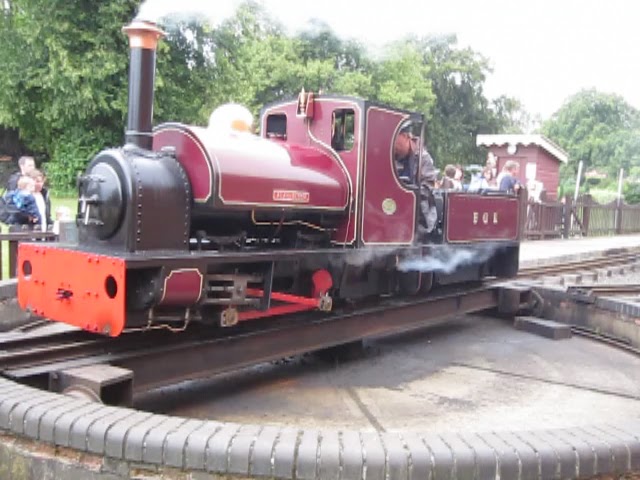
Outside, a 700 yard two foot gauge line has been laid around some of the paddocks belonging to the farm and on the day of my visit, a BEV which formerly operated in the Geevor tin mine was coupled-up ready for a trip.

 As I was the museum's only visitor at that particular moment, I was treated to a personalised ride around the line.

There are a couple of passing places on the railway, which has a balloon loop at its far end

After negotiating the loop ....

... we set off back up the line.

The loco running round its train at the main terminus, where there is an interesting collection of trackwork serving the various sidings and shed roads.

After browsing the museum exhibits in more depth, including seeing the Hornby Dublo layout in operation, and joining the workforce for a very welcome cup of tea, I explored the museum's re-creation of a coal mine in which exhibits are displayed in realistic tableau settings.

 Colin, the museum's owner, talked me through the history, origins and workings of the site's replica of the steam road vehicle which was developed in 1784 by William Murdoch. Apparently, it was being prepared for a run in a local gala that weekend.

As a narrow gauge railway enthusiast and railway modeller (see Railway Modelling and Me), I found the whole experience to be extremely rewarding. Colin was on hand to talk me through many of the exhibits and his long-term and well established devotion shone through. The vast majority of exhibits have been donated by organisations and individuals and a team of volunteers keep things running so they can be shared with fellow enthusiasts and the mildly curious.

There is no admission charge, but a donation to keep this unique collection maintained is, to my mind, well deserved. My only regret is that I was unable to spend more time there and that it is so far away from where I live, otherwise I would become a more frequent visitor. I feel there is so much I was unable to see and experience in the time I had available.

Video


Wednesday, 26 September 2012

Hopewell Colliery Museum

In a nutshell

Gauge:        2' (non passenger carrying)

Length:      unknown

Opened:     1823 (as a museum in 1997)

Location:

Prosper Lane
Lacinda Coalway
Coleford
Gloucestershire
GL16 7EL


View Narrow Gauge Railways in a larger map

Tel.        01594 810706 


Date of visit: 22 September 2012


Key Facts

  • The Hopewell mine is linked to the Phoenix mine underground but are worked as separate pits
  • The mines are worked as 'free-mines'. The Free Miners have mined coal for over 700 years unhindered anywhere in in the Forest of Dean by royal decree.
  • These are now the only full-time mines operating in the forest 
  • During the winter-months (October - March) the mines are worked using traditional methods of pick and shovel but they operate as a Museum in the summer months.
  • Visitors to the Hopewell mine walk through some of the mine workings to see exhibits of mining equipment and techniques.
  • The coal is extracted from the mines in railway tubs hauled by cable.


My Impressions

Unfortunately, the museum had closed for the winter on the day I visited, it seems that the museum opens during the summer school holiday season. However, as one of the miners was present, working on a mechanical coal loader, I was able to take a few photos and discuss the mining operations (and the state of the economy) with him.

Normally, I only include accounts of visits to passenger-carrying narrow gauge railways in this blog, but as this museum provides an insight into one of the last remaining operational mines of its type, I feel it deserves specific mention.

 The first thing to catch the eye on the edge of the car park is the pithead winding wheel

..... and the pithead gantry ........

....... together with its portable hand-winch and a coal tub.

Beside the car park is the rope-hauled incline down to an adit shrouded in trees.

This wasn't operating while I was there but it is clear that this is one of the means by which coal is extracted from the mine. The mechanical loader on the other side of the car park suggests that during the winter months, the car park becomes a coal yard for the mine.

Talking to the miner who was repairing the loader, he told me that although the coal is of very good quality, it is presently very difficult to make a living from mining the coal alone, and hence the miners have to diversify into other trades. However, there is a determination to keep the tradition alive and hopefully there will be another generation of free miners to assure the future of this piece of industrial history.

I intend to revisit the museum during the next season and hopefully fill in some of the blanks.

For more information see:

Tuesday, 18 September 2012

National Coal Mining Museum for England

In a nutshell

Gauge:     2' 6" and 2' 3" 

Length:   750 metres

Opened: 1988

Location:

National Coal Mining Museum for England,
Caphouse Colliery,
New Road,

Overton,
Wakefield
WF4 4RH


View Narrow Gauge Railways in a larger map

Email. http://www.ncm.org.uk/contact
Tel:      01924 848 806 


Date of visit: 9 September 2012


Key Facts

  • The museum was formerly the Caphouse Colliery which dates back to the 1770s
  • The timber headgear at Caphouse and the wood framed building at Hope Pit date from between 1905 and 1911
  • The colliery closed in 1985, re-opening in 1988 as the Yorkshire Mining Museum
  • The museum became the National Coal Mining Museum of England in 1995
  • There are free guided underground tours where visitors can experience the working conditions of miners and view their tools and machines
  • The visitor centre houses exhibitions including the artwork of former miners
  • It is also possible to view the pit-head baths, steam winding house, boiler house, coal screening plant and pit ponies
  • A battery powered 2 '6" gauge 'paddy train' takes visitors on a short journey around the park
  • There is also a 2' 3" gauge cable (funicular) railway showing how coal tubs were raised from the drift mine

¼  ½  ¾

Route


View National Coal Mining Museum Railways in a larger map

Red = Cable powered funicular railway (2' 3" gauge)
Blue - Battery powered 'Paddy' train (2' 6" gauge)

My Impressions

My first impression was that it was a great pity there were not more people at the museum. There is so much there to see and the museum depicts in good detail what was for many years a key industry in the history of the country. What's more, the café is well stocked and serves a very nice cup of coffee.

There was a modest fee (£1.00 return) to travel on the railway and the staff manning the former pit railway were extremely helpful and knowledgeable. The battery powered Bo-Bo locomotive was very powerful and very well turned-out.

We boarded the converted miners' coaches (the roofs of which have been raised to improve comfort for non-mining passengers).

At a sedate pace the train clanked its was across the park .....

 .... passing static exhibits of impressive-looking mining machinery.

 Before long we arrived at the furthermost terminus of the railway .......

.... where we alighted to explore some of the outdoor exhibits .........

.... such as the pump houses and winding engines.

There are also some intriguing remnants of the past such as this drift mine or adit ......

...... and a scrap yard of former mining equipment which is slowly and sadly rusting into decay.


Returning to the main station, it's possible to explore the main exhibition hall and descend into the mine for an accompanied tour - all of which is free!!

Beside the paddy train is the rope-hauled funicular railway, showing how wagons were extracted from the drift mines in the past. This exhibit wasn't operational when I was there, but the museum has special events during the year when sometimes this railway is working.

 What a fascinating place this museum is and on my initial visit I hardly scratched the surface of what can be done and seen. Another visit is certainly on the cards and when one compares what's freely available here with what has to be paid for at other so-called visitor attractions, they bear no comparison.

Video


Saturday, 1 September 2012

Bressingham Steam & Gardens

In a nutshell

Gauge:   2', 15" and 10¼

Length:  2' gauge - 1.31 miles - 15" gauge = 1.41 miles - 10¼" gauge =  480 yards

Opened: 1965

Location:

Bressingham Steam & Gardens
Low Road
Bressingham
Diss
Norfolk
IP22 2AA 


View Narrow Gauge Railways in a larger map


Date of visit: 27 August 2012


Key Facts

  • The railway museum was established initially as a private collection by Alan Bloom, a well known plant expert and nurseryman
  • In addition to the narrow gauge railways and stock, the museum also owns standard gauge exhibits, traction engines, stationary steam engines and houses a display celebrating the TV sitcom, Dad's Army
  • There is also a steam-powered fairground 'galloper' carousel
  • A single entry ticket provides access to the gardens, unlimited train rides and three rides on the carousel
  • The grounds also include a café and garden centre
  • The train rides take visitors through the nurseries adjacent to the gardens

Route

Source: http://www.buccabury.co.uk/bressingham/bressinghammap.jpg


My Impressions

It has been quite a few years since I last visited Bressingham and so I was not sure what I would find had changed. It was reassuring to see that most of the good things I remembered from my previous visits had been retained or improved.

As it was Bank Holiday Monday, I was directed to the overflow car park and bought my all-inclusive ticket from the booth. The ticket entitled me to access all exhibits, gardens and have free rides on all the trains. It also allowed me to have three rides on the Gallopers carousel.

I decided to start my exploration of the site by boarding the 15" gauge Waveney Valley train which was hauled on this occasion by 2-6-2 tank loco, St Christopher.

Shortly after leaving the station, the line crosses the 2' gauge Nursery Railway.

After skirting a small lagoon, the railway crossed the 2' line once more and, before pulling away from the nursery and heading for the lower end of the estate, there was an opportunity to view the 2' gauge locomotive "George Sholto" which had recently returned from a trip to the Penrhyn Quarry in Bethesda for the inauguration of the heritage railway where this loco originated.

The train then chuffed its way through water meadows before plunging into woodland .......

...... where it crossed a couple of streams and wound its way through trees and rhododendrons.

Eventually the railway ran parallel to the standard gauge railway ..........

........before returning to its station.

After a quick lunch of quiche and salad in the café, which also sells a range of hot pies, I decided to take a ride on the two foot gauge Nursery Railway. Ex-Penrhyn Quarry 0-4-0 Hunslet George Sholto was on duty for my train.

After slowly negotiating its way down the site towards the 15" gauge Waveney Valley Railway, past the carousel, the dodgems and the 7¼" gauge railway ............

....the train headed out towards the meadows.

A short while later we re-crossed the 15" gauge track, as its train waited patiently for our passing .....

...... and then the train meandered back through the nursery, which was slowly falling into decay as the tenancy had apparently lapsed. We eventually completed the circuit and detrained, before the loco pulled the train forward to the adjoining platform for its next train load of passengers.

Later in the day, another 2' gauge 0-4-0 loco, "Bevan" assumed duties. This freelance locomotive had been assembled at the Works in Bressingham from scratch.

I then spent some time studying the 10¼" gauge garden railway. After watching the arrival and departure of the train a couple of times under the control of 0-4-0 replica Hunslet, Alan Bloom .........

...........I wandered through the formal gardens, .........


  ....... to trace the route of the railway.

On this occasion, I didn't ride this railway - an excuse maybe for a return visit?

For the final hour or so of my visit, I explored the static exhibits. The standard gauge railway.......

.... together with its array of locomotives and royal carriages .......

 ....... the two foot narrow gauge locomotives ......

...... and one of the slumbering 15" gauge WVR locos.

 There was also an opportunity to observe the museum's steam powered Sentinel shuttle bus, Martha,.......

...... the collection of stationary steam engines, ..........

 ........ railwayana and model railway exhibits, including 7mm scale and16mm scale narrow gauge layouts ........

...... and a 4mm standard gauge scenic layout.

 Finally, there came more nostalgia in the form of the Dad's Army TV series exhibits.

I spent half a day at Bressingham, which didn't really do the museum and the gardens full justice. There is more than enough for all the family to see and do, whether the sun is shining or the weather turns wet (which it did for a while during my visit). I fully intend to return and fill in some of the gaps where I was unable to spend sufficient time exploring such things as the signal box and its simulated signalling system and watch more of the archive films which accompany some of the exhibits such as that devoted to the Travelling Post Office (TPO).

Video